
Auto Technology Company: Forged at the Intersection of Environment and Industry
Cleveland was destined to become the epicenter of corrosion science and the home of Auto Technology. It is the birthplace of modern infrastructure, and the natural home for the study of the forces that seek to degrade it.
To the north and west, iron ore moved through the Great Lakes into Cleveland’s furnaces, becoming the steel backbone of the industrial world. To the east, Pennsylvania’s oil fields gave rise to the modern petroleum industry. This oil did more than power engines—it birthed the chemistry of solvents, coatings, and inhibitors designed to protect steel.
Steel built the modern world. Petroleum protects it—and Auto Technology validates them all.
Foundations in Chemistry and Materials
The DNA of Auto Technology Company traces back to the Harshaw Chemical Company, a Cleveland-based pioneer in plating chemicals and petroleum-derived materials.
Harshaw thrived in an environment defined by heavy industry and the constant threat of material degradation. Over the early 20th century, the company built a global reputation for innovation, developing chemistries that extended the life of industrial products in the harshest conditions.
During World War II, Harshaw’s laboratories played a pivotal role in the Manhattan Project, developing specialized compounds for national defense.
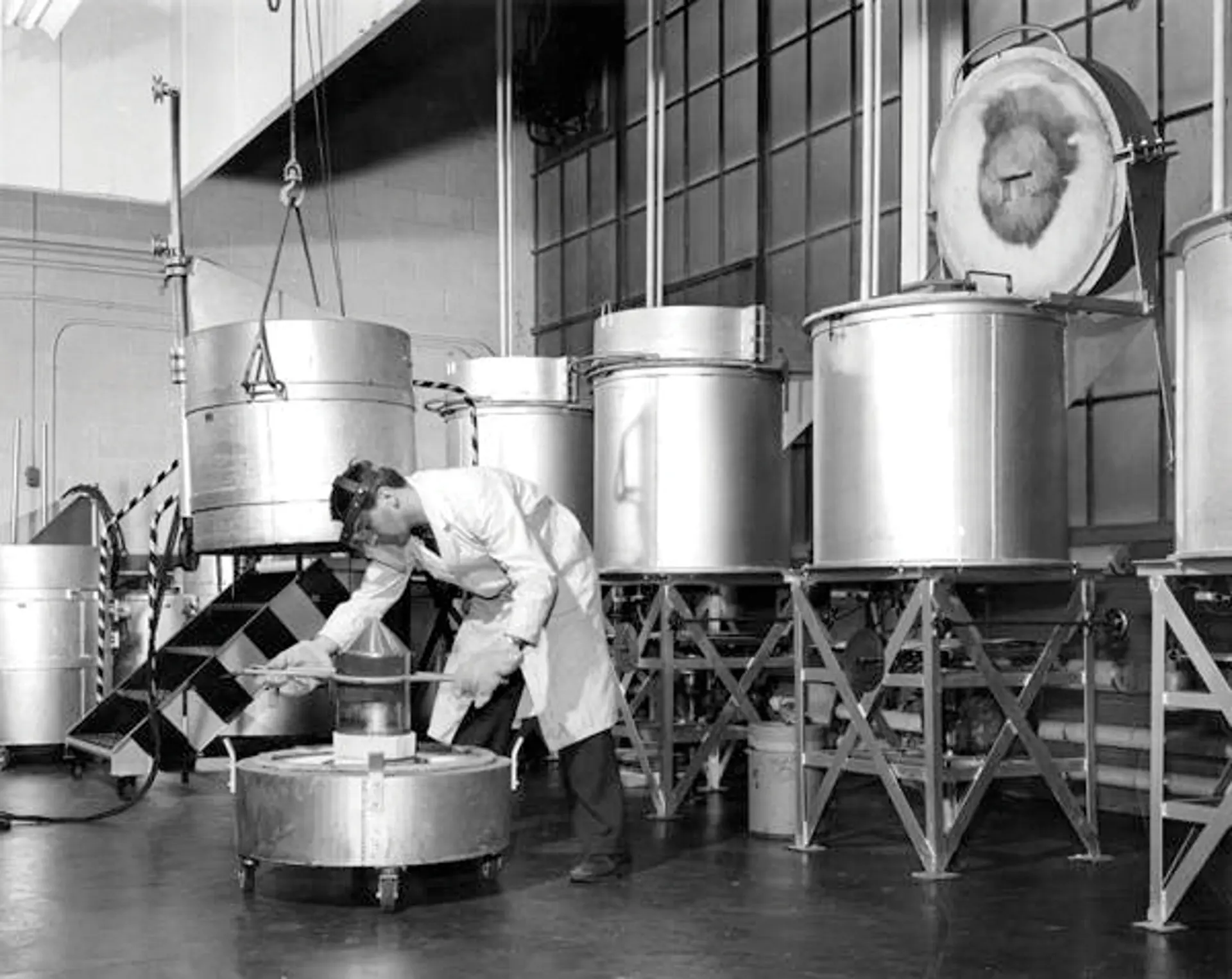
A worker at Harshaw Chemical Co. works with a sodium iodide and thallium ingot. Photo courtesy Cleveland State University, Michael Schwartz Library, Special Collections.
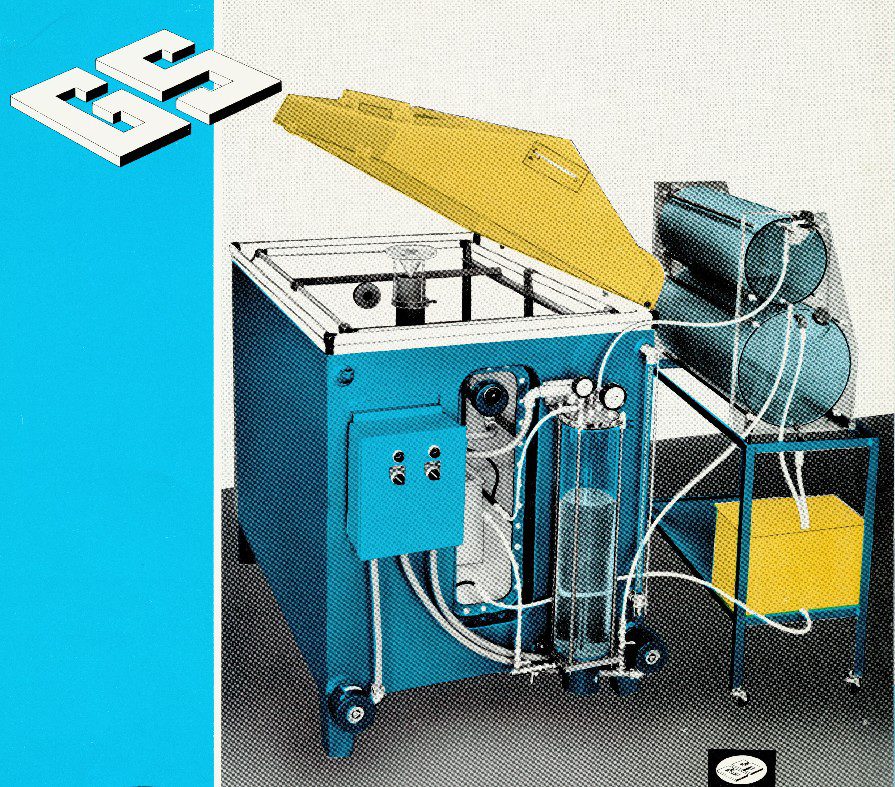
An early GS salt spray corrosion chamber featuring external solution reservoirs, pneumatic controls, and one of the company's original accelerated corrosion testing system designs.
Commercial Salt Spray Chambers and ASTM B117 Testing
While Harshaw advanced corrosion chemistry, GS Equipment was founded in nearby Brook Park, Ohio. GS pioneered the commercial manufacture of corrosion test chambers—specialized cabinets that allowed manufacturers to reproduce salt fog and salt spray test conditions in the lab.
Before commercially manufactured cabinets became common, salt fog apparatus was often built to order and individual laboratories made their own decisions about cabinet construction and operation. The spread of commercial equipment removed many of those design differences and made standardized testing more practical. GS Equipment became part of that transition, producing purpose-built chambers for the industry’s most widely recognized salt spray practice: ASTM B117.
At the same time, America’s car culture was expanding and clear-road winter initiatives made deicing salts increasingly important to public safety. Cleveland’s location on the Great Lakes—and its access to the salt resources that would shape winter road treatment across the region—placed it at the center of the same environmental problem the corrosion industry was trying to solve.
Road Salt Meets Lightweight Design
By the 1960s, corrosion was no longer driven by environment alone. Deicing salt use expanded rapidly across North America, increasing chloride exposure, wet-dry cycling, and moisture retention beneath vehicles. At the same time, automakers shifted toward thinner sheet metal, unibody construction, and lighter structural members that were often introduced before corrosion protection methods had matured. According to Michael C. Belangie’s 1977 paper, Vehicle Corrosion in Perspective, the post-1955 rise in automotive corrosion was likely the result of a harsher chloride environment interacting with more corrosion-susceptible vehicle design—not simply road salt alone.

Roadway buried during the historic 1967 Chicago Blizzard, illustrating the harsh winter conditions that accelerated the widespread adoption of deicing salt and intensified corrosion challenges for the automotive industry. Photo courtesy of Jeff Geisler via the National Weather Service, 25th Street & 50th Avenue, Cicero, Illinois.

Early Corrosion Test Chamber — one of the early generations of salt spray testing equipment that influenced modern Auto Technology chamber design.
Uniting Chemistry and Corrosion Test Equipment
Harshaw acquired GS Equipment, bringing chemistry and machinery under one roof. For the first time, coatings and the chambers to test them were united, giving industry a complete solution: the power to create protective systems and the means to prove their strength.
By this time, salt spray chambers had become essential tools for quality control in automotive and industrial labs around the world. Cleveland’s industrial ecosystem—steel, chemistry, and salt—was now officially linked to the world’s most advanced testing equipment.
Cyclic Corrosion Testing Takes Shape
Industry leaders were confronting a basic limitation of constant salt fog: it could expose coating defects, but it did not reproduce the changing wet, dry, humid, and salt-loading conditions experienced by vehicles in service. The challenge was to develop cyclic corrosion tests that produced more realistic corrosion mechanisms and more useful material rankings.
Engineers responded with chambers capable of moving between salt application, humidity, drying, and controlled-temperature stages. The methods were developed through long-term collaboration among automakers, steel producers, laboratories, equipment suppliers, and corrosion researchers seeking a better match between laboratory and vehicle performance.
This period saw the launch or expansion of important methods including ASTM G85 modified salt spray, DIN 50018 acidified SO2 testing, and SAE J2334 automotive cyclic corrosion testing.
International collaboration also produced ISO 9227 (neutral, acetic, and copper-accelerated salt spray tests, 1990), while ASTM B368 CASS grew in adoption for decorative coatings.
At the same time, the businesses that preceded Auto Technology continued developing corrosion equipment through changes in ownership from Harshaw to Gulf, Kaiser, Engelhard, and Atotech. That accumulated chamber-building experience positioned the organization for the more demanding cyclic methods that followed.

Early Atotech CCT-P cyclic corrosion chamber—an early-generation system that helped shape today's Auto Technology chamber designs.
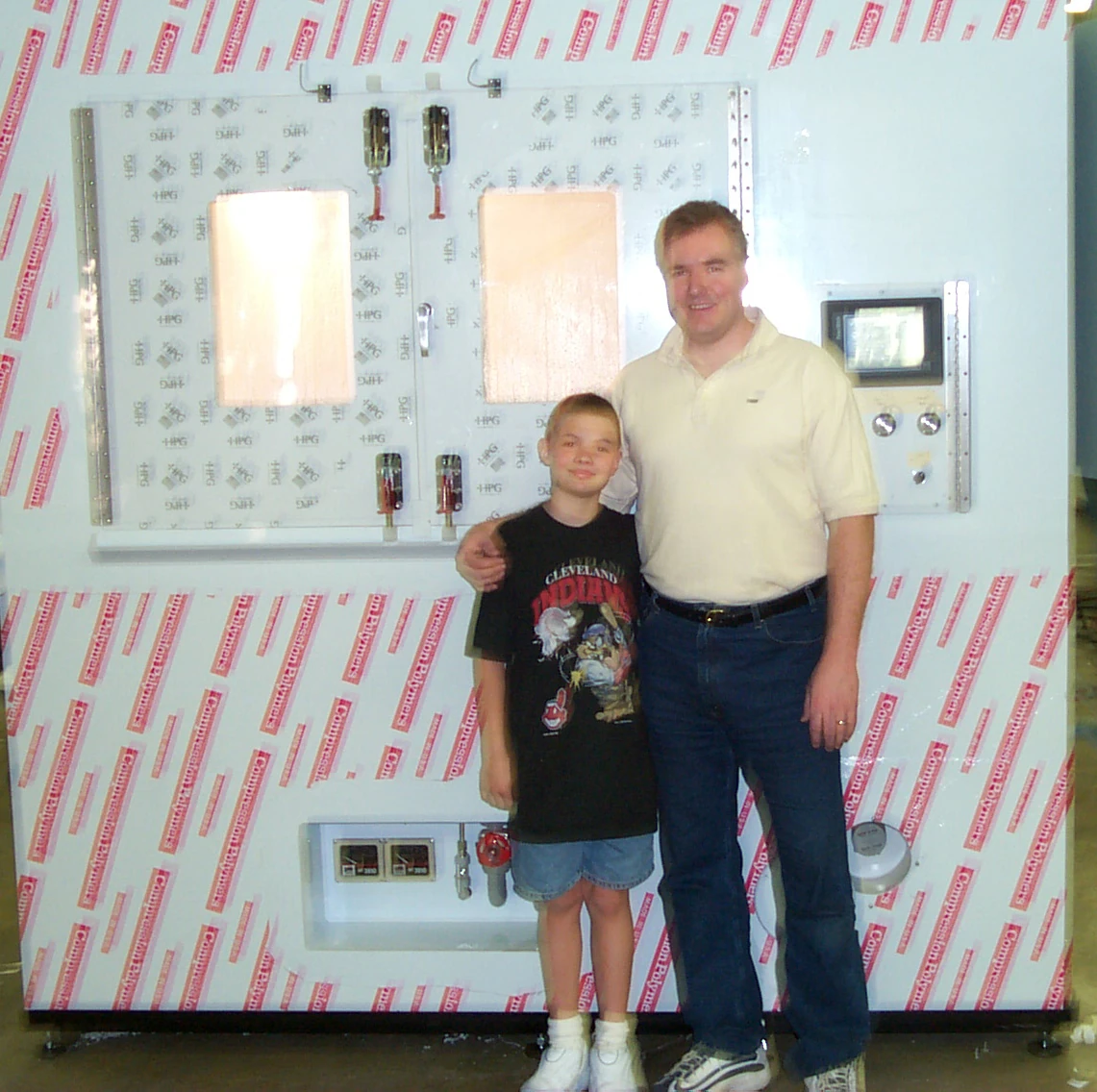
Auto Technology President Kevin A. Smith with Caleb Smith, Head of Sales and Engineering. Kevin Smith represented Auto Technology in the cooperative SAE J2334 development work.
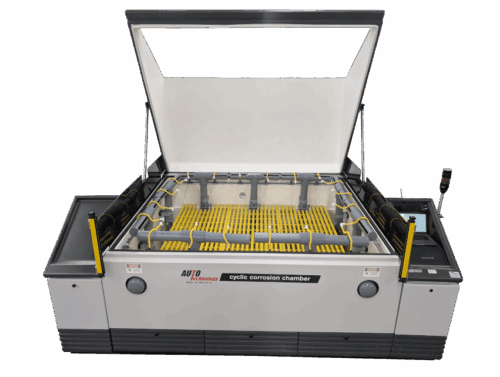
The modern X Series can be configured to automate the environmental stages required by SAE J2334, GMW 14872, Ford methods, and other advanced cyclic corrosion programs.
Auto Technology Helps Advance SAE J2334
Auto Technology directly contributed to the development of SAE J2334. Kevin A. Smith represented Auto Technology on a nine-author team that also included ACT Laboratories, Ford, General Motors, PPG Industries, Concurrent Technologies Corporation, National Exposure Testing, Singleton Corporation, and U.S. Army TACOM.
At the turn of the century, local leadership and investors also carried the chamber business forward under the Auto Technology name. Digital controls, improved sensors, data collection, and programmable sequencing made it practical to automate the humidity, salt application, drying, temperature, and transition stages required by J2334 and the OEM cyclic methods that followed.
Auto Technology today: Companies can use the ATC laboratory for SAE J2334 testing, purchase an X Series chamber configured to automate the method, obtain solutions and mass-loss coupons, or participate in ATC’s SAE J2334 proficiency testing program.
A Global Leader in Testing and Services
In 2008, Auto Technology expanded from manufacturing corrosion equipment into contract laboratory testing. The company could now support the same methods from both sides: building systems to automate the exposure and running customer specimens when purchasing a chamber was unnecessary or premature.
The ATC Test Lab grew into one of the largest independent corrosion testing facilities in the world. Today, it performs ASTM B117, SAE J2334, GMW 14872, Ford L-467, and other specialized environmental programs using the same types of systems Auto Technology designs and manufactures. That operating experience also gives the equipment business direct feedback about specimen loading, transition performance, maintenance, control materials, and the practical demands of running cyclic tests every day.
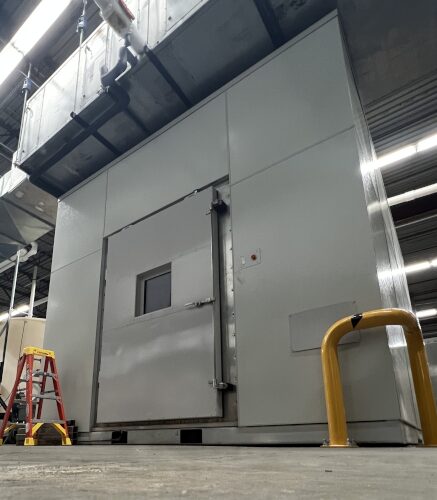
Custom stainless steel walk-in corrosion chamber for large-scale environmental simulation and corrosion testing.
Auto Technology’s Role Today
With over 125 years of corrosion science in its DNA, Auto Technology represents the ultimate convergence of materials science and environmental simulation. We provide the systems, services, and expertise that allow the world's most critical industries to build things that last.
Automotive
OEM qualification, supplier screening, cyclic corrosion, gravelometer work, coated panels, plated parts, trim, fasteners, underbody systems, and related assemblies across GM, Ford, Stellantis, Volkswagen / Audi, BMW, Mercedes-Benz, Volvo, Toyota, Honda, Nissan, Hyundai, Kia, Tesla, and other OEM requirements.
Aerospace
Corrosion-sensitive finishes, metallic materials, environmental exposure, and specification-driven qualification work for severe-service environments.
Coatings Manufacturers
Performance testing, weathering, adhesion, abrasion, product characterization, quality-control support, and comparative coating evaluation.
Plating & Finishing
Salt fog, CASS, AASS, humidity, corrosion evaluation, and screening of plated or conversion-coated systems.
Electronics
Connectors, terminals, assemblies, and pollutant-driven atmospheric corrosion testing using mixed flowing gas and related gas-corrosion methods.
Oil & Gas
Protective coatings, immersion testing, Atlas Cell and cathodic disbondment work, chemical resistance, and corrosion evaluation for pipelines, tanks, process equipment, and related infrastructure.
Infrastructure & Industrial
Protective coatings, structural slip coefficient support, immersion and weathering evaluation, durability qualification work, and prep-related testing tied to field exposure concerns.
Government & Defense
Programs requiring standards-driven environmental exposure, corrosion evaluation, and disciplined documentation practices.
Failure Investigation
Troubleshooting support, comparison studies, service-environment simulation, and investigation-driven testing where the right method must be selected carefully.