
G4 MULTI-GAS & SO₂ TEST CHAMBERS

The Auto Technology G4 is a 300-liter chamber with a stainless steel exposure zone for moist sulfur dioxide and custom corrosive-gas test programs. For fixed-dose moist SO₂ testing, a measured gas quantity is introduced according to the selected method, together with the required temperature, moisture, and exposure time.
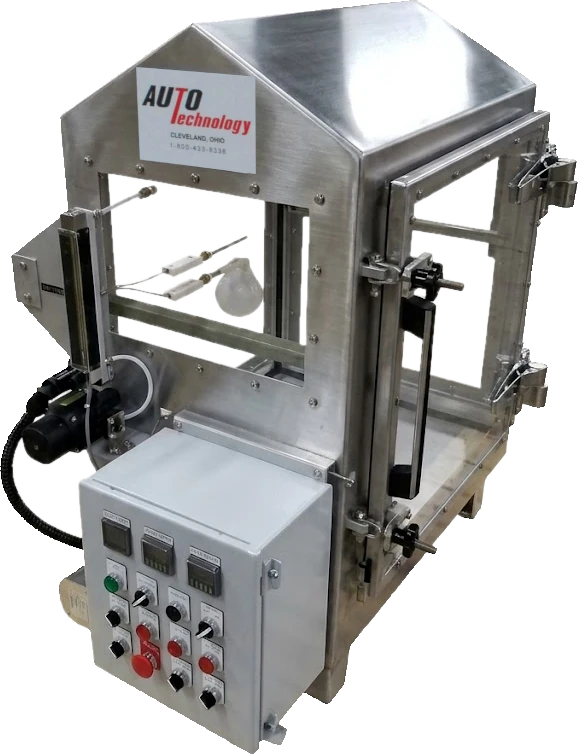
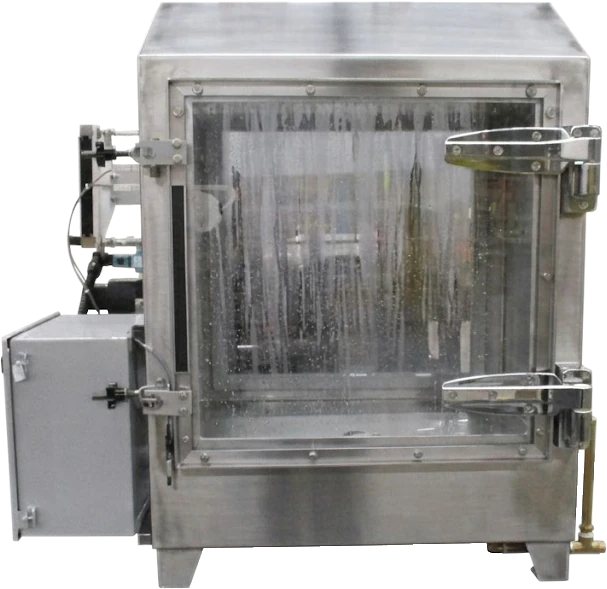
Measured Gas Dosing
Introduces the specified gas volume for fixed-dose moist SO₂ tests.
300-Liter Test Volume
Sized around the reference chamber volume used by ASTM G87 and ISO 22479 moist SO₂ methods.
Optional Multi-Gas Testing
Select optional accessories to configure the chamber for additional gas-exposure programs.
Gas Dosing and Mixed Flowing Gas Testing
Corrosive-gas testing generally uses one of two approaches depending on the specification. For fixed-dose moist SO₂ methods, the G4 uses measured gas dosing, where a defined quantity of gas is introduced into a known chamber volume. This is the approach used by moist SO₂ methods such as ASTM G87, ISO 22479, and DIN 50018.
Tests based on a continuously flowing mixture of low-level pollutant gases use a Mixed Flowing Gas (MFG) chamber . MFG systems continuously deliver the test atmosphere while controlling gas flow, chamber air exchange, temperature, humidity, and gas concentration as required by the method.
For fixed-dose moist SO₂ testing to ASTM G87, ISO 22479, or DIN 50018, the specified SO₂ quantity is introduced at the beginning of each test cycle. The gas concentration changes during exposure as sulfur dioxide dissolves into chamber water and interacts with the specimens. The gas dose, water charge, and specimen load together establish the exposure.
G4 Gas Dosing
- Measured quantity of gas
- Known 300-liter chamber volume
- Moist SO₂ and custom dosing programs
- Gas-volume metering
- Temperature and timed exposure control
Mixed Flowing Gas
- Continuous low-level pollutant gas flow
- Controlled chamber air exchange
- Temperature and relative-humidity control
- Gas-concentration measurement
- Long-duration electronics and connector exposures
Moist SO₂ and Gas Dosing Standards
For the fixed-volume moist SO₂ methods below, the quantity of gas introduced, chamber volume, water quantity, specimen loading, temperature, and exposure time work together to establish the test environment.
ASTM G87
Moist sulfur dioxide corrosion testing using a nominal 300-liter chamber, measured SO₂ delivery, water in the chamber base, heating, and either continuous or alternating exposure.
ISO 22479
Sulfur dioxide corrosion testing in a humid atmosphere using the fixed gas method. A measured volume of SO₂ is introduced into a fixed-volume cabinet at the beginning of the test cycle.
Legacy specifications: ISO 22479:2019 replaced ISO 6988:1985, the earlier sulfur dioxide test with general condensation of moisture. For projects specifying ISO 6988, follow the edition and requirements identified by the governing specification.
DIN 50018
Humid-atmosphere sulfur dioxide testing using AHT 1.0 S and AHT 2.0 S exposure conditions with defined SO₂ additions and a heated, condensing environment.
300-Liter Reference Chamber
The G4's 300-liter chamber volume closely follows the reference apparatus used by the principal moist SO₂ standards. Gas dose, water quantity, specimen loading, and test conditions are defined around this chamber size, making the relationship between the specified exposure and the chamber configuration straightforward.
| Standard / Method | SO₂ Dose for 300 L | Moist SO₂ Exposure | Following Exposure / Cycle Renewal |
|---|---|---|---|
| ASTM G87 — Method A | Typically 0.2, 1.0, or 2.0 L, as specified | 24-hour continuous chamber exposure at 40 ±3°C | Renew water and SO₂ before the next 24-hour cycle. |
| ASTM G87 — Method B | Typically 0.2, 1.0, or 2.0 L, as specified | 8-hour chamber exposure at 40 ±3°C | 16 hours drying at 20–30°C and below 75% RH; renew water and SO₂ before the next cycle. |
| ISO 22479 — Method A | 0.2, 1.0, or 2.0 L, selected for the coating or product specification | 24-hour exposure at 40 ±3°C and approximately 100% RH | Renew water and SO₂ each 24-hour cycle. |
| ISO 22479 — Method B | 0.2, 1.0, or 2.0 L, selected for the coating or product specification | 8-hour exposure at 40 ±3°C and approximately 100% RH | 16 hours at 23 ±5°C and below 75% RH; renew water and SO₂ each cycle. |
| DIN 50018 — AHT 1.0 S | 1.0 L | 8 hours, including heating, at 40 ±3°C and approximately 100% RH | 16 hours, including cooling, at 18–28°C and maximum 75% RH. |
| DIN 50018 — AHT 2.0 S | 2.0 L | 8 hours, including heating, at 40 ±3°C and approximately 100% RH | 16 hours, including cooling, at 18–28°C and maximum 75% RH. |
The governing material or product specification establishes the selected SO₂ dose, exposure sequence, number of cycles, specimen preparation, and evaluation requirements. ISO 22479 identifies 300 ±10 L as the preferred cabinet capacity; other capacities may be agreed with gas dose, water quantity, and specimen loading adjusted accordingly.
How the G4 Gas Dosing System Works
Measured Gas Delivery
For fixed-dose moist SO₂ testing, the volume of sulfur dioxide required by the governing specification is introduced through the gas inlet. Appropriate regulating and measuring equipment is used to deliver the specified volume.
ASTM G87 and ISO 22479 describe gas delivery using appropriate regulating and volume-measuring equipment such as a calibrated flowmeter. The specified gas quantity is introduced, and the exposure is carried out according to the selected method.
Moisture and Temperature
The chamber temperature is controlled by heating the floor and lower portions of the side walls. Water in the base of the exposure zone provides the moisture for the humid, condensing test atmosphere.
The chamber roof is shaped so that drops of condensed moisture do not fall on the specimens.
ASTM G87 and ISO 22479 specify a 2.0 ±0.2 L water charge for a 300-liter chamber. ASTM G87 specifies distilled water in its procedure; ISO 22479 allows distilled or deionized water with conductivity no higher than 5 µS/cm at 25 ±2°C.
Heating to ISO 22479 and ISO 6988
Under ISO 22479, the temperature in the cabinet is controlled by heating the floor and lower portions of the side walls. The cabinet temperature is raised to 40 ±3°C in less than 1.5 hours and maintained for the specified exposure period.
ISO 6988 requires the floor and lower portions of the walls to be capable of being heated. The heating device must be capable of raising the cabinet to 40 ±3°C in 1.5 hours and maintaining that temperature. Its operating procedure describes reaching the temperature in about 1.5 hours.
Temperature Measurement
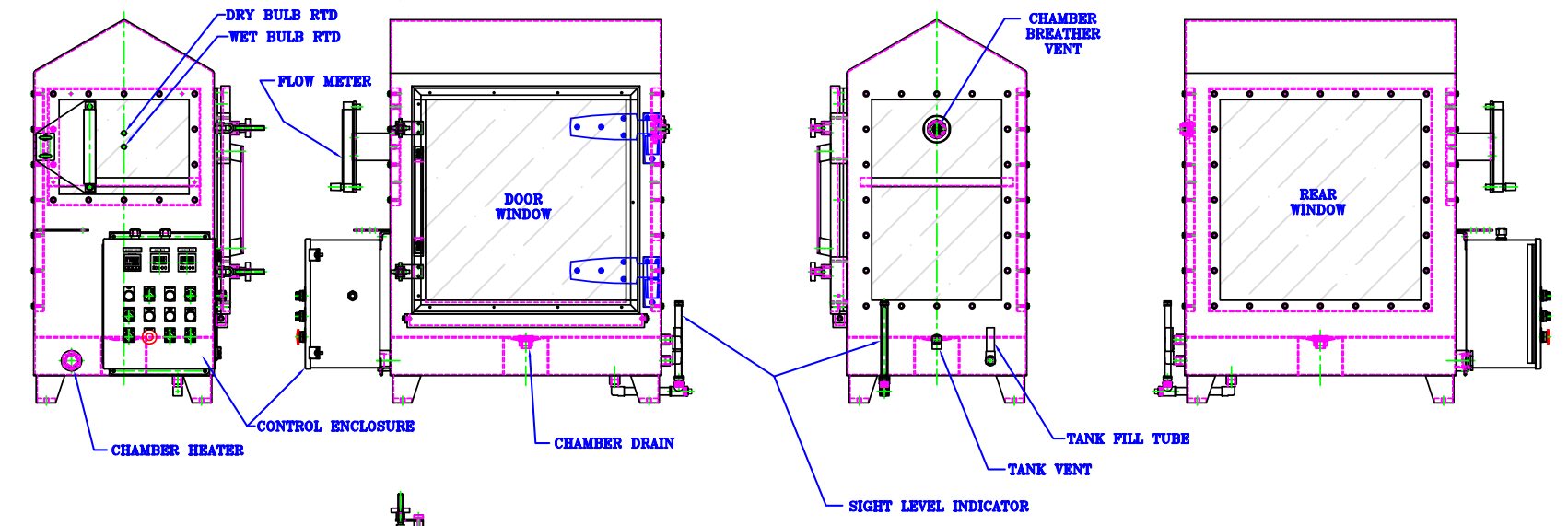
The G4 includes dry-bulb and wet-bulb RTDs. The dry-bulb RTD measures chamber air temperature; the wet-bulb RTD supplies the companion temperature measurement used for wet-/dry-bulb humidity assessment.
Benchtop Installation
The chamber is designed for benchtop installation under a ventilation hood. Coordinate the installation with the laboratory ventilation and gas-handling arrangements.
Chamber and Tank Connections
The component drawing identifies the chamber breather vent, chamber drain, tank fill tube, tank vent, and sight level indicator. These connections and fittings are shown alongside the chamber heater, flowmeter, and control enclosure.
Manual and Automatic Operation
The chamber supports manual and automatic operation. Preset flow rate, time, and temperature controls establish the selected operating conditions. Gas delivery and cycle timing follow the test method and chamber configuration.
Optional Test Configurations
The Model 300 brochure lists multi-gas, salt-fog, and humidity testing with the addition of selected optional accessories. The required equipment and operating sequence depend on the intended test program.
Typical Moist SO₂ Cycle
- Add the specified water charge. ASTM G87 and ISO 22479 use 2.0 ±0.2 L for a 300-liter chamber; DIN 50018 specifies 2 L for a 300-liter chamber.
- Position the specimens with the required exposed surface area, clearances, and orientation.
- Close and seal the chamber.
- Introduce the specified measured volume of SO₂. Under ISO 22479, the test cycle begins when the gas is introduced.
- Heat the chamber to 40 ±3°C. ISO 22479 requires this temperature to be reached in less than 1.5 hours; ASTM G87 specifies about 1.5 hours.
- Follow the selected continuous or alternating exposure cycle shown in the standards table. Heating is part of the cycle timing.
- For ISO 22479 Method B and DIN 50018 alternating exposures, turn off the heater and open and/or ventilate the chamber to establish the specified ambient conditions. ASTM G87 Method B specifies 16 hours of drying under the prescribed ambient conditions inside the chamber. ISO 22479 Method B requires 23 ±5°C and below 75% RH in approximately one hour; DIN 50018 requires its second-stage conditions after approximately one hour.
- Replace the chamber water and renew the SO₂ dose before each new 24-hour cycle.
Exposure-Zone Construction
Stainless steel.
Chamber Conditioning and Performance Verification
Condition a new chamber before testing specimens. ASTM G87 requires at least ten 24-hour conditioning cycles without test material, using a 2.0 L SO₂ dose. ISO 22479 requires at least one conditioning cycle without specimens using a 2.0 L SO₂ dose.
ISO 22479 also requires performance checks to assess repeatability and reproducibility. Its informative Annex B describes one suitable check using steel reference specimens and mass loss. DIN 50018 includes a functional check in Section 9. Apply the procedure and acceptance criteria of the governing standard.
Technical Specifications
| Feature | Specification |
|---|---|
| Chamber Type | Moist SO₂ and multi-gas environmental test chamber |
| Internal Volume | 300 L (approximately 10.6 ft³) |
| Optional Testing | Multi-gas, salt-fog, and humidity testing with selected optional accessories |
| Primary Application | Moist SO₂ and custom measured-dose gas exposures |
| Gas Delivery | Flowmeter with gas delivery set according to the selected method |
| Maximum Gas Pressure | 10 psi |
| Standard Moist SO₂ Test Condition | 40 ±3°C during the moist SO₂ exposure; ISO 22479 and DIN 50018 specify approximately 100% RH during this stage. |
| Operation and Controls | Manual or automatic operation with preset flow rate, time, and temperature controls |
| Heating | Temperature controlled by heating the floor and lower portions of the side walls |
| Temperature Measurement | Dry-bulb and wet-bulb RTDs |
| Chamber Connections | Chamber breather vent and chamber drain |
| Tank Fittings | Tank fill tube, tank vent, and sight level indicator |
| Observation | Viewing windows and a large transparent access door |
| Exposure-Zone Construction | Stainless steel |
| Condensate Management | Roof shaped to prevent drops of condensed moisture from falling on specimens |
For alternating methods, laboratory conditions and ventilation must support the required cooling and ambient exposure.
Specimen Loading and Placement
Specimen loading is part of the test condition in moist SO₂ testing. The amount and type of exposed material affect how sulfur dioxide is absorbed and consumed inside the chamber, so the standards define both total exposed surface area and specimen placement.
ISO 22479 Specimen Area
ISO 22479 specifies a total exposed specimen surface area of:
0.5 ±0.1 m² per 300 ±10 L
The required exposed surface area is adjusted proportionally for chambers of other volumes.
When the total exposed area is below 0.5 m² in a 300-liter cabinet, ISO 22479 calls for substitute specimens of the same material to bring the total to 0.5 m². This is the combined exposed surface area of the specimens, rather than their footprint on a rack.
ASTM G87 Specimen Placement
ASTM G87 requires 0.5 ±0.1 m² of total exposed specimen area unless otherwise agreed.
- Minimum 20 mm between specimens
- Minimum 100 mm from chamber walls and ceiling
- Minimum 200 mm above the chamber water
- Specimens arranged so condensate does not drip onto lower specimens
- Near-vertical orientation, 0–10° from vertical, is suggested unless otherwise agreed or specified.
ISO 22479 Specimen Orientation and Clearances
Unless otherwise specified, ISO 22479 places the exposed surface between vertical and 15 ±2° from vertical, with the area of primary interest facing upward. For assemblies and enclosures, the standard identifies the normal service orientation as preferable.
Maintain at least 20 mm between specimens and at least 100 mm between specimen edges and cabinet walls. Keep the lowest specimen edge more than 200 mm above the water surface, minimize contact with supports, and arrange specimens so they neither shield one another nor receive condensate dripping from specimens or supports above them.
Controlling the specimen load helps keep the relationship between gas dose, chamber volume, exposed material, and corrosion severity consistent from one test to the next.
Applications
The G4 supports materials, coatings, components, and assemblies evaluated in humid sulfur dioxide and other compatible measured-dose corrosive-gas environments.
Coatings and Corrosion Protection
Evaluate painted, plated, coated, and otherwise protected metal surfaces for coating defects, blistering, substrate attack, and corrosion produced by humid SO₂ exposure.
Metals and Alloys
Evaluate metals, alloys, and corrosion-protection systems using the specified SO₂ dose, water charge, temperature, and exposure period.
Components and Assemblies
Test manufactured components and assemblies when humid corrosive gas exposure is part of a product qualification, development, or comparison program.
Custom Gas Dosing Programs
Selected optional accessories support multi-gas test configurations. Gas selection, delivery, and operating conditions are established for the intended program.
Moist SO₂ Contract Testing
Auto Technology also operates an A2LA-accredited corrosion testing laboratory for customers that want test data, additional capacity, or help establishing a moist-gas test program before bringing the capability in-house.
Common Test Programs
- Material and coating qualification
- Product development and material comparisons
- Failure analysis and corrosion investigation
- Production or supplier verification
- Temporary or supplemental test capacity
- Test-program development before equipment purchase
Laboratory Capabilities
- ASTM G87 moist SO₂ testing
- ISO 22479 fixed-volume SO₂ testing
- DIN 50018 sulfur dioxide testing
- Specimen loading and fixture support
- Custom gas-dosing programs
Send the applicable standard, specimen dimensions and material, required exposure, and number of cycles for review.
Frequently Asked Questions
How does the G4 dose sulfur dioxide?
For fixed-dose moist SO₂ methods such as ASTM G87, ISO 22479, and DIN 50018, a measured volume of sulfur dioxide is introduced into the 300-liter chamber at the beginning of each test cycle. The required quantity comes from the governing test method or product specification.
ASTM G87 and ISO 22479 commonly use 0.2, 1.0, or 2.0 liters of SO₂ for a 300-liter chamber. The gas volume delivered to the chamber is measured using appropriate calibrated equipment.
Why is the G4 a 300-liter chamber?
ASTM G87 and ISO 22479 use a 300-liter chamber as the reference basis for moist sulfur dioxide testing. Gas quantity, water quantity, specimen loading, and other test conditions are defined around this chamber volume.
The G4 follows that established chamber size so the specified gas dose and specimen loading can be applied directly.
What is the difference between G4 dosing and mixed flowing gas testing?
For moist SO₂ methods such as ASTM G87, ISO 22479, and DIN 50018, the G4 introduces the specified measured gas quantity into a fixed chamber volume.
Mixed Flowing Gas testing continuously supplies low-level pollutant gases while controlling chamber air exchange, temperature, humidity, and gas concentration throughout the exposure. Auto Technology builds dedicated MFG chambers for those methods.
How is the gas dose measured?
The gas supply uses regulating and measuring equipment selected for the required gas and dose. ASTM G87 and ISO 22479 describe volumetric gas measurement using calibrated equipment such as a flowmeter.
For fixed-dose moist SO₂ testing, the objective is to introduce the specified gas volume into the known chamber volume at the start of the exposure.
How much specimen material can be placed in the chamber?
Specimen capacity is based on exposed surface area and placement as well as physical dimensions. ISO 22479 specifies 0.5 ±0.1 m² of total exposed specimen area for a 300 ±10 L chamber.
ASTM G87 requires 0.5 ±0.1 m² of total exposed specimen area unless otherwise agreed and specifies clearances from other specimens, chamber walls and ceiling, and the water surface.
Why does specimen loading matter?
Sulfur dioxide is absorbed and consumed by the materials exposed inside the chamber. The total specimen area and the material being tested therefore affect the chamber atmosphere and resulting corrosion exposure.
Maintaining the specified specimen load helps produce comparable results from cycle to cycle and between laboratories.
What is the exposure zone made from?
The exposure zone is stainless steel.
Can the G4 be configured for gases other than sulfur dioxide?
Yes. Multi-gas testing is available with selected optional accessories. Gas selection, materials compatibility, gas delivery, chamber controls, exhaust, and facility requirements are reviewed for the intended exposure.
How are gas exhaust and operator safety handled?
The system is integrated with the customer's laboratory ventilation and gas-handling setup. Exhaust routing, gas regulators, backflow protection, purge procedures, and other facility requirements are established around the gases used in the test program.
How long is a moist SO₂ test cycle?
One cycle is 24 hours. ASTM G87 and ISO 22479 provide Method A for continuous chamber exposure and Method B for 8 hours of moist SO₂ exposure followed by 16 hours at the specified ambient conditions. DIN 50018 AHT 1.0 S and AHT 2.0 S use an 8-hour moist stage, including heating, followed by a 16-hour ambient stage, including cooling. The governing specification establishes the number of cycles.
Does the SO₂ concentration stay constant during the exposure?
For fixed-dose moist SO₂ testing, the chamber receives the specified measured dose at the start of each cycle. The gas concentration changes as sulfur dioxide dissolves into chamber water and interacts with the specimens. Control of the initial dose, water charge, and specimen load is therefore part of establishing a repeatable exposure.
How much water is used, and when is it replaced?
ASTM G87 and ISO 22479 specify 2.0 ±0.2 L of water for a 300-liter chamber. DIN 50018 specifies 2 L for a 300-liter chamber. Replace the water and renew the SO₂ dose before each new 24-hour cycle.
How does ISO 6988 relate to ISO 22479?
ISO 6988:1985 is the earlier sulfur dioxide test with general condensation of moisture. It was withdrawn and replaced by ISO 22479:2019. When a project specifies ISO 6988, follow the edition and test requirements identified by the governing specification.