
ASTM G85 MODIFIED SALT SPRAY TESTING SERVICES

ASTM G85 is not one corrosion test or a five-step severity scale. It is a family of five modified salt-spray procedures that earned their relevance in different places: A1 became part of the international AASS testing tradition; A2 entered formal aluminum-alloy qualification records; A3 became a heat-exchanger and brazing-sheet test; A4 gained direct U.S. Navy and Department of Defense backing; and A5 moved from coatings research into Florida construction requirements. Those different paths to adoption do not make one annex technically “better” than another. The correct annex is the one required for the material, failure mechanism, product specification, or service environment being evaluated.
Auto Technology Company provides ASTM G85 testing services for metals, protective coatings, plated finishes, aluminum alloys, fasteners, components, test panels, and finished assemblies. Our materials and corrosion laboratory can perform A1, A2, A3, A4, and A5, including AASS, cyclic acidified salt fog, SWAAT, salt/SO2 testing, and dilute-electrolyte fog/dry testing commonly called Prohesion.
G85 programs are run in chambers selected and configured for the required annex. Auto Technology uses water-jacketed chambers where thermal stability is appropriate and specialized non-water-jacketed cyclic chambers where faster temperature transitions, fresh-air dry-off, or unhumidified atomizing air are required. ASTM G85 defines the modified salt-fog environments; your product specification or the test plan ATC confirms with you defines the annex, specimens, exposure duration, inspections, evaluation, and acceptance criteria.
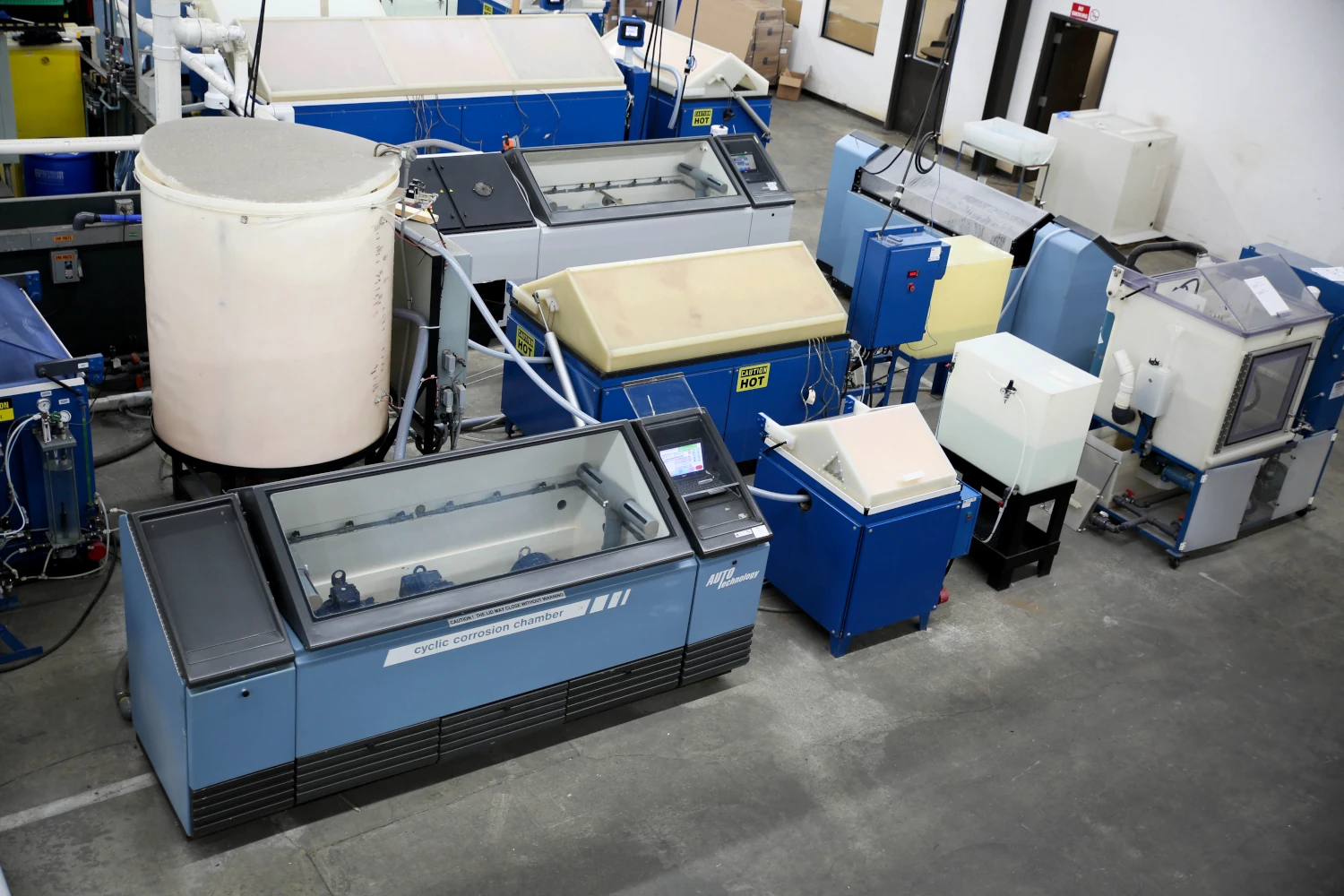
All Five G85 Annexes
Laboratory capability for A1 acetic acid salt spray, A2 cyclic acidified salt fog, A3 SWAAT, A4 salt/SO2, and A5 fog/dry testing.
Annex-Matched Chambers
Water-jacketed, non-water-jacketed cyclic, SO2-equipped, and specialized A5 configurations are selected around the required chemistry and cycle.
Prepared Solutions and Reporting
In-house solution preparation, controlled exposure, specified inspections, photography, evaluation, documentation, and reporting.
Standards expertise behind the testing: Auto Technology personnel have longstanding direct involvement with ASTM Committee G01 on Corrosion of Metals and its subcommittees, including leadership and participation in the development, revision, interpretation, and maintenance of corrosion testing standards.
Send the required annex and revision, governing specification, exposure duration, specimen quantity and dimensions, evaluation requirements, and requested completion date.
What Is ASTM G85 Modified Salt Spray Testing?
ASTM G85 is the Standard Practice for Modified Salt Spray (Fog) Testing. It contains five annexes that modify traditional salt-fog exposure through acidified solutions, cyclic operation, synthetic seawater, sulfur dioxide, dilute electrolyte, dry-air purge, high-humidity soak, or controlled fog/dry transitions. The practice applies to ferrous and nonferrous metals and to organic and inorganic coatings.
Unlike ASTM B117 testing, ASTM G85 is not one continuous neutral salt-fog condition. Each annex is a distinct exposure with its own chemistry, pH, temperature, airflow, humidity, gas, and timing requirements. The required annex must therefore be identified before ATC selects the chamber, prepares the solution, and establishes the test plan.
ASTM G85 is an exposure practice, not a universal product-performance specification.
It does not select the correct annex or prescribe one exposure duration, specimen design, evaluation method,
acceptance limit, or pass/fail result for every product. Those requirements must come from your governing
specification or from the test plan ATC confirms with you before exposure begins.
What ASTM G85 results can - and cannot - tell you
G85 testing can provide relative corrosion-resistance information, document conformance to a defined product requirement, compare materials or finishing systems, support product and process development, and investigate how a material responds to a particular modified salt-fog environment. Its annexes can expose behavior that may not appear under continuous neutral salt fog, including responses to acidity, synthetic seawater, pollutant gas, wet/dry cycling, salt concentration during dry-off, and changing humidity conditions.
A laboratory exposure should not be converted automatically into a specific number of years in outdoor or field service. Any claimed correlation must be supported by suitable service history or atmospheric-exposure data for the particular material system, environment, and failure mode being evaluated.
ASTM G85 Annex A1-A5 Testing Profiles
Auto Technology's laboratory can run all five ASTM G85 profiles. The table below provides a planning summary; the full standard, applicable revision, and governing product requirement control the actual program.
| Annex | Modified Salt Spray Profile | Core Chemistry and Cycle | Where It Has Value |
|---|---|---|---|
| A1 | Acetic Acid-Salt Spray (AASS) | Continuous acidified sodium-chloride fog at 35 ± 2°C; solution pH 3.1-3.3. | Decorative chromium plating, plated finishes, coating research, process evaluation, and quality control when A1 is specified. |
| A2 | Cyclic Acidified Salt Fog | Six-hour repetitive cycle: 45 minutes fog, 2 hours dry-air purge, and 3 hours 15 minutes high-humidity soak at 49 ± 2°C; solution pH 2.8-3.0. | Aluminum alloys, coatings, finishes, and development programs requiring an acidified cyclic exposure with purge and humidity stages. |
| A3 | Acidified Synthetic Sea Water (SWAAT) | Acidified synthetic sea-salt solution; 30 minutes fog followed by 90 minutes soak at or above 98% RH. The required exposure temperature depends on the material or governing specification. | Aluminum-alloy heat treatments, aerospace materials, marine-related systems, organic coatings, and other products for which SWAAT is specified. |
| A4 | Salt/SO2 Spray (Fog) | Salt fog combined with controlled periodic SO2 introduction at 35 ± 2°C. ASTM G85 provides example cycles; the governing requirement defines the solution and cycle used. | Metals, coatings, plated products, industrial equipment, electronics hardware, and infrastructure materials requiring an SO2-containing corrosive atmosphere. |
| A5 | Dilute Electrolyte Cyclic Fog/Dry (Prohesion) | One hour ambient fog followed by one hour dry-off. Uses 0.05% sodium chloride and 0.35% ammonium sulfate, with fresh-air purge and unhumidified atomizing air. | Paints and protective coatings on steel, pretreatments, formulation comparisons, and systems evaluated under repeating dilute-electrolyte wet/dry conditions. |
The annex number matters.
A request for "ASTM G85 testing" is not complete by itself. A1, A2, A3, A4, and A5 cannot be treated as
interchangeable because they use different chemistries, temperatures, humidity conditions, airflow paths,
gases, and cycle sequences.
Key operating conditions
| Annex | Solution | Exposure Conditions | Special Chamber Requirement |
|---|---|---|---|
| A1 | 5 ± 1 parts sodium chloride by mass in 95 parts qualifying water, acidified with acetic acid | Continuous fog; 35 ± 2°C exposure zone; 47 ± 1°C bubble tower | Stable acidified salt-fog operation |
| A2 | 5 ± 1 parts sodium chloride by mass in 95 parts qualifying water, acidified with acetic acid | 49 ± 2°C; fog, direct dry-air purge, and high-humidity soak | Timed cycling and a purge-air path that bypasses the bubble tower and atomizer |
| A3 | 42 g synthetic sea salt plus 10 mL glacial acetic acid per litre of solution | 30-minute fog / 90-minute soak; at or above 98% RH; specified temperature selected for the material | Wet-bottom cyclic fog and high-humidity soak control |
| A4 | Sodium-chloride or synthetic sea-salt solution as defined by the governing requirement | 35 ± 2°C with periodic controlled SO2 introduction | SO2-compatible gas delivery, metering, controls, materials, and safety provisions |
| A5 | 0.05% sodium chloride and 0.35% ammonium sulfate by mass | 1-hour fog at 24 ± 3°C ambient conditions; 1-hour dry-off at 35 ± 1.5°C, reached within 45 minutes | Specialized non-water-jacketed cyclic chamber with responsive heating, fresh-air purge, and unhumidified atomizing air |
Where the five annexes came from—and what each is meant to show
The annexes did not originate as five variations created for one market. They were developed around different materials and corrosion problems, then consolidated under ASTM G85. Expand any annex below for its lineage, intended use, and the standards or institutions that helped establish it.
A1 — From ASTM B287 to internationally standardized AASS testing
Annex A1 is the continuous Acetic Acid Salt Spray (AASS) procedure. It was originally published as ASTM B287 before being incorporated into G85. The lower-pH salt fog was developed primarily to differentiate the corrosion resistance of decorative copper-nickel-chromium and nickel-chromium finishes, including decorative chromium plating on steel and zinc die castings.
A1's larger adoption story is international rather than regulatory. AASS became one of the three named salt-spray methods in ISO 9227, alongside NSS and CASS. That does not make ISO 9227 AASS a legal incorporation of ASTM G85 A1, but it shows how the same basic test concept became part of the global plating and finishing vocabulary.
Sources: ASTM G85 annex lineage; ISO 9227:2022 scope; ISO explanation of AASS applications.
A2 — MASTMAASIS and formal aluminum-alloy qualification records
Annex A2 is the cyclic acidified salt-fog procedure commonly called MASTMAASIS. It was developed to accelerate exfoliation behavior in susceptible aluminum alloys by repeatedly moving the specimens through acidified fog, dry purge, and high-humidity soak conditions. Its useful question is not simply “does aluminum corrode?” but whether an alloy, temper, heat treatment, or product form is vulnerable to the layered attack associated with exfoliation corrosion.
A2 has one of the clearest formal adoption stories in the family. The Aluminum Association's registered alloy-and-temper records specify the dry-bottom A2 MASTMAASIS method for two weeks in the exfoliation- corrosion documentation for 2050-T34 plate. That places A2 inside a recognized materials-registration system used by the aluminum and aerospace supply chains—not merely in an individual laboratory procedure.
Navy-sponsored research also compared A2 results with exposure aboard an aircraft carrier. It reproduced the shipboard behavior of 7075 aluminum reasonably well, although the relationship was less consistent for the aluminum-lithium alloys evaluated. That is a useful reminder that an accelerated test must still be validated for the alloy and failure mode at issue.
Sources: Aluminum Association 2025 Tan Sheets addendum; Aluminum Association standards and registration records; ASTM aircraft-carrier correlation study.
A3 — SWAAT and the aluminum heat-exchanger supply chain
Annex A3 is the Sea Water Acetic Acid Test (SWAAT). It was originally published as ASTM G43 before being incorporated into G85. The synthetic sea-salt chemistry and alternating fog/soak cycle were adopted most deeply in the aluminum brazing-sheet and heat-exchanger industries.
A3 is meant to compare resistance to localized attack and eventual leakage or perforation in aluminum sheet, tube, radiators, condensers, evaporators, and complete heat exchangers. Its industrial credibility came partly from work showing that SWAAT could reproduce corrosion morphology seen on field-returned aluminum radiators. It is therefore better described as a specialized heat-exchanger qualification tool than as a universal “marine corrosion” test.
Sources: SWAAT history and heat-exchanger use; published radiator field-correlation abstract; ASTM G85 standard page.
A4 — The carrier-environment test formally adopted for naval systems
Annex A4 combines salt fog with controlled sulfur-dioxide introduction to create an acidic, pollutant- containing environment. Its history is unusually direct: it was developed through U.S. Navy work intended to model the severe mixed salt-and-pollutant corrosion encountered by carrier-based aircraft and hardware.
The DoD's JSSG-2006 aircraft-structures guidance states that the cyclic sodium-chloride/SO2 procedure in ASTM G85 A4 gave the best correlation with the aircraft-carrier environment. The current MIL-STD-1568E goes further: naval-system assemblies are to receive 500 hours of A4 exposure, and its Navy- only verification table specifies scribed panels and a maximum permitted pitting depth. A4 therefore has the strongest direct federal-defense adoption story among the five annexes.
Sources: DoD JSSG-2006 Aircraft Structures record; MIL-STD-1568E, sections 4.10.9 and C.3.5; A4 cycle and chemistry overview.
A5 — From Prohesion coatings research to Florida building requirements
Annex A5 is the cyclic dilute-electrolyte fog/dry test widely known as Prohesion. Its development began in the coatings field with work in the 1960s and 1970s using a much more dilute sodium- chloride and ammonium-sulfate electrolyte than conventional salt spray. Repeated wetting and complete dry-off concentrate and redistribute salts at coating defects, making the method particularly useful for comparing paints, pretreatments, and protective coating systems on steel.
A5 later acquired the clearest building-code story in G85. TAS 114-95 Appendix E adopted a modified A5 procedure for corrosion resistance of roofing nails and carbon-steel fasteners in South Florida's High- Velocity Hurricane Zone. Those requirements were carried into the Florida Building Code framework, and Miami-Dade product approvals continue to cite ASTM G85 A5 together with TAS 114 Appendix E.
Sources: Prohesion development history; Florida Building Code and TAS 114 requirements; Florida Building Commission A5 fastener study; Miami-Dade product-approval example.
Industries and Applications for ASTM G85 Testing
ASTM G85 testing is valuable when a product, coating, material, OEM, military, procurement, or development requirement calls for more than continuous neutral salt fog. ATC builds the program around the specified annex and the failure mechanism or comparison the customer needs to evaluate.
Aerospace, Defense, Marine and Energy
Aerospace and defense: aluminum alloys, heat treatments, plated hardware, fasteners, coatings, structural materials, enclosures, and specification-controlled assemblies.
Marine and offshore: aluminum, coatings, valves, fasteners, hardware, and material systems evaluated with acidified synthetic seawater or another specified G85 exposure.
Energy and utilities: coatings, cabinets, electrical hardware, pipeline components, renewable-energy equipment, and metallic systems used in coastal, industrial, or pollutant-containing environments.
Coatings, Finishing and Industrial Products
Paint, coatings and finishing: liquid and powder coatings, pretreatments, conversion coatings, decorative chromium, plated finishes, and passivation systems.
Industrial, infrastructure and construction: fabricated products, architectural hardware, building products, industrial equipment, enclosures, structural finishes, and pollutant-exposed systems.
Electronics and electrical equipment: connectors, terminals, housings, cabinets, plated hardware, and assemblies when a G85 annex is required.
Product development and quality: supplier comparisons, formulation screening, process changes, production control, qualification, and independent third-party verification.
How ASTM G85 Is Commonly Used with Aluminum
Aluminum is tested under several G85 annexes, but the alloy or substrate alone does not determine the method. Annex A2 is the annex most directly associated with exfoliation susceptibility in certain high-strength aluminum alloy, temper, heat-treatment, and product-form programs. For example, Aluminum Association registration records specify the dry-bottom A2 MASTMAASIS method for the exfoliation-corrosion qualification of 2050-T34 plate.
Annex A3 SWAAT is commonly used with brazed aluminum sheet, tube, radiators, condensers, evaporators, and complete heat exchangers, where localized attack and time to perforation can be more useful measures than general surface corrosion. Published SAE work found that A3 reproduced the mixed intergranular and pitting morphology observed on field-returned aluminum radiators more closely than neutral salt spray. A1, A4, or A5 may also be required for a coated, finished, or assembled aluminum product, but they should be selected because the governing specification or intended exposure calls for that annex—not simply because the substrate is aluminum.

Sources: ASTM G85 scope and annexes; Aluminum Association 2025 Tan Sheets addendum; SAE paper 910590 on SWAAT and aluminum heat exchangers.
When G85 may add value beyond ASTM B117
- The governing requirement specifies acidified salt spray rather than neutral salt fog.
- The material is evaluated under cyclic fog, purge, soak, or dry-off conditions.
- Synthetic seawater chemistry is required for an aluminum, aerospace, or marine-related program.
- The program requires controlled sulfur-dioxide exposure with salt fog.
- Coatings or pretreatments must be compared under dilute-electrolyte fog/dry cycling.
- A development team wants to compare performance across more than one defined laboratory environment.
Not sure which G85 annex applies?
Send ATC the product specification, drawing note, OEM requirement, or a description of what you need to
evaluate. We can review it with you and confirm whether the work calls for G85 A1, A2, A3, A4, A5,
ASTM B117, ISO 9227, ASTM B368 CASS, an OEM cyclic corrosion method, or another program.
How Auto Technology Runs an ASTM G85 Test Program
Auto Technology confirms the required annex and governing specification, selects the correct chamber and solution, plans specimen preparation and loading, controls the exposure, completes the specified inspections, and records the data required for the final report.
1. We confirm the annex and governing requirements
Before testing begins, ATC confirms the ASTM G85 edition and annex, the applicable product or material specification, specimen identification and quantity, preparation, orientation, exposure duration, cycle count, inspection points, post-test handling, evaluation methods, acceptance criteria, photography, and reporting. When the governing requirement does not provide every detail, we explain the available options and document the plan you approve.
2. We match the chamber to the profile
Chamber selection is part of the test plan. ATC uses water-jacketed equipment for applicable profiles that benefit from high temperature stability; appropriately configured cyclic equipment for fog, purge, and soak sequences; SO2-equipped systems for A4; and special non-water-jacketed chambers for A5. The A5 configuration must support ambient fog, unhumidified atomizing air, fresh-air dry-off, and the required rise to dry-off temperature within the specified transition time.
3. We prepare and verify the required chemistry
The laboratory prepares the sodium-chloride, acidified sodium-chloride, acidified synthetic-seawater, or dilute sodium-chloride/ammonium-sulfate solution required by the selected annex. Applicable solution makeup, pH, concentration or density, measurement temperature, fog collection, and collected-solution properties are verified and documented at the required intervals. A4 programs also include the controlled SO2 introduction specified by the approved cycle.
4. We control the exposure and complete the specified evaluation
During testing, ATC records the applicable exposure-zone conditions, solution and collection data, cycle operation, inspections, and interruptions. At completion, specimens are handled under the governing procedure and evaluated using the visual, dimensional, coating, mass-change, scribe-creep, adhesion, or other methods established in the approved scope.
ASTM G85 Test Solutions Prepared In-House
Auto Technology prepares the modified salt-spray solutions used in its own corrosion laboratory and supplies premixed 55-gallon drums to customers operating G85-capable chambers. Premixed chemistry reduces on-site handling and mixing and gives laboratories a ready-to-use supply associated with the specified annex. Users remain responsible for verifying the applicable standard revision, solution condition, storage, handling, and required measurements before and during testing.
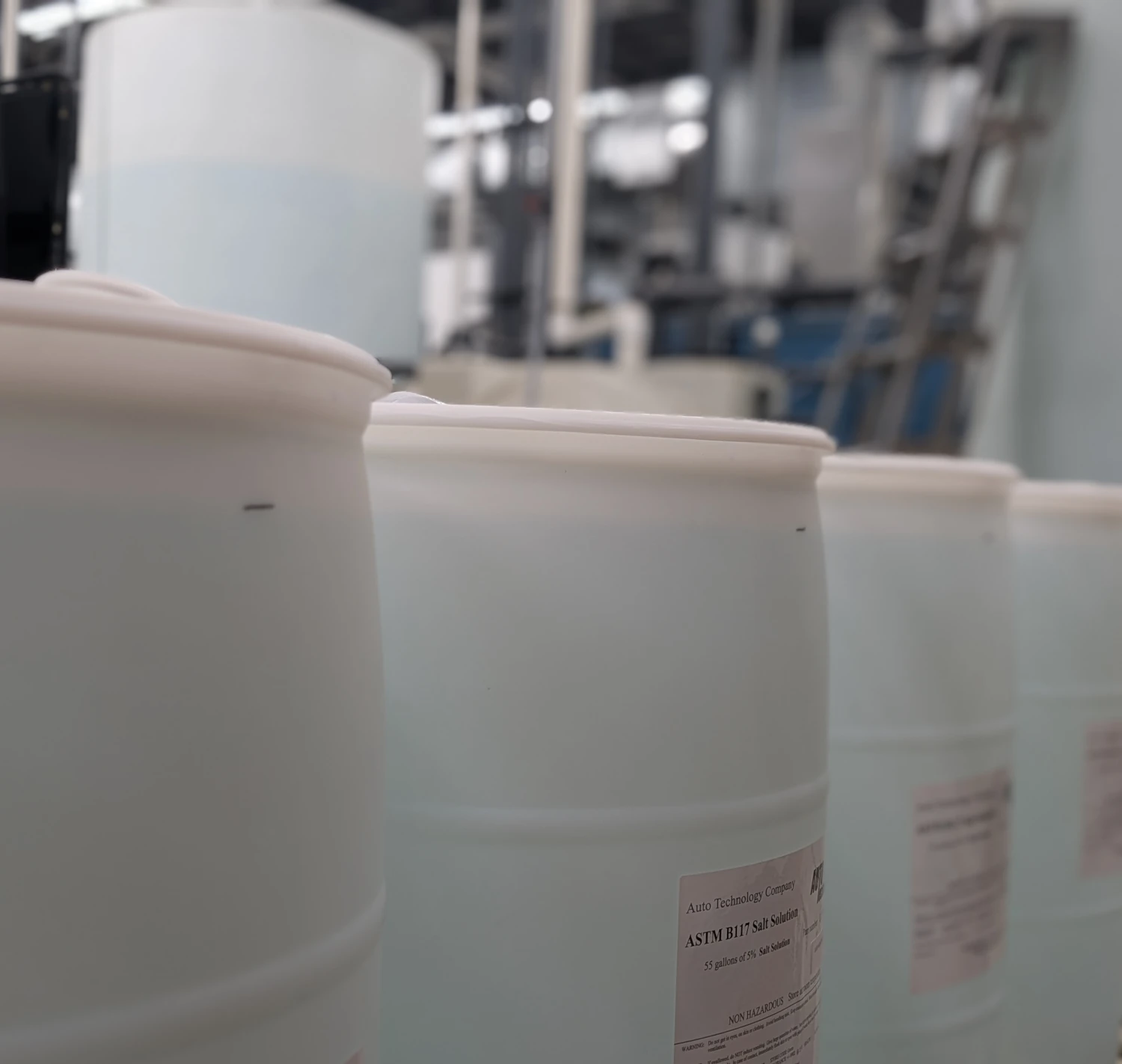
ASTM G85 A1 Test Solution
Premixed acetic acid-salt solution for continuous ASTM G85 Annex A1 testing. Supplied in a 55-gallon drum as part number C173330.
ASTM G85 A2 Test Solution
Premixed acidified sodium-chloride solution for ASTM G85 Annex A2 cyclic acidified salt-fog testing. Supplied in a 55-gallon drum as part number C173332.
ASTM G85 A3 SWAAT Test Solution
Premixed acidified synthetic sea solution for ASTM G85 Annex A3 SWAAT testing. Supplied in a 55-gallon drum as part number C173331.
ASTM G85 A5 / ASTM D5894 Test Solution
Premixed dilute-electrolyte solution for ASTM G85 Annex A5 and ASTM D5894 fog/dry programs. Supplied in a 55-gallon drum as part number C173334.
ASTM G85 A4 allows solution flexibility.
The governing product specification or an agreement between the purchaser and seller defines the salt
solution. A4 permits either a qualifying sodium-chloride solution or synthetic sea salt prepared under the
applicable G85 provisions. Controlled SO2 gas introduction is separate from the liquid solution.
ASTM G85 Specimens, Preparation and Evaluation
ASTM G85 requires the specimen type, quantity, and evaluation criteria to be defined by the governing product specification or by agreement. Metallic specimens must be cleaned using a method appropriate to the surface and contaminants without being recontaminated through handling. Coated specimens are prepared under the applicable material specification or agreed test plan. ATC can accept test-ready parts and panels or perform the preparation required for coating qualification, material comparison, process evaluation, or failure investigation.
Send Us Test-Ready Specimens
Send production parts or prepared panels with identification, the governing specification, G85 annex, duration or cycle count, orientation and support instructions, areas to be evaluated, and the required inspection and acceptance criteria. Include alloy, heat treatment, coating, plating, pretreatment, cure, and lot information when relevant.
Laboratory Preparation
ATC can prepare representative substrates, apply coatings, fabricate custom panels, document the prepared specimens, clean and mask defined areas, protect edges, and produce controlled scribes before exposure.

A controlled scribe is used only when the program evaluates corrosion developing from an intentional coating defect, with the scribing conditions defined by ASTM D1654 or another agreed procedure. Unless the governing requirement states otherwise, G85 also calls for protected cut edges, identification areas, and rack-contact areas; specimen surfaces positioned 6° to 45° from vertical; separation between specimens; unobstructed fog exposure; and loading that prevents solution from one specimen dripping onto another.
Available inspections and evaluations
- Visual observations and photographs at specified inspection points and after exposure.
- Time to first white corrosion, red corrosion, coating failure, or another defined condition.
- Rusting, blistering, underfilm corrosion, and other specified ratings.
- Scribe-creep, delamination, or corrosion measurements using the required preparation, cleaning, and rating method.
- Coating adhesion, mass change, and related coatings-performance measurements.
- Comparisons among alloys, heat treatments, coatings, suppliers, batches, pretreatments, or processes.
- Customer-defined observations and acceptance criteria.
ASTM G85 does not provide one universal passing result.
Your product, material, coating, OEM, military, procurement, or project specification must define the
evaluation method and acceptance criteria. If it does not, ATC will identify the decisions that must be
resolved and document the evaluation plan with you before testing begins.
ASTM G85 Test Records and Reporting
Your report reflects the program ATC confirms with you. It identifies your samples, the ASTM G85 annex and governing requirement, documents how the exposure was conducted, provides the applicable test data and photographs, and records the observations or evaluation results you requested. ATC identifies any test-specific limitation, interruption, or approved deviation in the report.
Typical report content
- Your organization, the ATC laboratory, project, and sample identification.
- Referenced ASTM G85 edition, annex, and governing product, material, OEM, or procurement specification.
- Sample quantity, description, preparation, orientation, and relevant identification.
- Test duration or cycle count, start and completion dates, and chamber or setup details.
- Solution makeup, pH, concentration or density, measurement temperature, and fog-collection data as applicable.
- Exposure-zone temperature, applicable humidity or soak conditions, and cycle details.
- SO2 flow and introduction details when applicable to A4.
- Setup, progress, or final photographs you request.
- Requested observations, inspection results, evaluation results, and sample disposition.
- Interruptions, limitations, or deviations that apply to the reported results.

Information needed for an ASTM G85 testing quote
- The required ASTM G85 annex and standard revision.
- Your complete governing product specification, drawing note, OEM requirement, procurement document, or procedure.
- Requested exposure duration, cycle count, and intermediate inspection schedule.
- Specimen type, material or alloy, heat treatment, finish or coating system, quantity, dimensions, and weight.
- Whether you will send test-ready specimens or want ATC to perform preparation, coating, masking, edge protection, or scribing.
- Required specimen orientation, racking, electrical or functional state, and special fixturing.
- Required evaluations, rating methods, acceptance criteria, photographs, and reporting format.
- Target start date, required completion date, and any witness, confidentiality, or shipping requirements.
Buying a Chamber for ASTM G85 A1-A5
Do not buy a chamber based only on the words “ASTM G85 capable.” The required annex determines the chemistry, airflow path, humidity behavior, gas equipment, heating response, and controls the chamber must provide. Auto Technology offers four platforms that cover different portions of the G85 family; options and final configuration must be established before purchase.
| Chamber Series | A1 | A2 | A3 | A4 | A5 | Best Fit |
|---|---|---|---|---|---|---|
| C Series | Yes | Yes | Yes | — | Yes | Fiberglass salt fog and straightforward G85 cycling in a modern integrated platform. |
| M Series | Yes | Yes* | Yes* | Yes* | — | Traditional water-jacketed stability, historical data continuity, and A4/SO2 capability. |
| A Series | Yes | Yes | Yes | — | Yes | Dedicated cyclic G85 work when broader advanced OEM climate control is not required. |
| X Series | Yes | Yes | Yes | Yes* | Yes | Advanced cyclic programs, wider future requirements, tighter environmental control, and optional cooling. |
Yes* indicates that an option or annex-specific configuration is required. Capability can also depend on chamber size, control package, gas-handling equipment, and the exact cycle required by the governing specification. Confirm the final configuration in the quotation.
Choose Around the Annex You Must Run
For A1, the simplest suitable salt-fog platform may be enough. A2 and A3 add meaningful purge, wet-bottom, soak, timing, and temperature considerations. A4 requires dedicated SO2 delivery and safety provisions. A5 requires responsive fog-to-dry transitions and should not be assigned to a conventional water-jacketed chamber.
Buy for the Work Beyond G85
The annex matrix is the first filter, not the entire purchase decision. Also define specimen dimensions and loading, required production throughput, utilities, ventilation, data logging, evaluation workflow, and the other salt-fog or cyclic standards the laboratory expects to run. An X Series is justified by broader cyclic requirements; it is not automatically necessary for a laboratory that only needs one simpler annex.
Water-Jacketed G85 Chambers
Water-jacketed chambers provide excellent temperature uniformity and stability for applicable continuous salt-fog and fixed-temperature G85 exposures. Appropriately equipped systems can support selected A1, A2, A3, and A4 programs, including required cycling, purge, humidity, or SO2 provisions. The exact annex and configuration must be confirmed before use.

Specialized A5 Fog/Dry Chambers
A5 requires one hour of fog at controlled ambient conditions followed by one hour of dry-off. The exposure zone must reach and remain at 35 ± 1.5°C within 45 minutes after the switch to dry-off, and all visible moisture must dry from the specimens. ATC uses a responsive non-water-jacketed chamber configured for fresh-air purge, unhumidified atomizing air, and the required thermal transition. A conventional water-jacketed salt-fog chamber should not be assumed capable of this profile.

A2 and A3 Cyclic Control
A2 requires timed fog, a direct dry-air purge, and a high-humidity soak. A3 requires repeated fog and high-humidity soak periods. The chamber must provide the correct airflow path, timing, wet-bottom condition, and exposure temperature for the selected material and program.
A4 SO2 Capability
A4 requires controlled SO2 introduction and compatible gas-handling components in addition to salt-fog capability. The chamber, flowmeter, solenoid valve, tubing, fittings, controls, ventilation, and safety provisions must be configured for the required gas exposure.
Learn more about Auto Technology's configurable ASTM G85 cyclic salt fog chamber or review the full range of industrial corrosion test chambers.
Why Choose Auto Technology for ASTM G85 Testing?
Auto Technology operates the laboratory and designs and manufactures corrosion test chambers. Our corrosion specialists work with the standard, chemistry, specimens, chamber configuration, environmental transitions, evaluation methods, and final reporting required for the project.
Corrosion Capacity and Experience
All five ASTM G85 annexes: one laboratory source for A1, A2, A3 SWAAT, A4 salt/SO2, and A5 Prohesion testing.
17,500+ sq. ft. and 80 test systems: capacity for corrosion, materials, analytical, and environmental programs.
Multiple chamber configurations: water-jacketed, cyclic, rapid-transition, SO2-equipped, and walk-in systems selected around the required program.
Standards and Project Support
ASTM involvement: ATC personnel have held leadership roles within ASTM Committee G01 and have participated directly in developing and maintaining corrosion standards.
Preparation through reporting: specimen and coating preparation, exposure, evaluation, photography, and final reporting can remain under one project.
Laboratory and manufacturer together: Strongsville laboratory, corrosion specialists, engineering, chamber manufacturing, service, and test-solution production are located together near Cleveland.
Explore Auto Technology's broader materials and corrosion testing capabilities, including salt spray, cyclic corrosion, humidity, condensation, immersion, gas corrosion, coatings testing, analytical testing, and failure investigation.
ASTM G85 Testing Services FAQ
What is the difference between ASTM G85 and ASTM B117?
ASTM B117 establishes a continuous neutral salt-fog environment. ASTM G85 contains five modified salt-spray annexes using acidified chemistry, cyclic purge and soak stages, synthetic seawater, SO2, or dilute-electrolyte fog/dry cycling. The correct practice and annex must come from the governing requirement or the approved test plan.
Can Auto Technology perform all five ASTM G85 annexes?
Yes. Auto Technology's laboratory can perform G85 A1 acetic acid-salt spray, A2 cyclic acidified salt fog, A3 acidified synthetic seawater or SWAAT, A4 salt/SO2 spray, and A5 dilute-electrolyte fog/dry testing. ATC selects a chamber specifically configured for the required annex.
What is ASTM G85 A5 Prohesion testing?
Annex A5 is a repeating dilute-electrolyte fog/dry exposure commonly called Prohesion. It uses 0.05% sodium chloride and 0.35% ammonium sulfate by mass, with one hour of fog at controlled ambient conditions followed by one hour of dry-off at 35 ± 1.5°C. The atomizing air is not humidified.
Why does G85 A5 require a special chamber?
A5 requires the chamber to alternate between ambient fog and dry-off, reach and remain at the required dry-off temperature within 45 minutes, remove visible moisture with fresh-air purge, and use unhumidified atomizing air. Auto Technology uses a responsive non-water-jacketed chamber configured for those requirements rather than assuming a conventional water-jacketed salt-fog chamber can make the transition.
What is SWAAT testing?
SWAAT is ASTM G85 Annex A3, the acidified synthetic sea water fog test. It uses synthetic sea salt and acetic acid and alternates 30 minutes of fog with 90 minutes of soak at or above 98% relative humidity. The exposure temperature is selected from the governing material or product requirement.
Does ASTM G85 define the test duration or a passing result?
No. ASTM G85 establishes the modified salt-spray conditions but does not prescribe one exposure duration, evaluation method, or acceptance limit for every product. Those requirements come from the governing product, coating, OEM, military, or procurement specification or from the test plan ATC confirms with you.
Does Auto Technology sell premixed ASTM G85 solutions?
Yes. Auto Technology supplies premixed 55-gallon solutions for G85 A1, A2, A3, and A5. A4 solution chemistry depends on the governing requirement and its SO2 gas is introduced separately.
Can Auto Technology prepare or coat G85 test panels?
Yes. Auto Technology can perform substrate preparation, blasting, custom panel fabrication, coating application, masking, edge protection, scribing, and related specimen preparation. You can also send ATC production parts or prepared panels that are ready to test.
Request an ASTM G85 Testing Quote
Tell us which ASTM G85 annex and revision apply, what you are testing, how long the exposure must run, and how the specimens must be evaluated. Auto Technology can quote testing for specimens you supply or a broader program that includes preparation, in-house test-solution chemistry, controlled exposure, specified post-test evaluation, photography, and reporting.
Need to Bring ASTM G85 Testing In-House?
Auto Technology designs and manufactures corrosion chambers for ASTM G85 variations, from stable water-jacketed salt-fog systems to non-water-jacketed cyclic chambers with purge, soak, dry-off, rapid temperature-transition, and optional SO2 capability. Tell us which annexes you need to run, your specimen size and loading, required utilities, and any related corrosion standards. We will help configure the correct chamber instead of assuming one standard package fits every G85 profile.
Explore the configurable ASTM G85 cyclic salt fog chamber or browse Auto Technology's full corrosion chamber range.