
GMW 14872 CYCLIC CORROSION TESTING SERVICES

Auto Technology Company performs GMW 14872 cyclic corrosion testing for automotive materials, coatings, components and assemblies. Our laboratory runs the agreed Method, vehicle-area classification, mounting condition, salt-application schedule, cosmetic or functional Exposure, coupon mass-loss target and approved deviation. GMW 14872 is not one fixed chamber program.
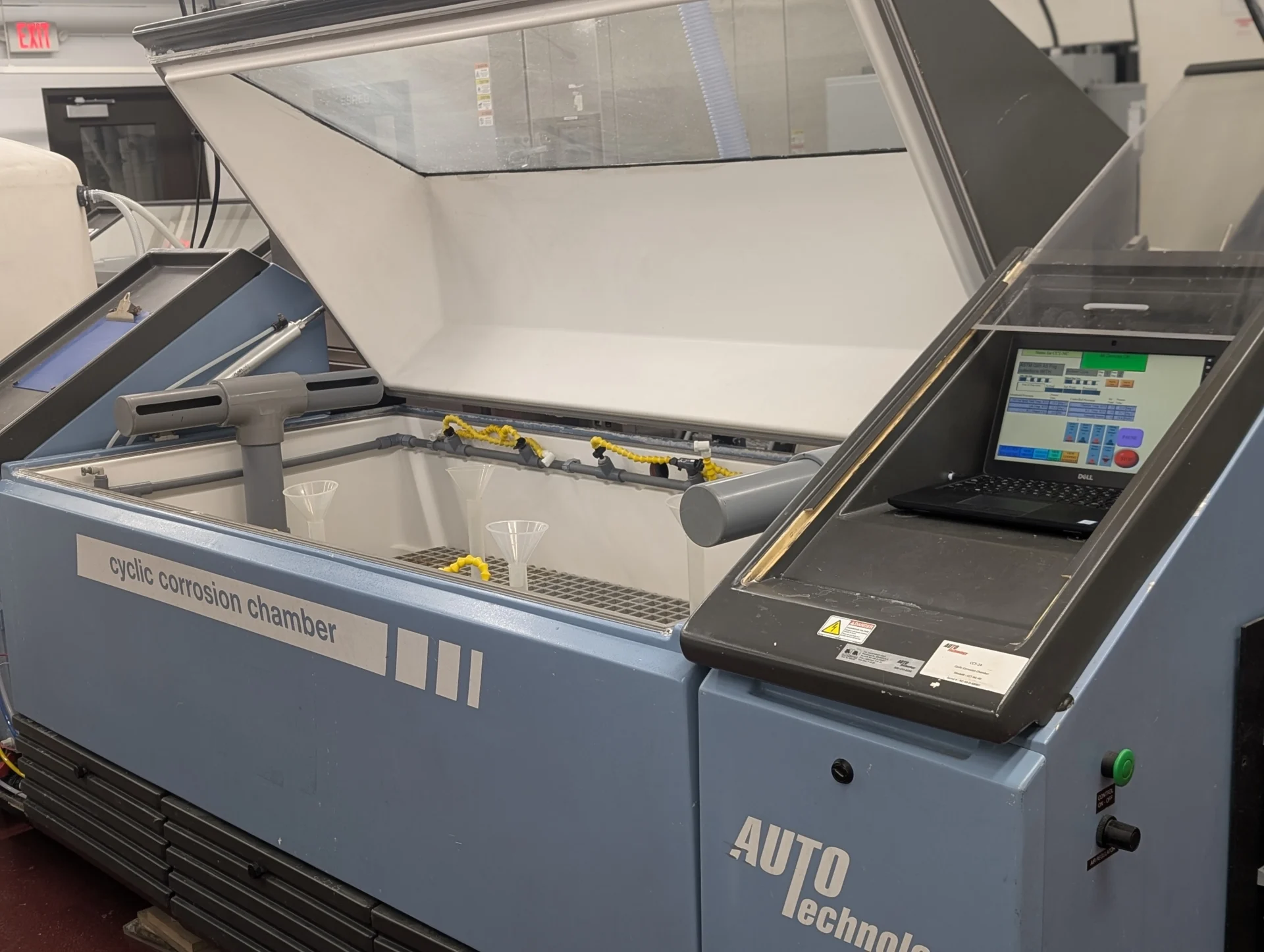
Test Program Definition
Method 1, 2 or 3; vehicle area; mounting location; spray frequency; Exposure 0, A, B, C, D or E; and any required deviation are established before testing begins.
GM Mass-Loss Coupon Control
GMW 14872 uses standardized bare-steel coupons to verify actual corrosion severity. The required mass-loss target must be reached within the specified cycle window.
Component-Specific Testing
Direct salt application, splash classification, part orientation, cosmetic inspections, functional evaluation and approved added stresses.
The exposure should be agreed before testing begins.
The Method, vehicle area, mounting location, Exposure and spray frequency are normally defined through the applicable GM engineering requirement and discussion with the responsible GM engineering team.
If those details are not fully resolved, Auto Technology can help review the application and help connect the supplier with the appropriate GM contacts before the test program is finalized.
GMW 14872 Testing for Automotive Components, Coatings and Assemblies
GMW 14872 is an accelerated cyclic corrosion procedure used for validation, development and quality-control testing of assemblies and components. It combines a dilute complex salt solution with controlled ambient exposure, high-temperature humidity and high-temperature dry-off. The method can be used to examine general, galvanic, crevice and other corrosion mechanisms, but the governing engineering documentation must define the test configuration and acceptance criteria.
The standard is fundamentally different from a fixed-duration neutral salt-fog test. The required exposure changes with the applicable global severity Method, vehicle area, part location, splash protection, cosmetic or functional objective and any added component-specific stress. Standard bare-steel coupons monitor the corrosion produced by the test. The applicable mass-loss target must be reached within the permitted cycle range.
Typical Test Articles
Painted, plated, conversion-coated and otherwise finished panels.
Fasteners, brackets, hinges, latches, key cylinders and hardware.
Underbody, underhood, exterior, secondary-surface and interior components.
Mixed-metal joints, assemblies, tubing, exhaust-adjacent parts and production-representative components.
Defining the Correct Exposure
The Method, vehicle area, mounting location, spray schedule and cosmetic or functional Exposure are normally established with the applicable GM engineering requirement and responsible GM engineers.
Sample preparation, scribing or gravel damage, inspection points, evaluation method and pass/fail criteria also need to be agreed before testing.
If a supplier has only a general GMW 14872 requirement or an incomplete drawing callout, ATC can help review what is missing and help make the appropriate GM connection before the program is finalized.
From GM9540P to GMW 14872
GMW 14872 grew out of a long automotive effort to replace simplistic continuous salt fog with controlled cyclic exposures that ranked coatings and materials more like actual vehicles. In the late 1980s, automakers, steel producers, pretreatment suppliers and corrosion laboratories began comparing cyclic procedures against proving-ground and on-vehicle exposures. Published SAE work from 1991 reported that the evaluated cyclic methods ranked coated automotive sheet more reliably than ASTM B117.
GM9540P was approved in 1991. Its daily sequence established the GM pattern of salt applications during an ambient period, followed by hot saturated humidity and hot dry-off. General Motors later moved its engineering procedures into worldwide standards. GMW 14872 was originated in 2005, approved by GM's Global Laboratory Corrosion Testing Harmonization Team in 2006, and first published in November 2006 as the worldwide replacement for GM9540P.
How the SAE J2334 work influenced GMW 14872
SAE J2334 and GM9540P came from the same broader period of automotive cyclic-corrosion development, but GM9540P was not copied from the final J2334 standard. GM9540P predates J2334's 1998 publication. The later J2334 program supplied something equally important: extensive field comparison, designed experiments, corrosion-product analysis and multi-laboratory evidence supporting dilute complex electrolytes, wet/dry cycling and tighter control of test severity.
A 1997 nine-laboratory round robin showed that J2334 could reproduce the material rankings observed in five-year vehicle exposures in Montreal and St. John's. A 2003 Auto/Steel Partnership study then compared J2334, GM9540P, Ford APGE and other accelerated procedures with up to seven years of on-vehicle perforation data. J2334, GM9540P and Ford APGE were the three laboratory methods found reasonably consistent with vehicle behavior. Auto Technology President Kevin A. Smith and GM corrosion engineer Larry S. Thompson were among the authors working in this technical community before GMW 14872 was created.
GMW 14872 retained the GM cycle architecture but incorporated the industry's improved test-control practices.
Compared with GM9540P, the new worldwide procedure reduced sodium bicarbonate from 0.25% to 0.075%, defined ASTM D1193 Type IV water, improved coupon construction and mounting,
added location-specific mass-loss targets, allowed multiple humidity-generation methods and expanded equipment, solution and cycle documentation.
Major revisions
| Date | Development | Significance |
|---|---|---|
| 1991 | GM9540P approved | Established GM's component-focused ambient/salt, humid and dry cyclic exposure with mass-loss monitoring. |
| 1998 | SAE J2334 issued | Formalized the field-correlated Auto/Steel Partnership and SAE cyclic test developed through vehicle exposure and round-robin work. |
| 2003 | J2334 refinement and perforation-correlation papers | Improved test precision and documented that J2334 and GM9540P both produced results reasonably consistent with on-vehicle behavior. |
| 2006 | GMW 14872 first published | Converted GM's legacy procedure into a worldwide, location-specific component-validation framework. |
| 2010 | Exposure 0 and numbered Methods introduced | Added the initial-delivery evaluation and replaced the original SH/SM/SL labels with Method 1/2 and Method 3. |
| 2013 | Exposure E added | Extended the functional exposure framework and revised the mass-loss tables and stage-duration requirements. |
| 2021 | Methods 1 and 2 separated | Split the former combined Method 1/2 into distinct functional-severity targets and added a separate table for Method 2. |
| 2022 | Galvanic Corrosion Focus added | Added Option 6 and its 3% salt/fireclay exposure for galvanic-corrosion-focused programs. |
Historical and correlation sources: SAE 892569, cooperative test-development program; SAE 912275, laboratory and vehicle comparisons; SAE 970734, J2334 round robin; SAE 2003-01-1238, perforation and on-vehicle correlation.
How to Read a GMW 14872 Test Callout
A complete GMW 14872 program identifies the part's corrosion environment and the required evaluation. In practice, the Method, vehicle area, mounting location and Exposure are normally established through the applicable GM engineering requirement and discussion with the responsible GM engineering team. Those choices determine the salt frequency, coupon target, cycle range and inspection level. When a supplier receives an incomplete or ambiguous callout, ATC can help identify the missing decisions and help connect the supplier with the appropriate GM contacts before testing begins.
One Standard, Different Vehicle Environments
GM was trying to solve two different exposure problems at the same time. First, vehicles sold in different global markets do not receive the same corrosion load. Road-salt use, climate, customer expectations, warranty targets and regional material practices all change the severity that a vehicle must withstand. That is why the original GMW system separated Severe-High, Severe-Moderate and Severe-Low marketing regions and why the present standard retains three Methods with different underbody and underhood targets.
Second, parts on the same vehicle do not experience the same local environment. An underbody bracket in direct road splash, a shielded underhood component, a hinge outside a weather strip and hardware inside the passenger compartment can see very different salt deposition, time of wetness, temperature and drying. Automotive field measurements support that distinction: an SAE vehicle micro-environment study placed sensors at more than 30 corrosion-prone locations and found that the environmental corrosion load varied considerably from site to site around the same vehicle. A separate SAE review documented large geographical differences in vehicle corrosion severity driven primarily by road and atmospheric salt exposure.
GMW 14872 turns those field differences into a manageable laboratory callout. The regional Method sets the broad severity level. Vehicle area and mounting location adjust the salt frequency and coupon target. Exposures A, B and C create location-specific cosmetic checkpoints, while D and E extend the test to functional durability. Approved deviations add dust, heat, condensate, mechanical operation or another stress when salt, humidity and drying alone would miss an important component failure mechanism.
The matrix is an engineering model of where and how the component is used.
It prevents a lightly exposed interior part from receiving the same salt dose as an unshielded underbody component, while also preventing a supplier from validating a severe-market application with a lower regional target.
The standard still requires coupon mass loss because chamber setpoints and elapsed days alone do not prove that the intended corrosion severity was produced.
Field-exposure basis: SAE 2000-01-1194, A Vehicle Micro Corrosion Environment Study; SAE 932351, Vehicle Corrosion Severity at Various Geographical Locations.
| Callout Element | Available Classifications | What It Controls |
|---|---|---|
| Method | Method 1, Method 2 or Method 3 | Regional corrosion-severity level and the applicable coupon mass-loss target and cycle range, particularly for underbody and underhood components. |
| Vehicle area | Underbody, underhood, exterior, secondary surface or interior | Which cosmetic Exposure applies and the basic level of salt contact represented by the test. |
| Mounting location | All/unclassified, splash protected, high, mid, low, inside weather strip or outside weather strip | Salt-application frequency and the mass-loss target associated with the component's actual shielding and position. |
| Exposure | 0, A, B, C, D or E | Initial-delivery, cosmetic or functional evaluation level. |
| Deviation | Dust, rinse, key-cylinder, thermal, condensate, galvanic or another approved added stress | Additional field input applied to the test parts when the base cycle does not reproduce the component's important failure mechanism. |
| Acceptance criteria | Defined by the VTS, SSTS, CTS, material specification, drawing, SOR or approved test plan | Required cosmetic rating, corrosion limit, function, leak performance, sectioning result or other pass/fail determination. |
Method 1, 2 and 3 Severity Levels
The original 2006 standard used the regional labels Severe-High, Severe-Moderate and Severe-Low. The higher levels covered markets with greater road-salt and environmental severity; the lower level covered regions with less severe underbody and underhood exposure. Those categories later became Methods 1, 2 and 3. The 2022 tables retain that logic: Method 1 has the highest underbody and underhood functional targets, Method 2 is intermediate, and Method 3 is lower.
The Method does not change every row equally. Exterior, secondary-surface and interior mass-loss targets are common across Methods 1, 2 and 3 in the 2022 tables. The principal Method differences occur in the underbody and underhood targets, where regional road exposure has the greatest effect.
Exposure 0 and Exposures A-E
| Exposure | Application | Purpose |
|---|---|---|
| 0 | All vehicle areas | Initial-delivery or zero-year evaluation at two cycles of the exposure associated with the applicable vehicle area and mounting location. |
| A | Underbody | Cosmetic evaluation for parts subjected to substantial direct road contamination and splash. |
| B | Underhood | Cosmetic evaluation adjusted for mounting height and whether effective splash protection keeps the component comparatively dry. |
| C | Exterior, secondary surface and interior | Cosmetic evaluation adjusted for direct exterior exposure, weather-strip protection and interior mounting height. |
| D | All component types | Functional assessment associated with the lower long-term service-life target. |
| E | All component types | Extended functional assessment associated with the higher long-term service-life target. |
GM Mass-Loss Coupons Control Test Severity
One of the most distinctive parts of GMW 14872 is its use of standardized bare-steel mass-loss coupons as an active test-control system. The test is not complete simply because a planned number of days or cycles has elapsed. The applicable tables define both a target coupon mass loss and a permitted cycle range, and the test must satisfy both. This gives GM a direct check on the amount of corrosion actually produced rather than relying only on chamber temperature, humidity and elapsed time.
Standardized Coupon Setup
Coupons are bare SAE 1008-1010 / CR1E cold-rolled steel, nominally 25.4 mm × 50.8 mm × 3.18 mm, with individual identification.
They are mounted vertically on the prescribed aluminum or nonmetallic rack with non-black plastic hardware, spaced from the rack and positioned near the test specimens.
The rack must receive the same base chamber exposure as the production parts without being subjected to added component-specific stresses unless a separate monitoring set is required.
Periodic Mass-Loss Checks
Coupons are weighed before exposure and removed at planned intervals during the test.
For a monitoring check, coupons are taken from opposite ends of the rack, cleaned of corrosion products and reweighed so average mass loss can be compared with the required target.
Mass-loss results are recorded throughout the program. If the required corrosion level is reached too early, too late or outside the specified range, the cause must be investigated; an out-of-range exposure can require the test to be repeated.
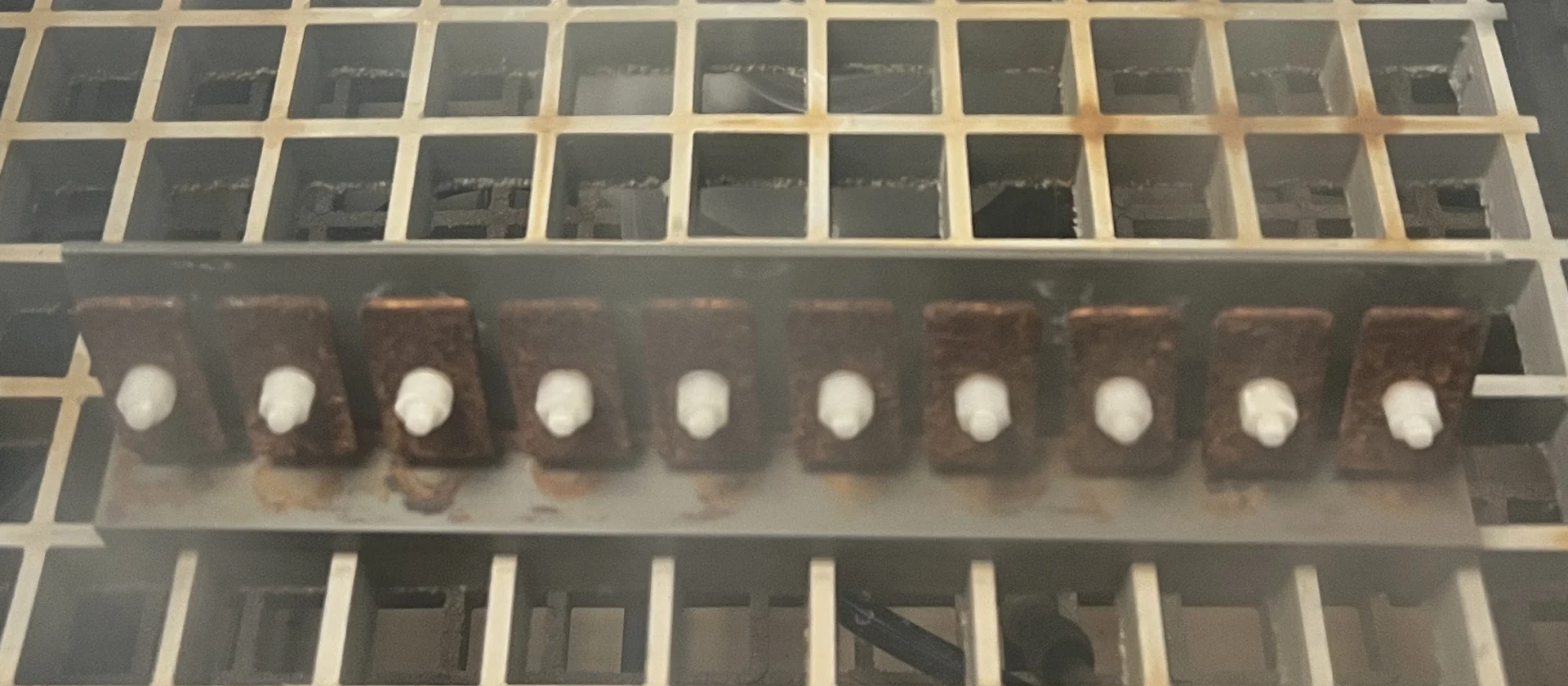
Coupon results are part of the evidence that the GMW 14872 exposure was valid.
Final reporting should include the target and actual cycle counts, coupon identification and removal points, and the target and actual mass-loss results. This coupon-based control is a major difference between GMW 14872 and simpler fixed-duration corrosion exposures.
Spray frequency follows the component environment
| Typical Location | Base Salt Schedule | Exposure Logic |
|---|---|---|
| Underbody; exterior; underhood with splash protection not defined | 4 applications per cycle | Represents substantial direct contamination or an unprotected location. |
| Splash-protected underhood; secondary surface outside the weather strip | 1 application per cycle | Represents regular but reduced direct exposure. |
| Secondary surface inside the weather strip; interior components | 1 application every 5 cycles | Represents a location shielded from routine direct salt splash. |
How different two valid GMW 14872 programs can be
The examples below use the 2022 tables and show why the complete callout matters. They are representative examples, not a substitute for the standard.
| Component Environment | Method | Salt Schedule | Cosmetic Target | Exposure E Target |
|---|---|---|---|---|
| Underbody, all locations | Method 1 | 4 per cycle | Exposure A: 6 ± 1 cycles | 95 ± 10 cycles |
| Underbody, all locations | Method 3 | 4 per cycle | Exposure A: 3 ± 1 cycles | 47 ± 5 cycles |
| Underhood, splash protection not defined | Method 1 | 4 per cycle | Exposure B: 9 ± 1 cycles | 71 ± 8 cycles |
| Underhood, mid-mounted and splash protected | Method 2 | 1 per cycle | Exposure B: 8 ± 1 cycles | 49 ± 5 cycles |
| Secondary surface, inside weather strip | Any Method | 1 per 5 cycles | Exposure C: 7 ± 1 cycles | 18 ± 2 cycles |
| Interior, low-mounted | Any Method | 1 per 5 cycles | Exposure C: 22 ± 3 cycles | 59 ± 6 cycles |
Do not convert this summary into a test callout.
The complete GMW 14872 table and the governing engineering documentation control the exact coupon target, cycle range and spray schedule.
A part's material or generic name does not establish the correct Method by itself.
The GMW 14872 Base 24-Hour Cycle
The base environmental sequence is one 24-hour cycle divided into three approximately eight-hour stages. Salt and any other specified stresses are applied during the ambient stage. The humid and dry stages then control specimen wetness, oxygen access, electrolyte concentration and drying. Ramp time matters because the standard identifies the transition periods as especially important to corrosion acceleration.
| Stage | Conditions | Execution |
|---|---|---|
| Ambient with stress Approximately 8 hours |
25 ± 3°C and 45 ± 10% RH | The first direct salt application occurs at the start. Additional applications, when required, are normally spaced about 1.5 hours apart so the parts can dry between sprays. |
| Humid Approximately 8 hours |
Ramp within approximately 1 hour to 49 ± 2°C and approximately 100% RH; maintain for approximately 7 hours | Humidity may be produced by water fog, wet-bottom or steam generation. The selected method must produce the required specimen wetness. |
| Dry-off Approximately 8 hours |
Ramp within approximately 3 hours to 60 ± 2°C and no more than 30% RH; maintain for approximately 5 hours | Air circulation must prevent temperature stratification and thoroughly dry the specimens. |
Direct application of the complex salt solution
GMW 14872 does not call for continuous neutral salt fog during the ambient stage. The solution is applied directly until the required specimen areas and corrosion coupons are thoroughly wet and dripping. Each application must visibly rinse away salt accumulation left from earlier sprays without removing corrosion products or damaging the coating system.
Base Solution
0.9% sodium chloride, NaCl
0.1% calcium chloride, CaCl2
0.075% sodium bicarbonate, NaHCO3
Prepared with water meeting ASTM D1193 Type IV requirements.
Application Controls
Nozzle placement and specimen orientation must wet the required production-representative surfaces.
The spray cannot be forceful enough to strip corrosion products or damage paint and coatings.
Representative production parts should be mounted in their in-service orientation whenever it is known.
Panels or parts with unknown orientation are generally mounted upward-facing at 20 ± 5 degrees from vertical.
Traditional laboratory ambient and automated cover lifters
The original manual workflow used a qualifying conditioned laboratory or a separate environmental chamber for the ambient stage. In the open-laboratory approach, sprayed specimens remained on racks in the room and changed temperature and surface wetness slowly under low-air-movement laboratory conditions before being moved to the humid stage.
Auto Technology's air-operated cover lifters automate that original room-ambient approach.
At the ambient stage, the cover opens and exposes the specimens directly to qualifying laboratory air. The chamber closes automatically for the humid and dry stages.
This eliminates manual transfers while preserving the programmed sequence. Open-cover operation is valid only when the room can maintain 25 ± 3°C and 45 ± 10% RH around the test load.
The current standard defines the ambient conditions but does not require an open cover or prescribe a natural-air velocity. A closed chamber with controlled temperature and RH is also a valid route when it produces and documents the required conditions. The cover lifter is valuable because it reproduces the traditional laboratory-ambient method automatically, not because it is the only compliant design.
Background reading: Introduction to Cyclic Corrosion Testing; Auto Technology A Series GMW 14872 chamber with automated cover lifters.
How Auto Technology Runs a GMW 14872 Test Program
1. We define the test program
ATC reviews the GMW 14872 revision, Method, vehicle area, mounting location, splash classification, salt frequency, required cosmetic and/or functional Exposure, deviation, specimen preparation, inspection schedule, evaluation method and acceptance criteria. These exposure details are normally defined with the responsible GM engineering team. If the requirement is incomplete or ambiguous, ATC can help identify the open items and help connect the supplier with the appropriate GM contacts before the program is released to the laboratory.
2. We confirm the specimen and fixture plan
The laboratory reviews part dimensions, mass, material, coating, production orientation, drainage, areas that must receive solution, electrical or mechanical operation, adjacent materials and requested damage such as a scribe or gravel impact. Nonmetallic or suitably isolated fixtures are selected to support the test load without creating unintended galvanic contact or shielding.
3. We prepare the solution and GM coupon controls
ATC prepares the complex salt solution with qualifying water and records the solution constituents, pH and conductivity or salinity information required for the project. The standardized bare-steel coupons are degreased, weighed and identified before exposure, then mounted vertically on the prescribed rack with nonmetallic hardware and positioned in the general vicinity of the test articles. The quantity of coupons and planned removal points are selected to support periodic mass-loss checks through the expected test duration.
4. We load the chamber around the production exposure
Production parts are placed in their known in-service orientation whenever possible. Nozzles are directed to wet the required surfaces without damaging coatings. Specimens cannot shield one another, drip onto lower samples or create unintended solution pockets. The coupon rack is placed in the general vicinity of the test load so it receives the same base environmental exposure.
5. We start the specified chamber program
After loading is verified, ATC starts the programmed ambient, solution-application, humid and dry stages. Direct sprays are scheduled at the specified frequency. Temperature, RH, stage timing, transition performance, spray execution, weekend operation and interruptions are monitored and recorded. If an open-cover ambient stage is used, qualifying room conditions are also documented.
6. We verify the exposure with coupon mass loss
Coupons are removed at predetermined intervals, normally from opposite ends of the rack, cleaned to remove corrosion products and weighed. The average mass loss is compared with the applicable target and the allowed cycle window. These checks are recorded throughout the test so ATC can see whether the exposure is tracking toward the GM target. If corrosion is developing too quickly or too slowly, the chamber conditions, transitions, spray application and other test controls are investigated before the final acceptance window is missed. Reaching a calendar date alone does not establish a valid GMW 14872 exposure.
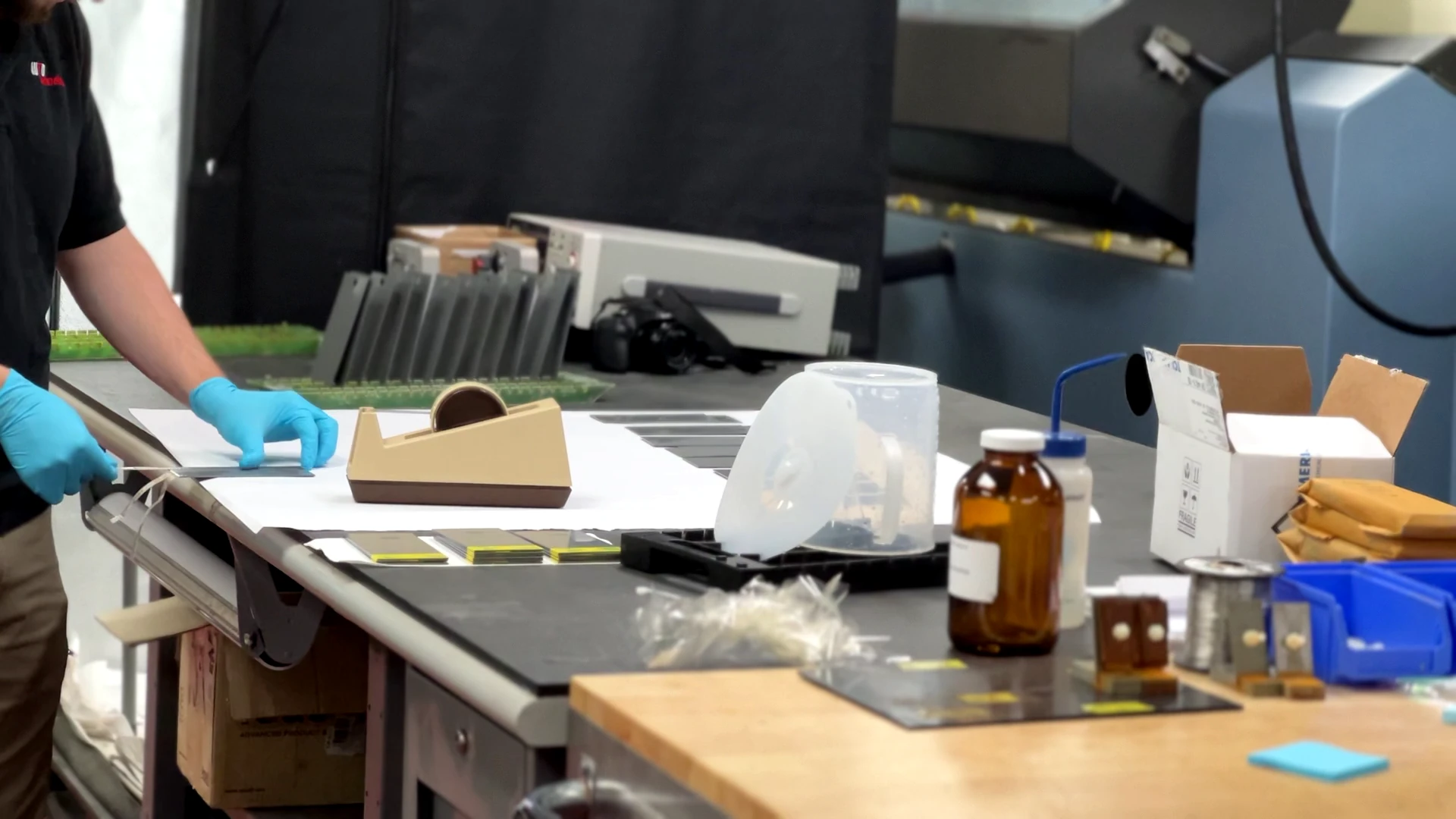
7. We complete the required inspections and functional evaluation
Cosmetic inspections may include photography, percent rusting, corrosion creepback, blistering, coating damage or another specified rating. Functional programs may require rinsing, operation, leak testing, sectioning, microscopic examination, removal of corrosion product or measurement of base-metal attack. The evaluation is performed against the criteria named in the governing requirement.
Component-Specific Deviations, Evaluation and Reporting
GMW 14872 permits approved deviations when the base salt, humidity and dry-off sequence does not reproduce an important field input. These stresses are generally added during the ambient stage and applied to the test parts. The standard mass-loss coupons normally remain on the base exposure so they continue to monitor chamber severity. If the modified exposure also needs independent corrosion-rate monitoring, a second coupon set is required.
| Deviation | Typical Application | Added Test Input |
|---|---|---|
| Option 1 | Door and hood latches, hinges, fuel-door hardware, door detents, cavity hardware and wiper systems | Scheduled dust application, with freshwater rinsing where specified for the component. |
| Option 3 | Key cylinders | High-volume hose salt application, dust and freshwater rinse. |
| Option 4 | Oil-cooler lines, mufflers, tailpipes, exhaust manifolds and flex couplings | Component-specific oven soak coordinated with the required salt schedule. High-temperature exposure is performed in suitable separate equipment when required. |
| Option 5 | Rear bumpers and exhaust tips | Exhaust-condensate application following the scheduled salt applications. |
| Option 6 | Galvanic-corrosion-focused assemblies | Four applications of a 3% salt and fireclay mixture and a modified 66°C ambient-stage exposure. |
| Custom approved deviation | Components with a documented field mechanism not addressed by the listed options | Agreed mechanical, electrical, thermal, contaminant, grit, poultice, rinse or other input with an associated mass-loss requirement. |
Option 6: Galvanic Corrosion Focus and Fireclay Slurry
The 2022 revision of GMW 14872 added a dedicated Option 6: Galvanic Corrosion Focus. This is not the standard 1% complex-salt application used by the base cycle. Option 6 modifies an underbody, all-location, four-spray program with four applications per cycle of a 3% sodium chloride and fireclay solution and a hotter ambient stage at approximately 66°C. The galvanic-focus solution is applied to both the test parts and the corrosion coupons.
Galvanic-Focus Slurry
Salt concentration: 3% sodium chloride by weight.
Solid contaminant: 20-mesh dry-milled fireclay at 0.317 kg per 1 kg of salt.
Water: reverse-osmosis water meeting ASTM D1193 Type IV requirements.
The salt and fireclay are combined as the specified galvanic-focus test solution rather than using the normal GMW 14872 complex salt mixture.
Separate Severity Targets
Option 6 has its own coupon mass-loss targets and cycle windows for Method 1 and Method 2 functional Exposures D and E.
Because the modified solution is applied to the coupons as well as the test parts, the coupon controls directly monitor the severity of the galvanic-focus exposure.
The standard directs users to GMNA Corrosion Engineering when determining whether an available deviation is appropriate or when developing additional modifications.
Option 6 requires different solution handling and chamber capability than the base GMW 14872 cycle.
A laboratory or chamber configured only for the standard complex-salt spray should not be assumed to be ready for the fireclay-containing galvanic-focus mixture. Solution preparation, agitation, delivery hardware, spray coverage, cleanup and the applicable coupon targets should be reviewed before the program is quoted or started.
Deviation capability must be reviewed before quoting.
Send the exact option or approved custom instruction, part drawings, temperatures, transfer limits, operating requirements, application equipment and safety information.
A chamber that performs the base GMW 14872 cycle may not include every pump, oven, fixture or contaminant-handling system needed for a specialized deviation.
Typical GMW 14872 report content
- Customer, project, part, material, coating, lot and specimen identification.
- GMW 14872 revision and the governing drawing, material specification, VTS, SSTS, CTS, SOR or approved test plan.
- Method, vehicle area, mounting location, splash classification, salt frequency and required Exposures.
- Specimen quantity, preparation, damage, production orientation, fixture, chamber position and evaluated surfaces.
- Complex salt-solution preparation, water type, constituents, pH, salinity or conductivity and solution-use information.
- Chamber identification, humidity-generation method, temperature and RH profiles, collection rate when applicable, air circulation and transition times.
- Target and actual cycles, coupon identifications, removal points, individual and average mass loss, and comparison with the specified ranges.
- Test options, deviations, additional stresses, transfers, interruptions, downtime and corrective measures.
- Inspection photographs, cosmetic ratings, dimensional measurements, functional checks and final acceptance results defined in the project scope.
GMW 14872 Beyond General Motors
GMW 14872 originated as a General Motors component-validation method, but its use is not limited to GM automotive programs. Its controlled wet/dry cycling and coupon-based severity control have also been used in U.S. military coating specifications, Army ground-vehicle research, Navy aerospace research and NASA materials evaluations.
U.S. Army and CARC Coating Requirements
GMW 14872 has been incorporated into U.S. Army corrosion-control work and military coating requirements. Army Regulation 750-59 references GMW 14872, and MIL-DTL-53022F uses the method for cyclic-corrosion qualification of epoxy primers used in Chemical Agent Resistant Coating (CARC) systems.
The Army made a documented transition from GM9540P to GMW 14872.
MIL-DTL-53022F explains that Army Research Laboratory compared the standardized coupon mass-loss ranges from the two procedures. Based on the similar severity ranges, ARL established a GMW 14872 cycle requirement to replace the older GM9540P requirement and stated that the change would be carried into CARC pretreatment, primer and application specifications as they were revised.
Military sources: DLA ASSIST listing for MIL-DTL-53022; MIL-DTL-53022F, epoxy primer specification and GMW 14872 cyclic-corrosion requirement; DoD vehicle micro-environment research using GMW 14872 and military fleet corrosion data.
Navy and Defense Research
Defense use extends beyond Army ground systems. DoD research hosted by the Defense Acquisition University documents GMW 14872 use on aerospace materials, aircraft wiring systems and corrosion-control technologies. In one NAVAIR/NAWCAD study, repaired aerospace aluminum was exposed to GMW 14872 and also evaluated through natural seawater spray and long-term atmospheric exposure at the Naval Research Laboratory Key West test facility.
Another DoD aircraft wiring study reported that extended GMW 14872 exposure produced corrosion mechanisms that closely resembled those observed in fleet electrical wiring interconnect systems. Based on those results, the researchers selected GMW 14872 for subsequent internal wiring-corrosion investigations. These studies do not make GMW 14872 a universal military requirement, but they show that the method is used beyond automotive validation when its wet/dry cycling is useful for reproducing service-relevant corrosion behavior.
Defense research: NAVAIR/NAWCAD GMW 14872 and Key West atmospheric-exposure research; DoD aircraft wiring corrosion research using GMW 14872.
GMW 14872 and Field Correlation
GMW 14872 does not establish a universal conversion between laboratory cycles and years in service. Accelerated corrosion tests compress and control selected environmental stresses, while actual service environments vary with location, design, materials, contaminants, climate and time of wetness. Field correlation is most meaningful when a laboratory method reproduces relevant corrosion mechanisms, material rankings or known service behavior for a defined application.
NASA selected GMW 14872 for cyclic corrosion resistance in a Kennedy Space Center evaluation of alternatives to nitric-acid passivation. The published test protocol states that project stakeholders considered the method to provide acceptable correlation between accelerated laboratory corrosion testing and corrosion experienced in the field. The program used an 80-cycle exposure with periodic photographs; it did not define a universal conversion from cycles to years in service.
Mass-Loss Coupons Provide a Severity Check
GMW 14872 does not rely only on chamber setpoints and elapsed time. Standardized bare-steel coupons provide a measurable corrosion-severity control, and the specified mass-loss target must be reached within the required cycle window. The coupon result is not itself proof of field correlation, but it verifies that the laboratory exposure produced the specified level of bare-steel corrosion before component performance is evaluated.
Correlation source: NASA TEERM, cyclic corrosion evaluation using GMW 14872. The earlier SAE J2334 and GM9540P vehicle-correlation papers cited above provide important historical support for the automotive cyclic-test approach, but they should not be presented as direct field-correlation studies of GMW 14872 itself.
Primary Standard and Technical Sources
Testing must be performed from the complete purchased GMW 14872 standard and the engineering document that calls it out. The public technical papers below document the industry problem the test family was built to solve, the field and round-robin work behind SAE J2334, the comparison of J2334 and GM9540P with vehicle exposure, and documented military and NASA use of GMW 14872.
Standards and Official Listings
GMW 14872: Cyclic Corrosion Laboratory Test
Current standard listing, scope summary and revision history.
SAE J2334: Laboratory Cyclic Corrosion Test
Field-correlated SAE procedure developed through the Auto/Steel Partnership and SAE corrosion committee.
GMW 14872 mass-loss coupons
Standardized bare-steel monitoring panels supplied by Auto Technology.
GMW 14872 coupon rack
Rack for consistent coupon positioning and nonmetallic mounting.
MIL-DTL-53022F
U.S. military epoxy-primer specification incorporating GMW 14872 cyclic corrosion and documenting the Army Research Laboratory transition from GM9540P.
Development and Correlation Papers
SAE 892569: Cooperative accelerated-test development
Describes the original automotive and steel-industry program and its planned field comparisons.
SAE 912275: Progress toward an improved cosmetic corrosion test
Compares cyclic laboratory methods with Canadian vehicle exposures and documents the limitations of continuous salt spray.
SAE 970734: J2334 round-robin evaluation
Nine-laboratory study of repeatability and reproducibility using painted automotive steel products.
SAE 2003-01-1234: J2334 precision improvements
Reports the later work used to refine the published J2334 procedure.
SAE 2003-01-1238: Perforation corrosion and vehicle correlation
Compares J2334, GM9540P and other accelerated tests with long-term on-vehicle behavior.
SAE 2000-01-1194: Vehicle micro-environment study
Documents substantial differences in temperature, RH and time of wetness among more than 30 corrosion-prone locations on instrumented vehicles.
SAE 932351: Geographical vehicle-corrosion severity
Reviews the regional effect of road and atmospheric salt and the need for rational geographical severity classifications.
NASA TEERM: GMW 14872 cyclic corrosion evaluation
Documents NASA stakeholder selection of GMW 14872 based on acceptable correlation between accelerated laboratory corrosion testing and field corrosion for the evaluated program.
DoD vehicle micro-environment corrosivity research
Uses GMW 14872 coupon severity together with military fleet corrosion data to develop location-specific ground-vehicle corrosivity projections.
NAVAIR/NAWCAD aerospace corrosion research
Uses GMW 14872 alongside natural seawater spray and long-term atmospheric exposure at the Naval Research Laboratory Key West test facility.
DoD aircraft wiring corrosion research
Reports service-relevant corrosion mechanisms under GMW 14872 and subsequent selection of the method for internal aircraft wiring corrosion investigations.
Laboratory Testing and GMW 14872 Chamber Experience
Auto Technology operates the corrosion laboratory and manufactures the equipment used to automate GMW 14872 exposures. That combination is useful when a project raises questions about direct spray coverage, room-ambient exposure, humidity generation, dry-off, transition time, coupon behavior, fixtures or the equipment needed to reproduce the program in-house.
Laboratory Services
Callout interpretation: Method, vehicle area, mounting location, spray frequency, Exposure and deviation are resolved before testing.
Complete execution: specimen planning, solution preparation, coupon control, programmed exposure, inspections, evaluation and reporting.
Related work: coating evaluation, analytical examination, failure investigation, salt spray, humidity and other cyclic corrosion programs can be added when required.
Chamber Engineering
Automated cover lifters: reproduce the traditional qualifying laboratory-ambient stage without manually moving the test load.
Direct-solution spray: configurable nozzle placement and programmed application frequency for the specified component exposure.
A Series and X Series options: touchscreen systems for defined GMW programs or PC-controlled platforms for broader configurations and combined stresses.
Explore Auto Technology's materials and corrosion testing laboratory, A Series GMW 14872 test chamber, or X Series cyclic corrosion chambers.
GMW 14872 Testing FAQ
Is GMW 14872 one standard test cycle?
No. The base 24-hour environmental sequence is consistent, but the Method, vehicle area, mounting location, salt frequency, coupon target, cycle range, cosmetic or functional Exposure and approved deviation change with the engineering callout.
What is the difference between Method 1, Method 2 and Method 3?
The Methods represent different regional corrosion-severity levels. In the 2022 tables, Method 1 has the highest underbody and underhood functional targets, Method 2 is intermediate and Method 3 is lower. The applicable Method must come from the drawing, material specification or engineering requirement.
What do Exposures A, B and C mean?
They are the cosmetic exposure categories for different vehicle areas. Exposure A applies to underbody components, Exposure B to underhood components and Exposure C to exterior components, secondary surfaces and interior components. Mounting location and splash protection further change the spray schedule and coupon target.
What do Exposures D and E mean?
Exposures D and E are used for functional assessment. Exposure E represents the extended functional target. Passing requires the component evaluation defined by the governing engineering document; completion of the chamber exposure alone does not establish that every possible failure mode has been validated.
How long does a GMW 14872 test run?
Duration depends on the selected Method, vehicle area, mounting location and Exposure. The applicable coupon mass-loss target must be reached within the specified cycle range. Depending on the callout, the planned exposure may range from a two-cycle initial-delivery inspection to a long functional program extending for many weeks.
Is GMW 14872 a salt fog test?
Not in the same sense as continuous ASTM B117 or ISO 9227 salt fog. GMW 14872 uses scheduled direct applications of a dilute complex salt solution during the ambient stage. The specimens must be thoroughly wet and dripping, but they then proceed through separate humid and dry stages.
Does GMW 14872 require an open chamber cover during the ambient stage?
The current standard requires the specified ambient temperature, RH and duration but does not prescribe an open cover. Auto Technology's cover lifters automate the traditional room-ambient method by opening the chamber when the laboratory can maintain the required conditions. A closed, controlled ambient stage is another valid approach.
How do mass-loss coupons control a GMW 14872 test?
GMW 14872 uses standardized bare-steel coupons as test-control devices. They are weighed before exposure and at planned removal points, and their mass loss is compared with the GM target and permitted cycle range. The test must produce the required corrosion severity within that window; an out-of-range result is investigated and can require the exposure to be repeated. The coupons verify test severity but do not replace evaluation of the customer component.
Does GMW 14872 include a galvanic corrosion or fireclay slurry option?
Yes. The 2022 revision includes Option 6, Galvanic Corrosion Focus. It modifies an underbody four-spray exposure with a 3% sodium chloride and fireclay solution, an approximately 66°C ambient stage, and separate Method 1 and Method 2 coupon mass-loss targets for functional Exposures D and E. The galvanic-focus mixture is applied to both the test parts and the coupons.
What should I send for a GMW 14872 quote?
Send the standard revision, complete drawing or engineering callout, Method, vehicle area, mounting location, splash classification, required Exposures, salt frequency, deviation, specimen quantity and dimensions, production orientation, preparation, inspections, acceptance criteria, functional checks, reporting requirements and requested schedule.
Request a GMW 14872 Testing Quote
Send Auto Technology the GMW 14872 requirement you have, along with the governing drawing or engineering documentation, specimen information, preparation, orientation, known Exposures, deviations, evaluation criteria and schedule. If the Method, vehicle area, mounting location or Exposure still needs to be resolved with GM, ATC can help identify the open items and help make the appropriate engineering connection before testing begins.
Need to Bring GMW 14872 Testing In-House?
Auto Technology designs and manufactures A Series and X Series chambers configured around the exact GMW 14872 requirement. Available systems combine direct solution spray, programmed ambient exposure, automated air cover lifters, high-temperature humidity, controlled dry-off, corrosion-coupon monitoring and data recording. Final configuration is based on the standard revision, Method, part load, spray schedule, deviations, utilities and facility ambient conditions.
For larger loads or more advanced combined-stress programs, review the X Series cyclic corrosion chambers or ask ATC to configure a system around your callout.