
CORROSION CHAMBER TRAINING COURSES
Auto Technology provides instructor-led training in ASTM B117, corrosion chamber operation, laboratory practices, and other corrosion testing specifications for technicians, engineers, quality professionals, laboratory managers, maintenance personnel, and chamber operators.
Training can focus on understanding and applying a corrosion standard, operating and maintaining a chamber, improving laboratory procedures, troubleshooting test conditions, or combining these topics into one customized course.
Our instructors include professionals with years of leadership experience within ASTM Committee G01 on Corrosion of Metals and its subcommittees, along with direct participation in the development, revision, interpretation, and maintenance of corrosion testing standards. Therefore, students learn not only what a standard says, but why its requirements exist, how those requirements have evolved, and how laboratories should apply them.
Auto Technology offers complimentary ASTM B117 training with qualifying new chamber purchases, private remote instruction, and hands-on private training at our Strongsville, Ohio laboratory and manufacturing facility.
Understanding ASTM B117 Salt Spray Testing
Private courses can be customized around your chamber, products, personnel, laboratory procedures, maintenance needs, and applicable corrosion specifications.
ASTM B117, Chamber Operation and Custom Corrosion Training
Auto Technology offers training in three closely connected areas: understanding corrosion testing standards, operating and maintaining corrosion chambers, and applying sound laboratory practices. Courses may focus on one area or combine all three.
ASTM B117 serves as the example curriculum on this page because it provides many of the foundational chamber, atomization, solution, air-supply, specimen-positioning, documentation, and laboratory concepts used throughout accelerated corrosion testing.
However, private courses are not limited to ASTM B117. We can develop training around ASTM G85, ASTM B368, ISO 9227, SAE J2334, GMW 14872, automotive corrosion specifications, customer procedures, cyclic corrosion methods, chamber controls, preventive maintenance, troubleshooting, test documentation, or other requested topics.
Standards and Test Methods
- ASTM B117
- ASTM G85
- ASTM B368
- ISO 9227
- SAE J2334
- GMW 14872
- Automotive and customer specifications
- Laboratory-developed procedures
Chamber Operation and Maintenance
- Chamber controls and operating sequences
- Installation and utility requirements
- Air saturation and atomization systems
- Fog generation and distribution
- Collection-rate verification and adjustment
- Routine inspections and preventive maintenance
- Troubleshooting unstable conditions
- Operator responsibilities and recordkeeping
Laboratory Practices
- Solution preparation and verification
- Water quality and pH measurement
- Specimen preparation and positioning
- Calibration and verification practices
- Test interruptions and documentation
- Result interpretation and test limitations
- Development of internal procedures
- Laboratory consistency and repeatability
1. Complimentary ASTM B117 & Salt Spray Chamber Training
Included with the Purchase of a New Chamber
The purchase of a qualifying new Auto Technology corrosion chamber includes complimentary attendance for two people in one of our scheduled online ASTM B117 group training classes.
Group classes take place at predefined intervals throughout the year. In addition, each live session brings together operators from multiple organizations for instructor-led training and discussion.
The course introduces the purpose and limitations of ASTM B117, the construction and operation of salt spray chambers, solution preparation, air and water requirements, specimen positioning, collection-rate verification, laboratory practices, routine maintenance, and common operator mistakes.
As a result, new chamber users gain a stronger technical foundation for operating their equipment and developing internal procedures.
Includes registration for two attendees with a qualifying new Auto Technology chamber purchase. Training is offered on scheduled group dates.
2. Private Custom Remote Training
Private remote training provides live digital instruction tailored to the specific needs of your organization.
Before the class, Auto Technology works with your team to identify the equipment, standards, applications, experience levels, operating responsibilities, and technical challenges that the course should address.
Consequently, the course can provide broad instruction in ASTM B117 and chamber operation or concentrate on another corrosion specification, a particular chamber system, laboratory procedures, preventive maintenance, troubleshooting, or other customer-requested topics.
Potential Standards and Methods
- ASTM B117 salt spray and salt fog
- ASTM G85 modified salt spray methods
- ASTM B368 CASS testing
- ISO 9227 salt spray methods
- SAE J2334 cyclic corrosion
- GMW 14872 cyclic corrosion
- Automotive and customer-specific methods
- Laboratory-developed corrosion procedures
Potential Equipment and Laboratory Topics
- Chamber operation and controls
- Installation and utility requirements
- Solution preparation and water quality
- Specimen preparation and positioning
- Collection-rate verification
- Calibration and documentation
- Preventive maintenance
- Chamber troubleshooting
- Laboratory best practices
- Understanding test limitations
Private Remote Training Pricing
$2,000 for up to four attendees.
Additional attendees may be added for $500 per person.
Purchase Private Remote Training →Auto Technology confirms the course topics, equipment details, participant roles, and schedule before the training date.
3. Private In-Person Training in Strongsville, Ohio
In-person instruction connects classroom concepts with the systems that create and control the chamber exposure zone.
Auto Technology conducts private in-person training at our Strongsville, Ohio facility. Each course combines customized classroom instruction with practical demonstrations inside our corrosion laboratory and manufacturing facility.
Like the private remote course, we develop the content around the customer's requested standards, equipment, products, applications, operating responsibilities, and technical concerns.
In addition, the in-person format allows attendees to observe chamber systems, laboratory procedures, maintenance activities, manufacturing methods, and corrosion testing equipment in operation.
Laboratory Demonstrations
Depending on the agreed curriculum and available laboratory activity, demonstrations may include:
- Salt solution preparation
- Water-quality verification
- pH measurement and adjustment
- Specimen preparation and positioning
- Fog collection and collection-rate calculations
- Chamber setup and operation
- Air saturation and atomization systems
- Routine chamber inspections
- Preventive maintenance procedures
- Chamber troubleshooting
Laboratory and Manufacturing Tour
Attendees receive a guided, hands-on tour of Auto Technology's corrosion testing laboratory and chamber manufacturing facility.
The tour provides a practical look at how Auto Technology designs, assembles, plumbs, controls, tests, services, maintains, and operates corrosion chambers.
As a result, students gain a clearer understanding of how individual chamber systems work together to create and maintain a repeatable exposure environment.
Private In-Person Training Pricing
$2,000 for up to four attendees.
Additional attendees may be added for $500 per person.
Auto Technology provides lunch during the class. However, attendees must arrange and pay for their own transportation, airfare, lodging, and other travel expenses associated with attending training in Strongsville.
Purchase In-Person Training →Auto Technology coordinates the training date, demonstrations, and final curriculum before attendees make travel arrangements.
Private Training Pricing
| Training Format | Included Attendees | Base Price | Additional Attendees |
|---|---|---|---|
| Private Remote Training | Up to 4 | $2,000 | $500 per person |
| Private In-Person Training | Up to 4 | $2,000 | $500 per person |
In-Person Travel and Lodging
The in-person course price does not include airfare, ground transportation, hotel accommodations, or other attendee travel expenses. Therefore, students must arrange and pay for their own travel and lodging in the Strongsville area.
Auto Technology provides lunch during the training day.
Example ASTM B117 and Chamber Operation Course
The following curriculum illustrates the type and depth of material that an ASTM B117 training course may include.
This example combines instruction in the ASTM B117 standard with practical training in salt spray chamber operation, solution preparation, specimen handling, operating checks, laboratory documentation, maintenance, and troubleshooting.
Private courses can use this curriculum as a starting point. We can then add, remove, or expand topics based on the customer's chamber, standards, products, personnel, and testing requirements.
Course Objectives
- Understand ASTM International, its documents, and its standards-development process
- Understand the history, purpose, strengths, and limitations of ASTM B117
- Understand how a salt spray chamber is designed and operated
- Learn how chamber systems generate and distribute salt fog
- Understand how laboratory practices influence test repeatability
- Learn proper solution preparation, specimen positioning, and operating checks
- Recognize common chamber installation and operating problems
- Understand routine chamber inspections and maintenance needs
- Understand what ASTM B117 does and does not specify
- Apply the course material to the student's equipment and testing program
Corrosion Testing Foundations
Why Corrosion Testing Is Performed
- Quality control and process qualification
- Comparative evaluation of materials and coatings
- Supplier and production monitoring
- Product-development screening
- Verification against customer requirements
- Investigation of corrosion-related failures
Static and Cyclic Exposures
- Constant salt spray and salt fog exposure
- Modified salt spray procedures
- High-humidity and condensation exposures
- Wet, dry, humid, ambient, and temperature cycling
- Direct solution spray and immersion
- Selection of an appropriate corrosion method
ASTM Standards and the History of ASTM B117
Students learn about ASTM International, its committee and subcommittee structure, its standards-development process, and the relationship between ASTM B117 and other referenced corrosion and evaluation standards.
The course also examines the development of salt spray testing, beginning with early corrosion experiments and continuing through the formal adoption and ongoing revision of ASTM B117.
ASTM and Standards Development
- How ASTM committees are organized
- How standards are developed and revised
- Mandatory requirements, notes, appendices, and referenced documents
- How to read and apply a standards document
- How ASTM B117 interacts with product and evaluation specifications
History and Intended Use
- Early salt mist and salt spray testing
- Development of standardized chamber conditions
- Changes to salt concentration and collection requirements
- Why ASTM B117 remains widely used
- Appropriate and inappropriate uses of B117 results
A Critical Limitation of ASTM B117
ASTM B117 establishes the apparatus, procedure, and operating conditions for maintaining a salt spray environment. However, it does not independently establish the correct exposure duration, specimen type, pass-or-fail criteria, or expected field-service life for a product.
Therefore, the laboratory must obtain those requirements from the applicable material specification, product standard, drawing, customer requirement, or mutually agreed testing program.
Understanding the ASTM B117 Document
The course reviews the principal sections of ASTM B117 and explains how each requirement affects chamber operation and laboratory practice.
- Scope
- Referenced documents
- Significance and use
- Apparatus
- Test specimens
- Specimen preparation
- Positioning during exposure
- Salt solution
- Air supply
- Chamber conditions
- Continuity of exposure
- Period of exposure
- Cleaning specimens
- Evaluation of results
- Records and reports
- Construction guidance
- Research and interpretation guidance
Salt Spray Chamber Design and Operation
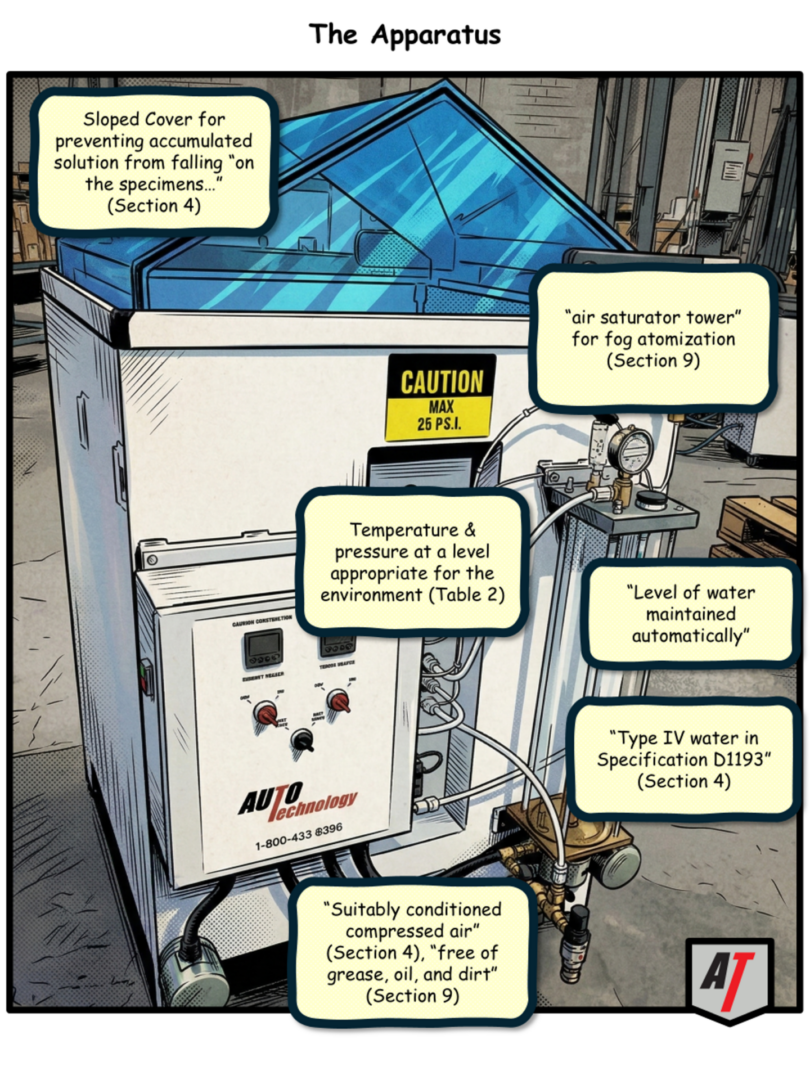
Annotated salt spray chamber highlighting major ASTM B117 apparatus requirements.
Students learn how the major chamber systems work together to create a heated, humidified, uniformly distributed salt fog environment.
In addition, the course explains how chamber construction, airflow, solution delivery, temperature control, drainage, and venting affect test consistency.
Chamber Systems
- Exposure chamber construction
- Salt solution reservoirs
- Automatic fill systems
- Bubble or humidifying towers
- Atomizing nozzles
- Fog towers and dispersion baffles
- Specimen supports and racks
- Heating and temperature control
- Drains, vents, and exhaust systems
Installation Requirements
- Climate-controlled laboratory space
- Level supporting floor
- Clean, dry compressed air
- ASTM D1193 Type IV water
- City water when required by the chamber design
- Open floor drain access
- Proper venting or exhaust provisions
- Electrical and utility planning
Proper Venting Matters
Improper vent piping can create back pressure, disrupt chamber operation, alter collection rates, and allow corrosive fog to escape into the laboratory.
Therefore, the course explains common venting errors, appropriate piping arrangements, and why laboratories should not connect multiple chambers to a shared exhaust line without proper engineering.
Salt Solution Preparation and Verification
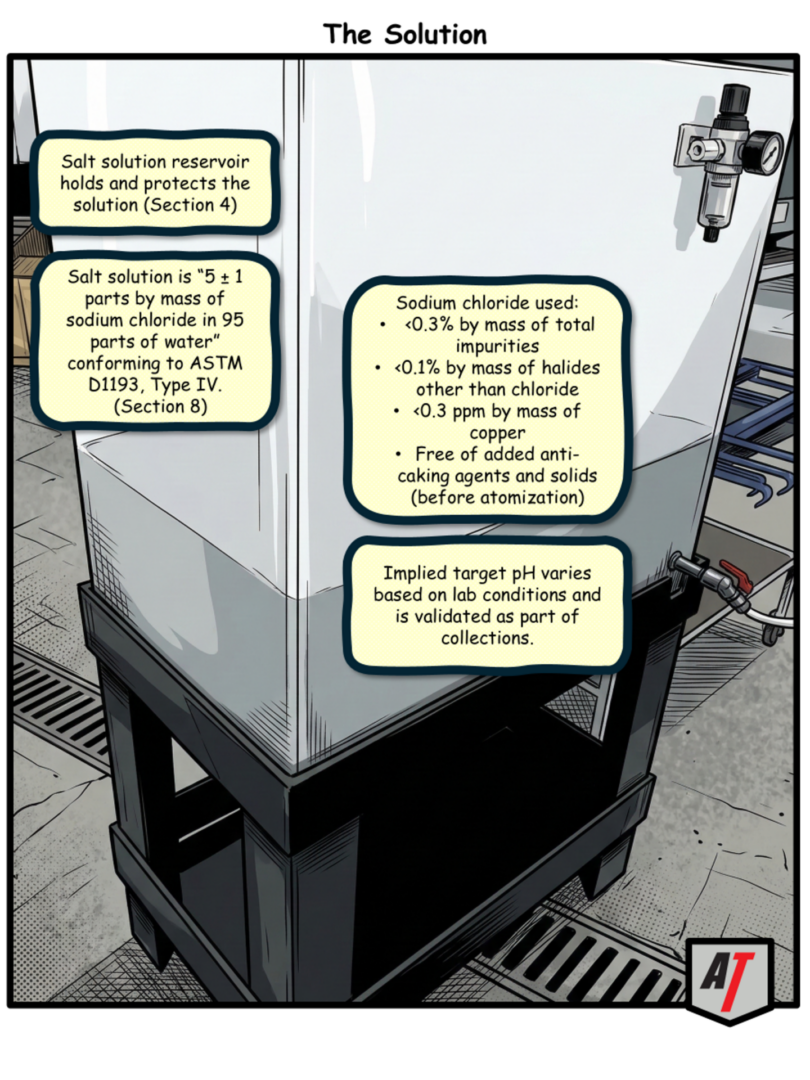
ASTM B117 salt solution preparation requires controlled salt concentration, water quality, and pH.
Salt solution preparation is one of the most important operator-controlled parts of ASTM B117 testing. Differences in salt, water, pH, mixing, storage, or measurement practices can affect test consistency.
Consequently, the course covers both the preparation of the reservoir solution and the verification of solution collected inside the exposure zone.
Solution Preparation
- Preparing solution by mass
- Using appropriate sodium chloride
- Avoiding salt containing anti-caking agents
- Using ASTM D1193 Type IV water
- Hand and mechanical mixing methods
- Preparing large-volume solution batches
- Using premixed solution
Solution Verification
- Salt concentration by mass
- Specific gravity and salinity measurements
- pH measurement
- pH adjustment materials and procedures
- Instrument calibration
- Measurement temperature
- Collected-versus-reservoir solution checks
Air Supply, Temperature, Fog Collection and Chamber Conditions
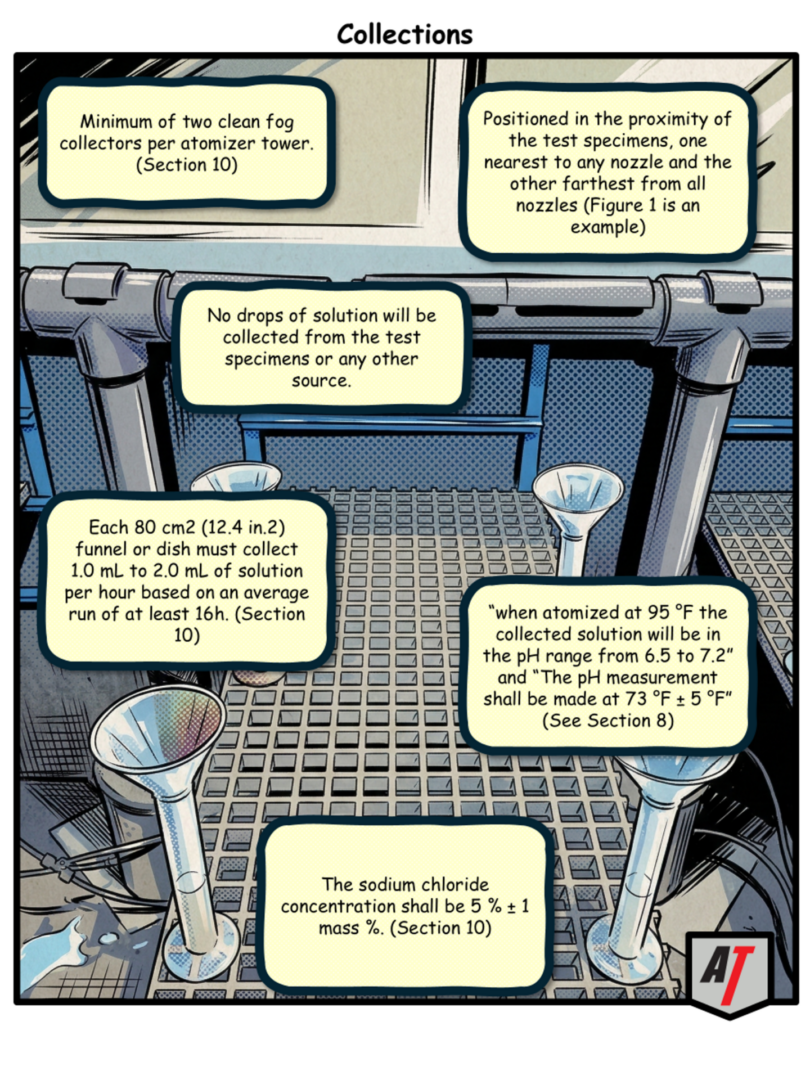
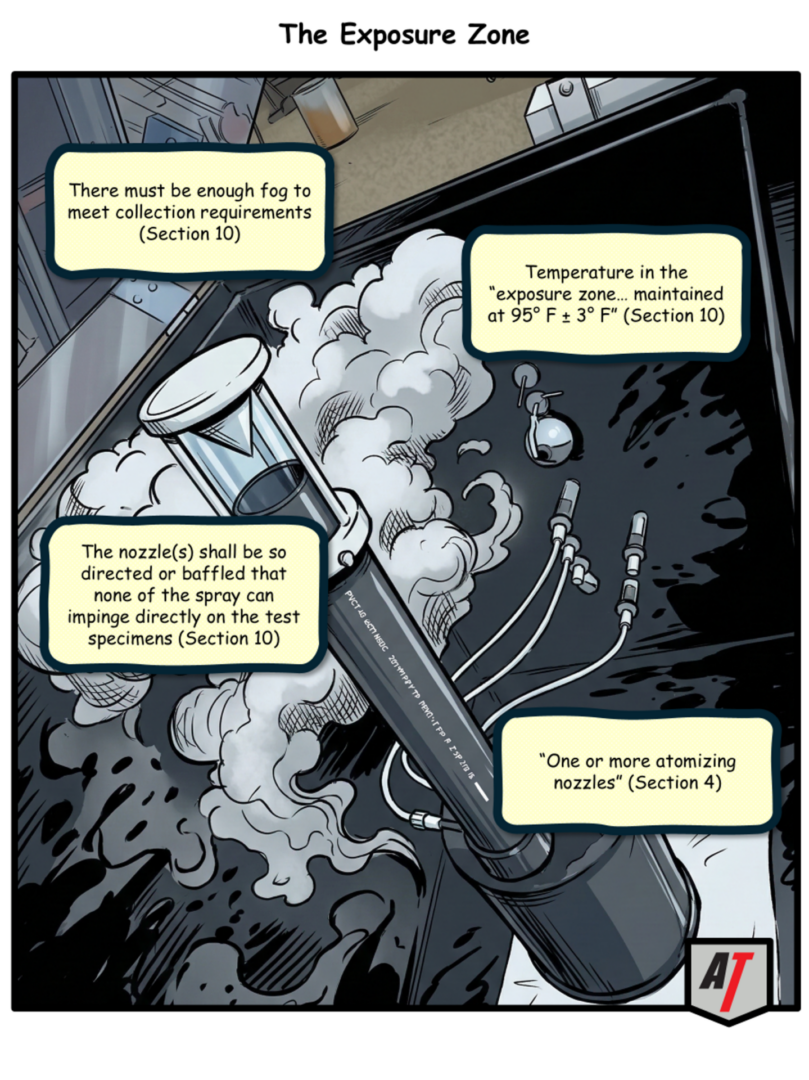
Fog collection funnels allow operators to verify collection rate, salt concentration, and collected-solution pH.
Students learn how compressed-air quality, air pressure, bubble-tower temperature, chamber temperature, nozzle performance, solution delivery, and vent conditions influence fog generation and collection rates.
Moreover, students learn how to place and read fog collectors, calculate hourly collection rates, and use collected solution to confirm chamber performance.
Air and Temperature Control
- Clean and oil-free compressed air
- Air filtration and conditioning
- Bubble-tower temperature and pressure relationships
- Humidification of atomizing air
- Chamber temperature measurement
- Exposure-zone temperature control
- Recognizing unstable operating conditions
Fog Collection
- Collector quantity and placement
- Using 80 cm² collection funnels
- Graduated-cylinder selection
- Reading the liquid meniscus
- Calculating hourly collection rates
- Verifying collected salt concentration
- Verifying collected-solution pH
Specimen Preparation, Scribing and Positioning
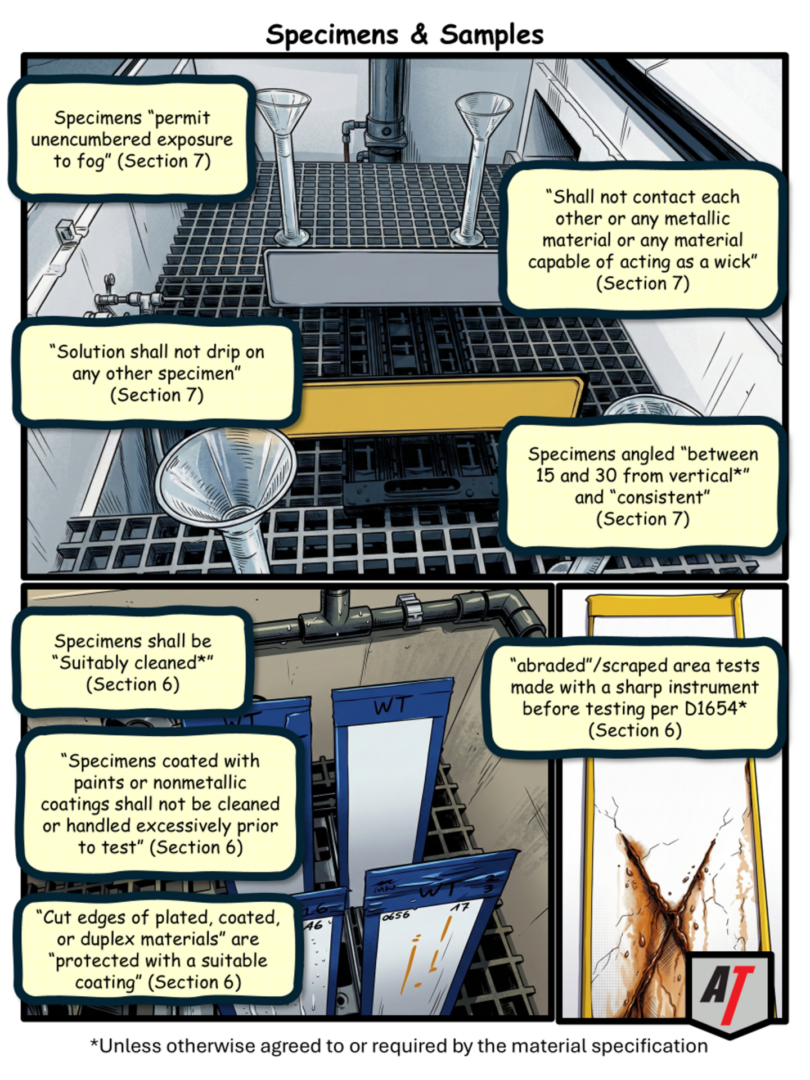
Proper preparation, spacing, orientation, and racking help prevent specimen contact, shadowing, and drip contamination.
ASTM B117 does not independently define every specimen-preparation or evaluation requirement. Therefore, the laboratory must review the governing material, product, coating, or customer specification before starting the exposure.
The course also explains how poor spacing, incorrect angles, sample shadowing, incompatible rack materials, and runoff from one sample onto another can affect the exposure.
Specimen Preparation
- Cleaning and handling specimens
- Avoiding contamination
- Masking and edge protection
- Identifying the dominant test surface
- Scribing coated specimens
- Using appropriate scribing tools
- Documenting pre-test condition
Positioning and Racking
- Recommended specimen angles
- Maintaining free settling of fog
- Preventing contact between specimens
- Preventing runoff from one specimen onto another
- Avoiding sample shadowing
- Selecting compatible rack materials
- Maintaining repeatable rack positions
Laboratory Practices, Maintenance and Troubleshooting
The course connects the written requirements of ASTM B117 with the daily operating, inspection, maintenance, and documentation practices required to keep a chamber running consistently.
In addition, students learn how to recognize the symptoms of common operating problems before those problems compromise a long-duration exposure.
Laboratory Best Practices
- Pre-test chamber inspections
- Daily operating records
- Solution and water-quality records
- Temperature and collection documentation
- Calibration and verification schedules
- Cleaning between exposures
- Contamination prevention
- Test interruption documentation
Maintenance and Troubleshooting
- Low or high collection rates
- Uneven fog distribution
- Nozzle and plumbing restrictions
- Bubble-tower water-level problems
- Air-pressure instability
- Temperature-control problems
- Vent back pressure
- Leaks, salt buildup, and routine wear
Why Train with Auto Technology?
Auto Technology approaches corrosion training from several connected perspectives: standards development, chamber engineering, equipment manufacturing, laboratory operation, calibration, maintenance, troubleshooting, and customer support.
ASTM G01 Committee and Subcommittee Leadership
Our instructors include professionals with years of leadership experience within ASTM Committee G01 on Corrosion of Metals and its subcommittees, together with direct involvement in the development, revision, interpretation, and maintenance of corrosion testing standards.
ASTM Committee G01 has jurisdiction over a broad body of standards addressing laboratory corrosion tests, atmospheric corrosion, environmentally assisted cracking, corrosion in natural waters and soils, electrochemical measurements, in-plant corrosion testing, corrosion of nuclear materials, corrosion of reinforcing steel, and other areas where corrosion of metals is a concern.
Therefore, this experience allows students to learn the intent behind written requirements, understand how corrosion standards evolve, and recognize common interpretations that do not reflect proper laboratory practice.
Practical Chamber and Laboratory Experience
Auto Technology designs and manufactures corrosion chambers, operates corrosion testing laboratories, supports equipment in the field, and helps customers address difficult operating and testing problems.
As a result, training reflects the realities of working laboratories and operating equipment rather than simply repeating standards text.
Training Built Around Your Program
We adapt private classes to the experience level and responsibilities of your participants, whether they operate the equipment, maintain it, supervise the laboratory, review reports, develop procedures, or manage testing compliance.
Request a Custom Training Course →Corrosion Testing Training Frequently Asked Questions
What types of corrosion testing training does Auto Technology offer?
Auto Technology offers three training formats: complimentary scheduled ASTM B117 group training for two attendees with a qualifying new chamber purchase, paid private remote training, and paid private in-person training at our Strongsville, Ohio facility.
Does the training cover both ASTM B117 and chamber operation?
Yes. Training can combine instruction in the ASTM B117 standard with practical chamber operation, solution preparation, specimen positioning, fog collection, operating checks, routine maintenance, troubleshooting, and laboratory documentation.
Can training focus primarily on operating and maintaining a corrosion chamber?
Yes. Private courses can focus on chamber controls, utilities, air saturation, atomization, solution delivery, fog distribution, collection-rate adjustment, routine inspections, preventive maintenance, troubleshooting, or other equipment-related topics.
What is included with the purchase of a new Auto Technology chamber?
A qualifying new chamber purchase includes attendance for two people in one of Auto Technology's scheduled online ASTM B117 group training classes. Auto Technology holds these classes at predefined intervals throughout the year.
How much does private training cost?
Private remote training and private in-person training each cost $2,000 for up to four attendees. Each additional attendee costs $500.
Can a private course cover standards other than ASTM B117?
Yes. Private training can cover ASTM B117, ASTM G85, ASTM B368, ISO 9227, SAE J2334, GMW 14872, automotive corrosion methods, customer specifications, laboratory-developed procedures, chamber operation, maintenance, troubleshooting, or other agreed topics.
Why is ASTM B117 used as the example course?
ASTM B117 provides many of the foundational equipment concepts and laboratory practices used in later salt spray, modified salt spray, and cyclic corrosion procedures. Therefore, understanding B117 helps students understand how many newer corrosion specifications developed and how their requirements differ.
Who teaches the courses?
Auto Technology training involves instructors with extensive corrosion testing, chamber engineering, laboratory, manufacturing, maintenance, and equipment-support experience. Instructors include professionals with years of leadership experience within ASTM Committee G01 on Corrosion of Metals and its subcommittees, as well as direct participation in the development and maintenance of corrosion testing standards.
Do students need to use Auto Technology equipment?
No. Auto Technology can develop private courses for organizations using Auto Technology equipment or corrosion chambers manufactured by other companies. Customers should provide equipment information before the course so we can prepare the curriculum properly.
Where does Auto Technology conduct in-person training?
Auto Technology conducts in-person training at its Strongsville, Ohio facility. The course includes customized instruction, laboratory demonstrations, and a hands-on tour of the corrosion testing laboratory and manufacturing facility.
Are travel and lodging included with in-person training?
No. Attendees must pay for their own airfare, ground transportation, hotel accommodations, and other travel expenses. However, Auto Technology provides lunch during the training day.
What demonstrations are included with in-person training?
Demonstrations depend on the agreed curriculum and laboratory activity available on the training date. Potential topics include solution preparation, pH measurement, water-quality verification, specimen positioning, fog collection, chamber operation, preventive maintenance, troubleshooting, and chamber-system demonstrations.
Can the course be customized for different employee roles?
Yes. We can adapt training for chamber operators, laboratory technicians, maintenance personnel, engineers, quality professionals, laboratory managers, report reviewers, and employees responsible for developing or approving corrosion testing procedures.
Does ASTM B117 define the test duration and pass-or-fail criteria?
No. ASTM B117 defines the apparatus, procedure, and operating conditions for the salt spray environment. However, the applicable material specification, product standard, drawing, customer requirement, or agreed testing program must define the exposure duration, specimen requirements, evaluation methods, and acceptance criteria.