
HOW TO RUN ASTM B117 SALT SPRAY TESTING

Running ASTM B117 correctly involves more than setting a chamber to 35 °C and turning on the fog. The operator must begin with the governing product or coating specification, prepare and position the specimens correctly, establish the required salt-fog environment, monitor the collected fog, limit interruptions, and document anything that could affect the result.
ASTM B117 defines the exposure environment—not a universal pass/fail test. The standard covers the apparatus, procedure, and conditions used to create and maintain salt fog. The specification governing the material, coating, component, or product normally establishes the exposure duration, specimen preparation, inspection method, and acceptance criteria.
This guide explains the operating sequence at a practical level. It does not replace the current, authorized copy of ASTM B117 from ASTM International, the governing product specification, your laboratory procedure, or the chamber manufacturer’s instructions.
ASTM B117 Operating Sequence
- Define the complete test
- Inspect the chamber and utilities
- Prepare and verify the salt solution
- Prepare and identify the specimens
- Establish chamber conditions
- Verify fog collection
- Load the chamber correctly
- Monitor the exposure
- End the exposure and evaluate the specimens
- Report the test conditions and results
1. Define the Complete Test Before Starting
ASTM B117 tells the laboratory how to create and operate the salt-fog environment. It does not tell every laboratory to expose every specimen for the same number of hours, nor does it assign one universal failure limit. Before preparing anything, identify the document that invokes B117 and record the exact requirements that apply to the job.
- Applicable ASTM B117 revision
- Governing material, coating, component, customer, or purchase specification
- Specimen quantity, dimensions, substrate, coating, and identification
- Required cleaning, masking, edge protection, and scribing instructions
- Required specimen angle and orientation
- Exposure duration and any permitted inspection intervals
- Post-exposure rinsing, drying, conditioning, or corrosion-product removal
- Evaluation method, acceptance criteria, photographs, and reporting requirements
A requirement such as “500 hours ASTM B117” is incomplete if it does not also define what is being evaluated and what constitutes failure. Painted or coated specimens, for example, may be evaluated after exposure using a separate method such as ASTM D1654. Visible rust on painted steel may be rated using ASTM D610. Use only the evaluation method required by the governing specification or agreed test plan.
2. Inspect the Chamber and Utilities
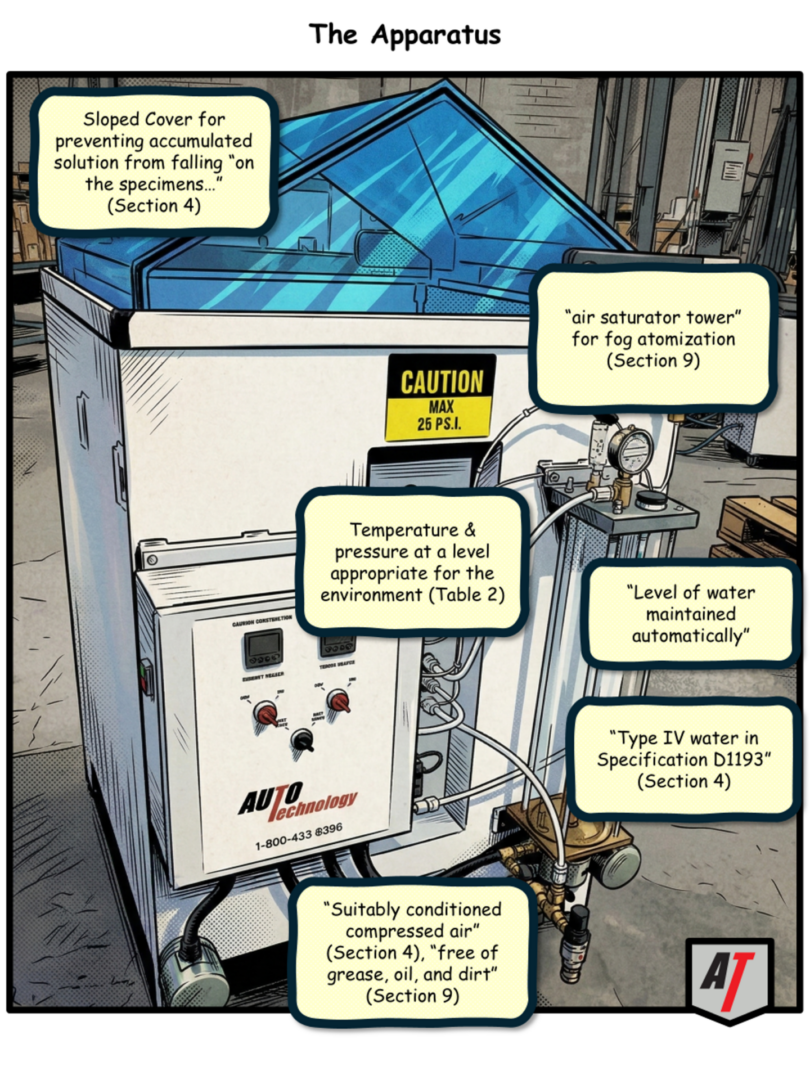
The complete apparatus includes more than the exposure cabinet. Solution storage, clean conditioned air, atomization, heating, specimen supports, collectors, controls, drainage, and exhaust all affect operation.
Confirm that the chamber is clean, serviceable, and ready for the planned exposure. Residue from a different solution or test method can contaminate the run. Examine the cabinet, lid, seals, atomizing nozzles, solution lines, reservoir, collectors, specimen supports, drains, air-conditioning system, sensors, and controls according to the equipment manual and laboratory procedure.
- Verify that wetted surfaces and specimen supports are clean and compatible with the exposure.
- Confirm that the atomizing nozzles and solution lines are clean and unobstructed.
- Use clean, oil-free compressed air supplied at the pressure and capacity required by the chamber.
- Confirm the water supply, drain, exhaust, electrical service, and solution capacity before beginning a long exposure.
- Verify that required measuring devices and chamber sensors are within their calibration or verification intervals.
- Make sure the lid or ceiling directs condensate away from the specimens and that specimen runoff cannot return to the solution reservoir.
For a more detailed purchasing and equipment discussion, see ASTM B117 salt spray chamber requirements.
3. Prepare and Verify the Salt Solution
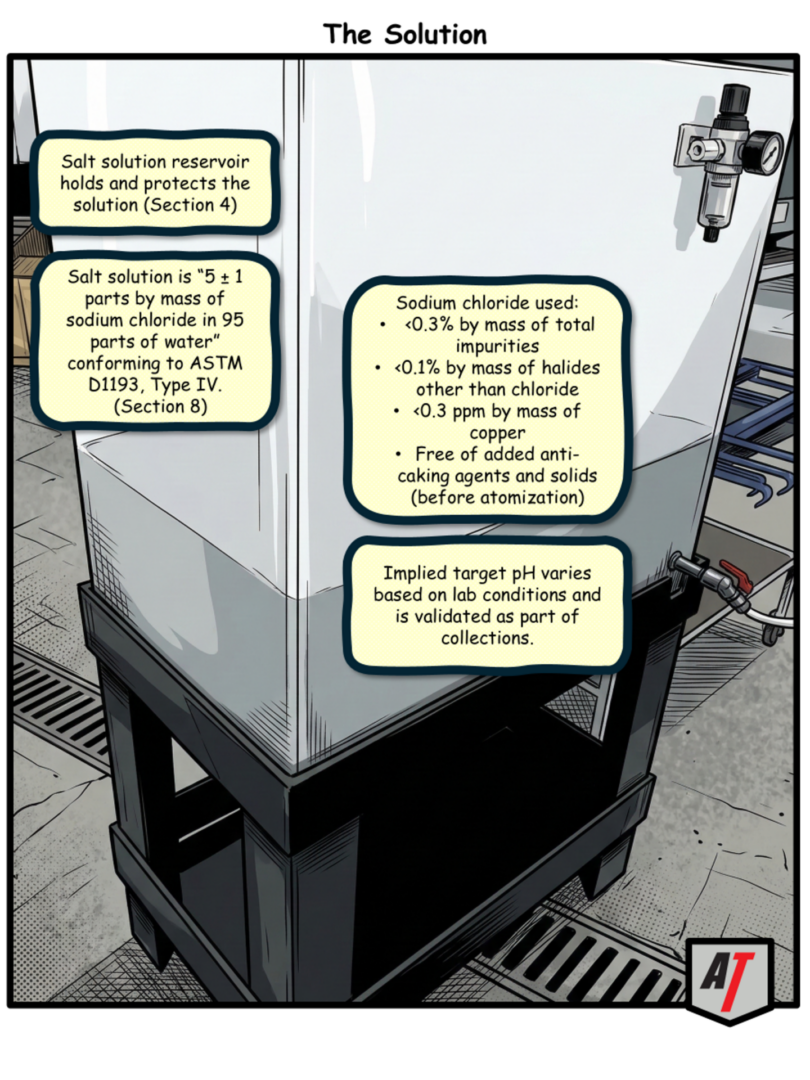
Solution quality begins with suitable sodium chloride, compliant reagent water, clean mixing equipment, and documented measurements.
Prepare a 5 ± 1% sodium chloride solution by mass using water that meets the applicable ASTM D1193 Type IV provisions stated in B117. ASTM D1193 defines the characteristics of reagent water; a basic sediment or carbon filter does not, by itself, demonstrate that the water meets those requirements.
- Use sodium chloride that meets the impurity restrictions stated in the applicable B117 revision.
- Use clean, noncontaminating mixing and storage equipment.
- Measure and document the prepared solution concentration using an appropriate laboratory method or instrument.
- Adjust the prepared solution so that the collected fog will fall within the required pH range of 6.5 to 7.2.
- Measure pH at the temperature and by the procedure required by the current standard and laboratory method.
- Identify the batch and record the salt lot, water source, preparation date, measurements, adjustments, and operator.
Prepared solution and collected solution are not interchangeable measurements. Atomization and temperature can change the pH. B117 compliance is determined from the solution collected in the exposure zone, so the prepared batch may require adjustment based on collected-fog results.
Auto Technology supplies certified and non-certified salt, premixed 5% solution, ASTM D1193 Type IV water, hydrometers, collectors, and startup packages. See the dedicated ASTM B117 testing supplies guide for the practical differences.
4. Prepare and Identify the Specimens
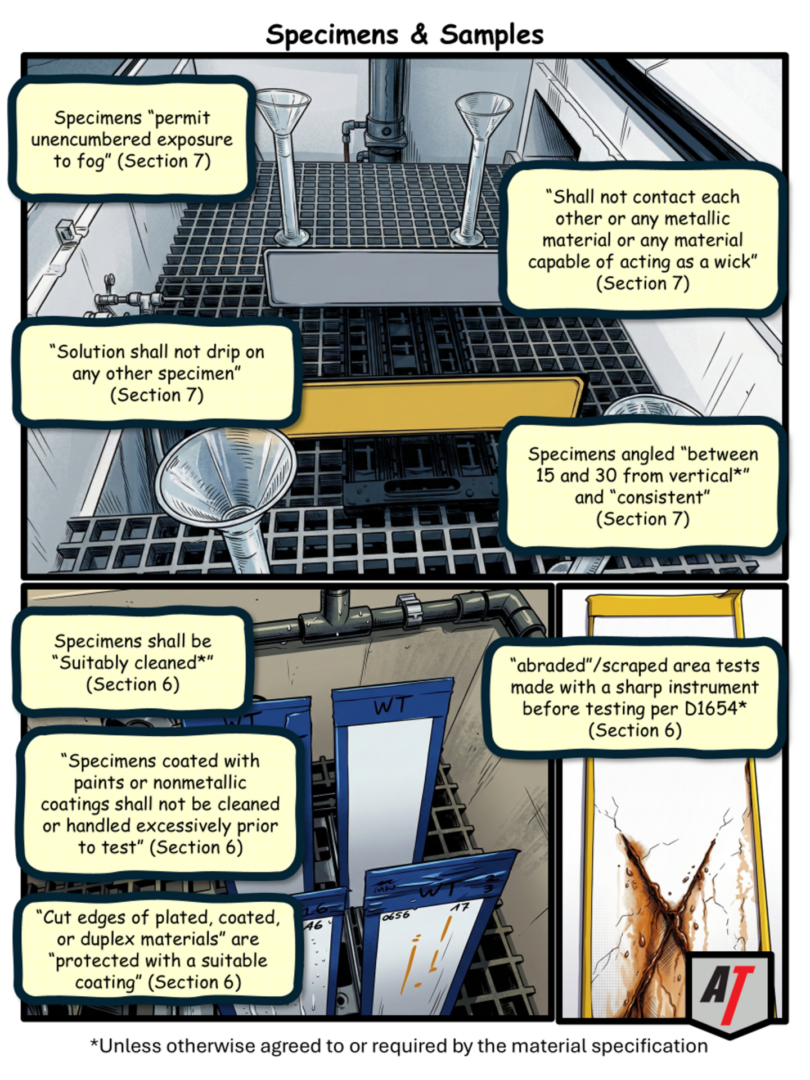
Preparation, scribing, masking, orientation, and post-exposure evaluation come from the governing specification—not from one universal B117 specimen procedure.
Prepare the specimens exactly as required by the governing specification or agreed test plan. Do not introduce an unrequired cleaning, scribing, masking, or edge-sealing step simply because it is common in another B117 program.
- Record specimen identification before exposure using a method that will remain legible and will not contaminate the chamber.
- Document the condition of each specimen and photograph it when required.
- Clean only as directed and handle prepared surfaces in a way that avoids fingerprints, oils, dust, or damage.
- Apply scribes, masks, edge protection, or intentional defects only when required, using the specified tool and geometry.
- Define which surface is being evaluated and how it must face inside the chamber.
- Use enough replicate specimens to address the expected variability of the material and exposure when the test plan permits.
5. Establish Chamber Conditions
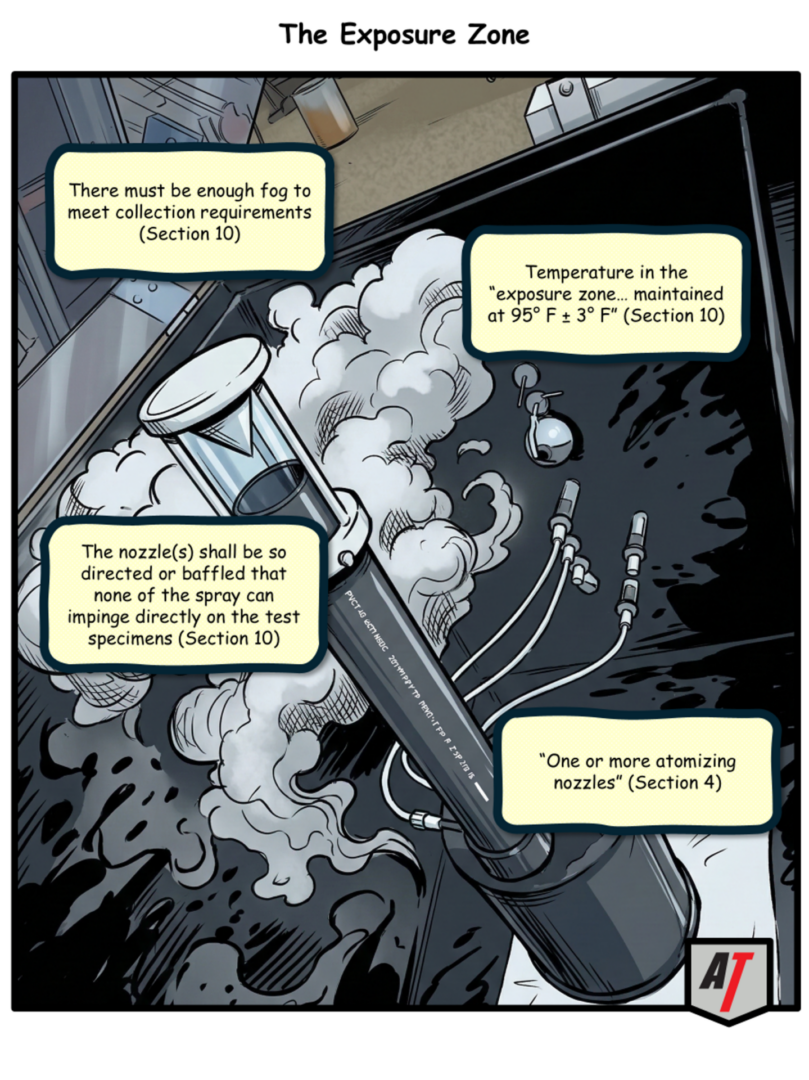
The exposure zone must maintain the specified temperature while distributing fog without directly spraying the specimens.
Bring the apparatus into stable operation according to the current B117 revision, your approved laboratory procedure, and the chamber manual. The standard environment is continuous neutral salt fog with the exposure zone maintained at 35 ± 2 °C.
- Fill or connect the prepared-solution reservoir without introducing contamination.
- Establish the required chamber temperature and conditioned-air supply.
- Adjust atomization to create a fine, distributed fog—not a direct spray onto the specimens.
- Confirm that the chamber can produce compliant collection rates and collected-solution chemistry.
- Record the applicable setpoints, actual readings, verification results, and time the exposure conditions were established.
A displayed setpoint does not prove that the exposure is compliant. Temperature must be measured in the required location, and the fog must be verified from collectors positioned in the specimen exposure zone.
6. Verify Fog Collection
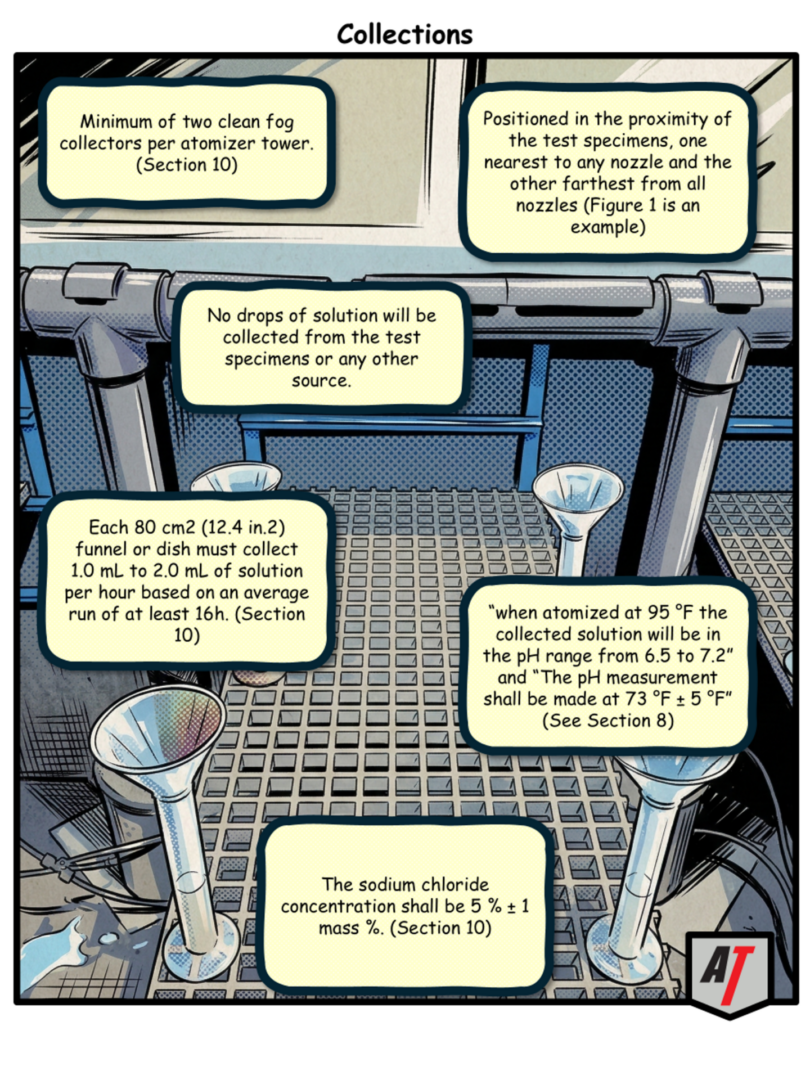
Collectors measure the fog that actually reaches the exposure zone. They are not filled by direct nozzle spray or by liquid dripping from specimens.
Use at least two clean collectors for each atomizing tower and position them within the exposure zone as required by B117. Place them so they collect fog rather than droplets from specimens, supports, the lid, or another surface.
- Collection rate: 1.0 to 2.0 mL per hour for each 80 cm² of horizontal collecting area
- Averaging period: at least 16 hours of continuous collection
- Collected-solution pH: 6.5 to 7.2
- Collected-solution concentration: 5 ± 1% sodium chloride by mass
Record each collector separately. Do not average an out-of-range collector together with an in-range collector and call the chamber compliant. A difference between collector locations can indicate nozzle problems, poor loading, air-distribution issues, or an obstruction in the exposure zone.
7. Load the Chamber Correctly
Unless another specification states otherwise, support the surface of interest between 15° and 30° from vertical. The arrangement must expose each specimen to freely settling fog without direct spray, shielding, cross-contamination, or reactive contact.
- Use nonmetallic or otherwise suitable supports that do not affect the exposure.
- Do not allow specimens to contact one another.
- Do not allow specimens to contact bare metal or materials that can act as a wick.
- Space specimens so one does not block fog from reaching another.
- Arrange specimens so runoff from one specimen cannot fall onto another.
- Keep specimens out of the direct path of the atomizing nozzle.
- Maintain clear space around the collectors so they represent the specimen exposure zone.
- Record the chamber location and orientation of each specimen when position could affect interpretation.
Do not maximize capacity by defeating the exposure. A chamber that can physically hold a certain number of panels may not be able to expose that many panels correctly once spacing, collector access, runoff, shadowing, and lid clearance are considered.
8. Run and Monitor the Exposure
Start the exposure and maintain continuous operation for the duration specified by the governing document. Interruptions should be limited to the minimum necessary for specimen inspection, solution replenishment, collection measurements, or required maintenance.
Monitor and record the items required by the current B117 revision and your laboratory procedure. These commonly include:
- Exposure-zone temperature
- Air-saturator or air-conditioning conditions used by the chamber
- Fog-collection volume from each collector
- Collected-solution pH and concentration
- Solution reservoir level and replenishment
- Specimen inspections authorized by the test plan
- Alarms, adjustments, interruptions, maintenance, and deviations
Use the collection interval required by the applicable standard revision and laboratory procedure. Because the specified collection rate is based on an average of at least 16 hours, a quick spot collection cannot establish compliance.
Safety: Do not open a chamber while it contains dense salt fog. Stop fog generation and use the equipment’s purge or ventilation procedure before opening. Follow the chamber manual, solution safety data sheet, and your facility’s safety and environmental requirements.
9. End the Exposure and Evaluate the Specimens
At the specified exposure time, stop the fog, purge the chamber, and remove the specimens without damaging or mixing them up. What happens next must follow the governing specification or agreed test plan.
- Record the actual exposure time and any excluded downtime.
- Photograph specimens before cleaning when required.
- Rinse, dry, clean, or condition specimens only as directed.
- Do not remove corrosion products before an as-exposed inspection if their appearance is part of the required evaluation.
- Evaluate the specified surface, scribe, blistering, rusting, adhesion loss, mass change, or other required property using the stated method.
- Apply only the acceptance criteria supplied by the governing specification or customer.
B117 exposure hours are not a fixed conversion to years in service. ASTM notes that stand-alone salt-spray results have seldom correlated with performance in natural environments. Use B117 for the comparative or qualification purpose for which it was specified, not as an unsupported service-life prediction.
10. Report Enough Information to Reconstruct the Test
A useful report identifies what was tested, which requirements controlled the work, what conditions were achieved, and how the specimens were evaluated. At minimum, capture the information required by B117, the governing specification, and your quality system.
- ASTM B117 revision and governing specification or test plan
- Specimen description, identification, preparation, orientation, and chamber location
- Salt and water identification, solution concentration, pH, and preparation records
- Exposure-zone temperature and required chamber operating records
- Individual collector locations, volumes, calculated collection rates, pH, and concentration
- Exposure start and stop times, total duration, inspections, and interruptions
- Post-exposure handling and evaluation method
- Results, photographs, acceptance decision when applicable, and all deviations
If a condition falls outside the required range, document the actual condition, its duration when known, the response taken, and how the deviation was dispositioned. Do not silently convert an invalid interval into a passing exposure.
ASTM B117 Equipment, Supplies, Training, and Testing
Auto Technology supports laboratories that operate ASTM B117 equipment as well as organizations that prefer to outsource the exposure.
- Chamber requirements: compare required capabilities, facility needs, and Auto Technology chamber configurations.
- Testing supplies: compare salt, premixed solution, Type IV water, hydrometers, collectors, and supports.
- Salt spray chambers: review Auto Technology equipment for continuous B117 exposure.
- Operator training: build consistent procedures for chamber operation, collection checks, maintenance, and troubleshooting.
- Proficiency testing: compare laboratory performance through an interlaboratory program.
- Laboratory testing: outsource ASTM B117 exposure when purchasing or operating a chamber is not practical.
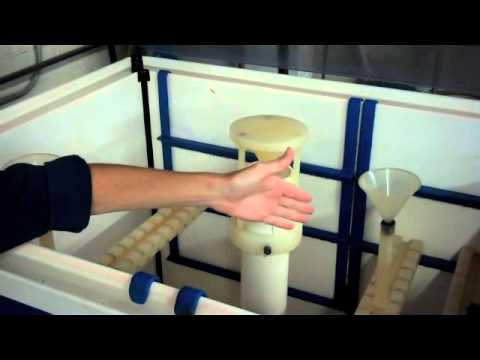
Historical ASTM B117 Chamber Operation
This historical Heatbath Corporation operating video shows an older Auto Technology—formerly ATO Tech—salt spray chamber with the legacy dual-tank design. The equipment has changed, but the video provides useful context for the traditional air-conditioning, solution-delivery, and fog-generation system.
Frequently Asked Questions
What are the basic ASTM B117 operating conditions?
The exposure zone is maintained at 35 ± 2 °C. The chamber uses a 5 ± 1% sodium chloride solution, and the collected fog must have a pH of 6.5 to 7.2. Each collector must receive 1.0 to 2.0 mL per hour per 80 cm² of horizontal collecting area, based on an average collection period of at least 16 hours. Always verify the complete requirements in the current standard.
How long should an ASTM B117 test run?
ASTM B117 does not establish one universal exposure duration. The product, coating, material, customer, or purchase specification must state the required number of hours and any permitted inspection intervals.
Does ASTM B117 define whether a specimen passes or fails?
No. B117 defines the salt-fog apparatus and exposure environment. The governing specification or agreed test plan defines the evaluation method and acceptance criteria.
Can an ASTM B117 chamber be opened during a test?
The exposure is intended to remain continuous, and interruptions should be kept to the minimum necessary. When access is required, stop fog generation and follow the chamber manufacturer’s purge and safe-opening procedure. Record the interruption as required by the laboratory procedure and governing specification.
Does 1,000 hours of ASTM B117 equal a certain number of years outdoors?
No universal conversion exists. ASTM states that salt-spray results used by themselves have seldom correlated with performance in natural environments. B117 results should be interpreted for the comparative or qualification purpose defined by the governing specification.