
ASTM B117 SALT SPRAY CHAMBER REQUIREMENTS

1. Specification Requirements
Begin with the exposure conditions and apparatus provisions stated in ASTM B117, then identify any additional requirements in the governing product or material specification.
2. Necessary Capabilities
Translate those requirements into temperature control, conditioned air, fog delivery, collection monitoring, solution handling, specimen support, and reporting capabilities.
3. Appropriate Auto Technology Chamber
Compare the traditional water-jacketed M Series with the modern fiberglass C Series based on temperature uniformity, capacity, controls, solution storage, humidity capability, and laboratory fit.
4. Laboratory-Testing Alternative
Use Auto Technology's materials and corrosion laboratory when test volume, timing, staffing, utilities, or capital cost make outsourcing more practical than chamber ownership.
ASTM B117 is a practice, not a product-performance specification. It defines the salt spray exposure environment and operating procedure. It does not establish a universal exposure duration, specimen design, acceptance criterion, or pass/fail result. Those requirements normally come from the specification governing the material, coating, component, or product.
What Does ASTM B117 Require From a Salt Spray Chamber?
ASTM B117 identifies the apparatus and operating conditions used to create a controlled neutral salt spray environment. Detailed chamber construction is optional provided that the apparatus consistently produces the required conditions. This is why both traditional water-jacketed chambers and modern non-corrosive cabinet designs can be appropriate for ASTM B117.
| Requirement Area | ASTM B117 Operating Requirement | What the Chamber Must Enable |
|---|---|---|
| Exposure-Zone Temperature | Maintain the chamber exposure zone at 35 ± 2°C. | Stable chamber heating, temperature sensing, control, and a means of recording the required operating temperature. |
| Salt Solution | Prepare a 5 ± 1% sodium chloride solution by mass using water that conforms to the applicable ASTM D1193 Type IV provisions. | A compatible solution reservoir and delivery system that does not contaminate or alter the prepared solution. |
| Collected-Solution pH | Maintain the pH of the collected solution between 6.5 and 7.2. | Accessible collectors and a controlled process for sampling, measuring, adjusting, and documenting solution chemistry. |
| Fog Collection Rate | Each collector must receive 1.0 to 2.0 mL of solution per hour per 80 cm² of horizontal collecting area, based on an average collection period of at least 16 hours. | Controllable atomization, appropriate fog distribution, and at least two clean fog collectors per atomizer tower positioned within the exposure zone. |
| Compressed Air | Supply air that is free of grease, oil, and dirt and suitably conditioned before atomization. | Filtration, pressure regulation, air saturation or conditioning, automatic water-level control, and suitable atomizing nozzles. |
| Fog Delivery | Prevent direct spray from impinging on specimens and produce a distributed fog throughout the exposure zone. | Properly oriented or baffled nozzles and a chamber geometry that supports repeatable fog distribution. |
| Specimen Positioning | Unless otherwise specified, support the surface of interest 15° to 30° from vertical without specimen-to-specimen dripping or contact with reactive or wicking materials. | Nonreactive support bars, racks, or custom fixtures sized for the specimens and arranged for unencumbered fog exposure. |
| Cabinet Construction | Use materials that do not affect fog corrosiveness and prevent condensate from the ceiling or cover from dripping onto specimens. | Corrosion-resistant wetted components, a drip-controlled lid or roof, and drainage that does not return specimen runoff to the solution reservoir. |
| Continuous Exposure | Maintain continuous exposure unless the governing specification permits otherwise, with interruptions kept to the minimum necessary. | Reliable controls, adequate solution capacity, safe replenishment, fault awareness, maintenance access, and operating records. |
Why the traditional water-jacketed design still matters: The water jacket is the traditional chamber-heating method associated with ASTM B117 salt fog testing. By heating the cabinet indirectly through water surrounding the exposure zone, the M Series provides Auto Technology's most uniform temperature profile and excellent temperature stability. ASTM B117 does not require a water jacket, but the design remains important for laboratories that prioritize maximum temperature uniformity or continuity with historical results produced in traditional water-jacketed chambers.
Necessary Chamber Capabilities for ASTM B117 Testing
Once the specification requirements are understood, the next question is not simply whether a chamber can reach the ASTM B117 setpoints. The laboratory must define how the chamber will be used over its service life: how much work it must carry, what specimens must fit, how much operator attention is practical, how repeatable the results must remain, and whether the equipment can be supported years after purchase.
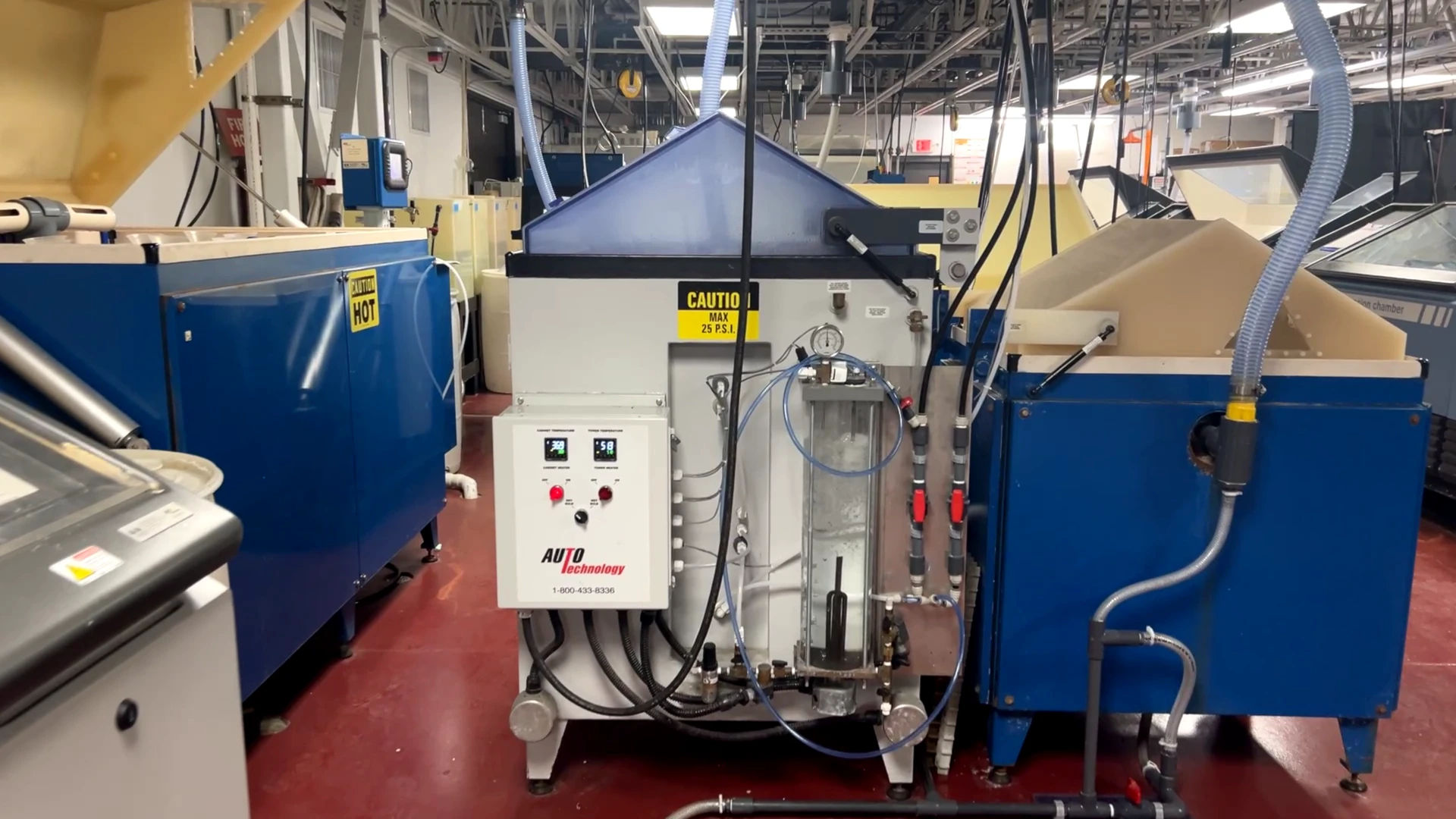
Auto Technology corrosion test chambers installed in a working laboratory. A chamber purchase must support repeatable testing, maintainability, available replacement parts, and continued service throughout the equipment's useful life.
Define the Operating Program Before Comparing Chambers
Testing Volume and Duty Cycle
Define expected runs per year, typical exposure duration, scheduling demands, peak workload, solution consumption,
and how long the chamber must operate with limited intervention.
Usable Specimen Capacity
Compare actual parts and fixtures with the exposure zone. Specimen spacing, collector placement, lid clearance, runoff,
loading weight, and shadowing determine useful capacity more accurately than empty cabinet volume.
Temperature Uniformity
Determine whether the program needs basic B117 temperature control or the strongest available temperature uniformity
and continuity with historical results produced in traditional water-jacketed chambers.
Operating Autonomy
Long exposures make reservoir capacity, refill frequency, monitoring, alarms, maintenance access,
drainage, and recovery from interruptions important purchasing considerations.
Future Test Methods
Identify likely water-fog humidity, condensing-humidity, or cyclic corrosion requirements before purchase.
A chamber selected only for continuous salt spray may restrict the laboratory later.
Long-Term Supportability
Evaluate expected service life, replacement-parts availability, technical documentation, calibration support,
repair access, manufacturer service, and whether the platform will remain supportable over time.
Why a Cheap Imported Salt Spray Chamber Can Be a Bad Long-Term Purchase
A low purchase price is not the same as a low cost of ownership. ASTM B117 chambers operate in a continuously warm, wet, salt-laden environment and are often expected to produce comparable data for many years. A low-cost imported chamber can satisfy a feature checklist at purchase and still become expensive if it deteriorates early, produces inconsistent conditions, cannot be repaired promptly, or must be replaced with a different platform that disrupts historical data continuity.
| Ownership Issue | Risk With a Low-Cost, Poorly Supported Chamber | What a Laboratory Should Verify Before Purchase |
|---|---|---|
| Longevity | Cabinet materials, seals, hinges, plumbing, heaters, sensors, and fog-system components may deteriorate quickly in continuous salt exposure if they were selected primarily to reduce initial cost. | Construction materials, corrosion protection, service history, replaceable wear components, maintenance requirements, and expected support life. |
| Repeatability | Drifting sensors, inconsistent temperature control, unstable air conditioning, or variable fog delivery can create chamber-to-chamber and run-to-run differences even when the displayed setpoints look correct. | How the chamber controls temperature and fog, how it is calibrated, how collection problems are diagnosed, and whether performance can be restored after component replacement. |
| Replacement Parts | Proprietary or undocumented components, changing models, overseas shipping, and limited domestic inventory can turn a minor failure into extended chamber downtime. | Which parts are stocked, where they ship from, typical lead times, documentation quality, component interchangeability, and how long the manufacturer supports discontinued models. |
| Technical Service | A distributor may be able to sell the chamber without having technicians who understand salt fog generation, collection-rate problems, solution delivery, controls, or field repair. | Who answers technical questions, who performs service, whether remote troubleshooting is available, and whether technicians can support the chamber on-site when necessary. |
| Data Continuity | If an unsupported chamber must be replaced prematurely, changes in heating architecture, fog delivery, controls, or specimen loading can complicate comparisons with historical results. | Platform stability, long-term parts support, repeatable control architecture, service records, and the ability to maintain the same chamber rather than replace it after routine failures. |
Before selecting a chamber on price alone, ask: Are replacement parts stocked in the United States? Who will troubleshoot collection or temperature problems? Are wiring diagrams, manuals, calibration procedures, and component information available? How long will the model be supported? Who performs field service? If the supplier cannot answer those questions clearly, the price difference represents added operating risk rather than guaranteed savings.
Facility Capabilities Required for Chamber Ownership
A chamber can be technically appropriate for ASTM B117 and still be a poor fit for the intended laboratory. Utility availability, room layout, exhaust routing, drainage, access, and solution handling should be reviewed before the chamber size and configuration are finalized.
Water and Solution
Plan for ASTM D1193 Type IV water, salt-solution mixing or delivery, reservoir access, replenishment, spill control, and disposal consistent with facility requirements.
Compressed Air
Provide clean, dry, oil-free compressed air at the pressure and capacity required by the selected chamber and its air-conditioning system.
Exhaust and Drainage
Provide suitable chamber exhaust and a floor drain. Exhaust routing must avoid excessive backpressure that could disrupt chamber operation.
Electrical Service
Confirm the voltage, phase, amperage, disconnect, and installation requirements for the selected chamber size and options.
Room and Service Clearance
Account for chamber footprint, lid travel, specimen loading, external tanks, maintenance access, ventilation, and the path used to move the system into the laboratory.
Operating Support
Budget for measurement instruments, collectors, specimen supports, salt, Type IV water, preventive maintenance, calibration, operator training, and replacement parts.
Final utility requirements are model-specific. Use the approved chamber documentation and Auto Technology's installation requirements when planning the facility. Do not size electrical, air, water, exhaust, or drainage connections from a general standards page.
Which Auto Technology Chamber Is Appropriate for ASTM B117?
Auto Technology's M Series salt fog chambers and C Series salt spray chambers are both designed to run ASTM B117. The choice is not about one series being more compliant. It is about selecting the construction, size, solution arrangement, controls, humidity capability, and laboratory fit that best support the testing program.
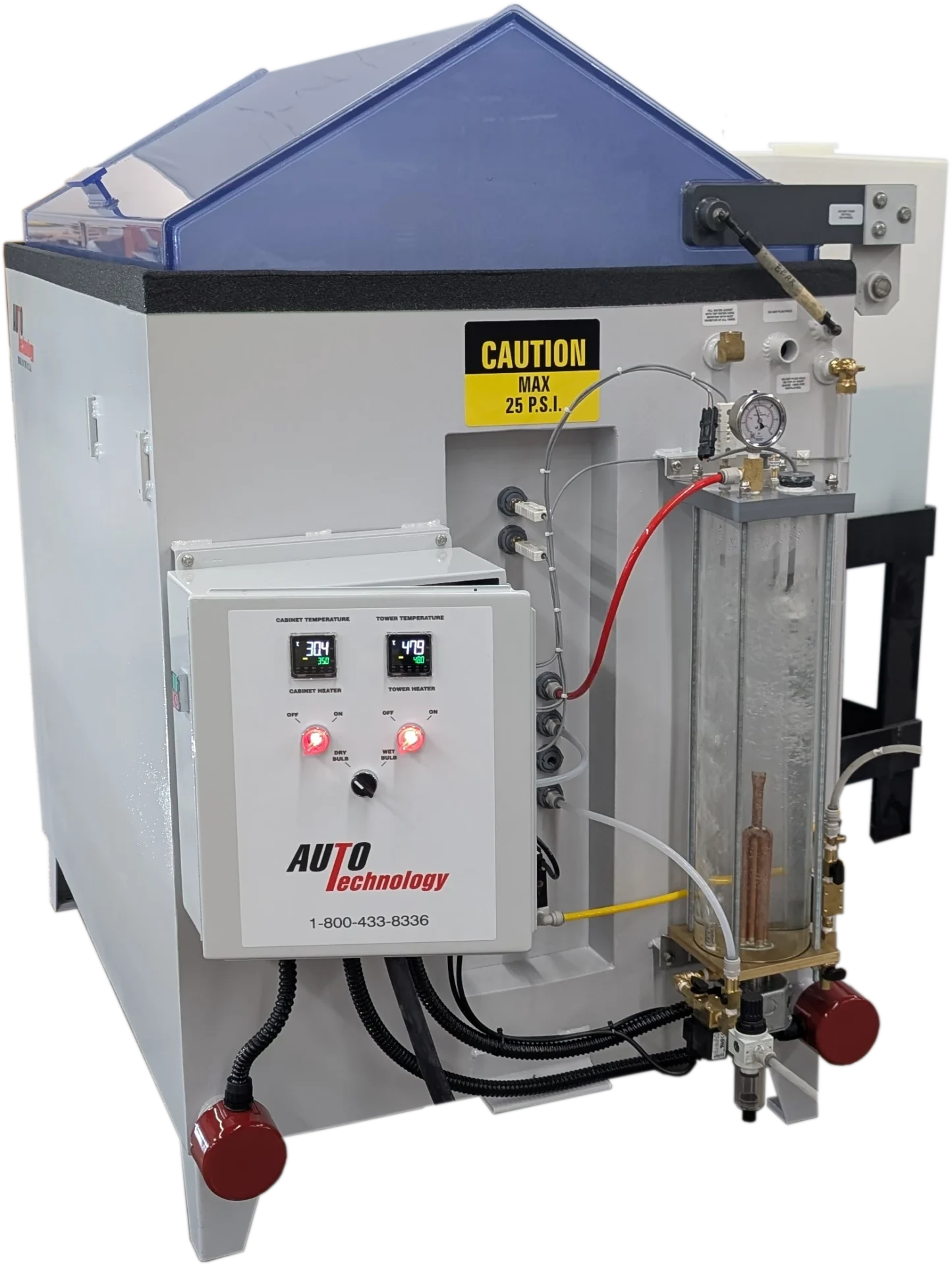
M Series Salt Fog Chamber
Best fit: Laboratories that prefer Auto Technology's traditional steel, water-jacketed chamber architecture and need a broad selection of chamber sizes.
- Coated steel cabinet with indirect water-jacket temperature control.
- External 55-gallon salt-solution mixing and storage tank.
- Available in multiple sizes for different specimen capacities.
- Supports salt fog and water-fog humidity operation.
- Traditional Auto Technology design used in established corrosion laboratories.
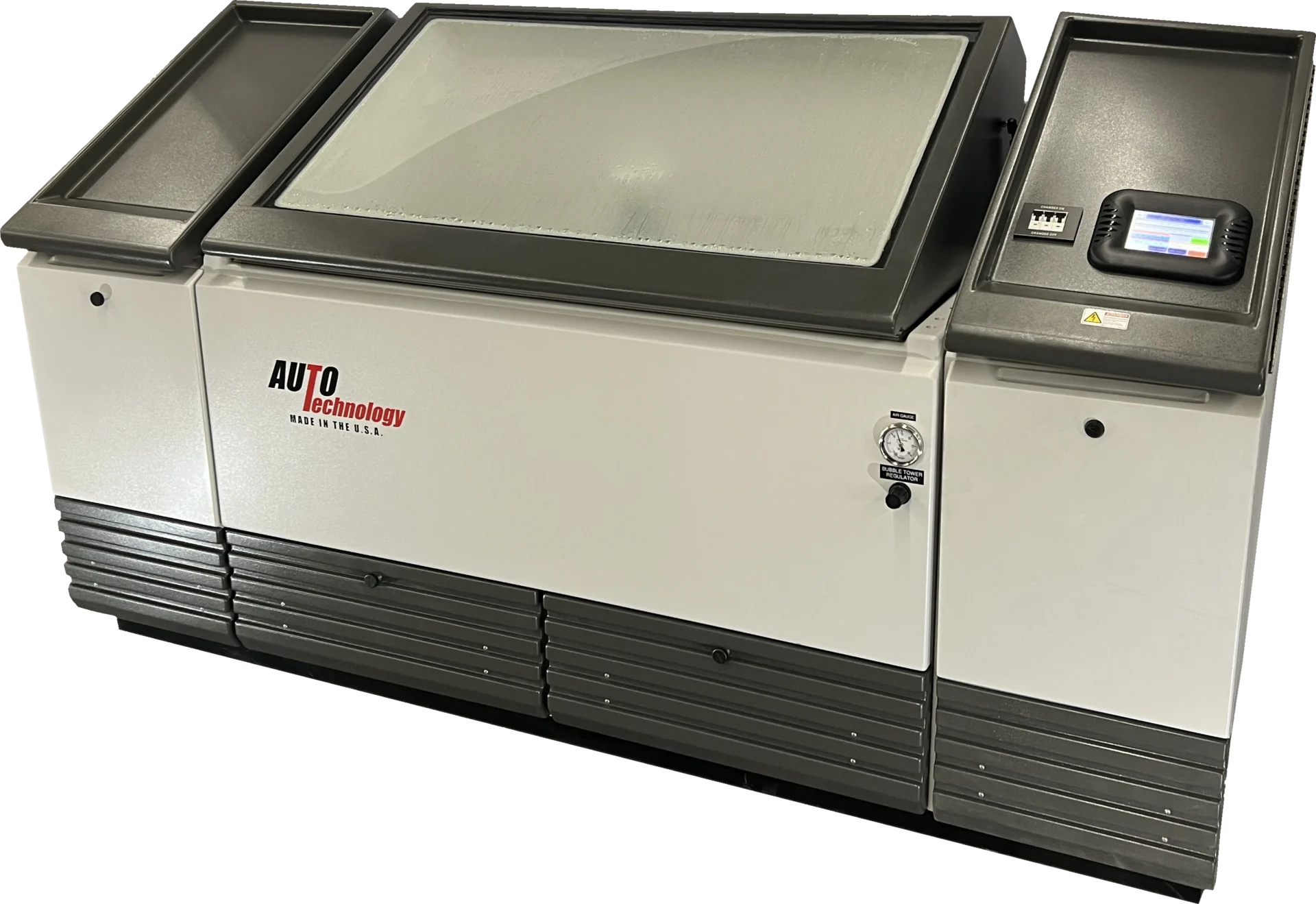
C Series Salt Spray Chamber
Best fit: Laboratories that want modern non-corrosive fiberglass construction, touchscreen operation, integrated solution storage, and added humidity flexibility.
- Molded fiberglass cabinet with a wet-bottom chamber design.
- Integrated 60-gallon salt-solution reservoir.
- Touchscreen controls for salt spray and humidity operation.
- Water-fog and condensing-humidity capability.
- Provides a practical path beyond continuous B117 exposure into basic cyclic work.
| Selection Factor | M Series | C Series |
|---|---|---|
| ASTM B117 Capability | Designed for continuous ASTM B117 salt fog exposure. | Designed for continuous ASTM B117 salt spray exposure. |
| Cabinet Construction | Traditional coated steel chamber with a water jacket. | Modern molded fiberglass chamber with a wet bottom. |
| Solution Storage | Detached 55-gallon mixing and storage tank. | Attached 60-gallon solution reservoir. |
| Controls | Legacy-style chamber controls. | Touchscreen controls are standard. |
| Humidity Capability | Water-fog humidity; other humidity configurations depend on chamber options. | Water-fog and condensing-humidity operation. |
| Available Capacity | Broader selection of chamber sizes. | Available in Size 20 and Size 40 configurations. |
| Choose It When | You want the traditional Auto Technology architecture, external solution storage, or an M Series size that fits the required capacity. | You want fiberglass construction, an integrated reservoir, touchscreen operation, or built-in condensing humidity capability. |
Need help choosing? Provide Auto Technology with the specimen dimensions, quantity, required exposure duration, anticipated test volume, governing specifications, available utilities, laboratory space, and any future cyclic or humidity methods. Those details determine the appropriate chamber series, size, fixtures, and options more reliably than ASTM B117 alone.
Laboratory ASTM B117 Testing as an Alternative to Chamber Ownership
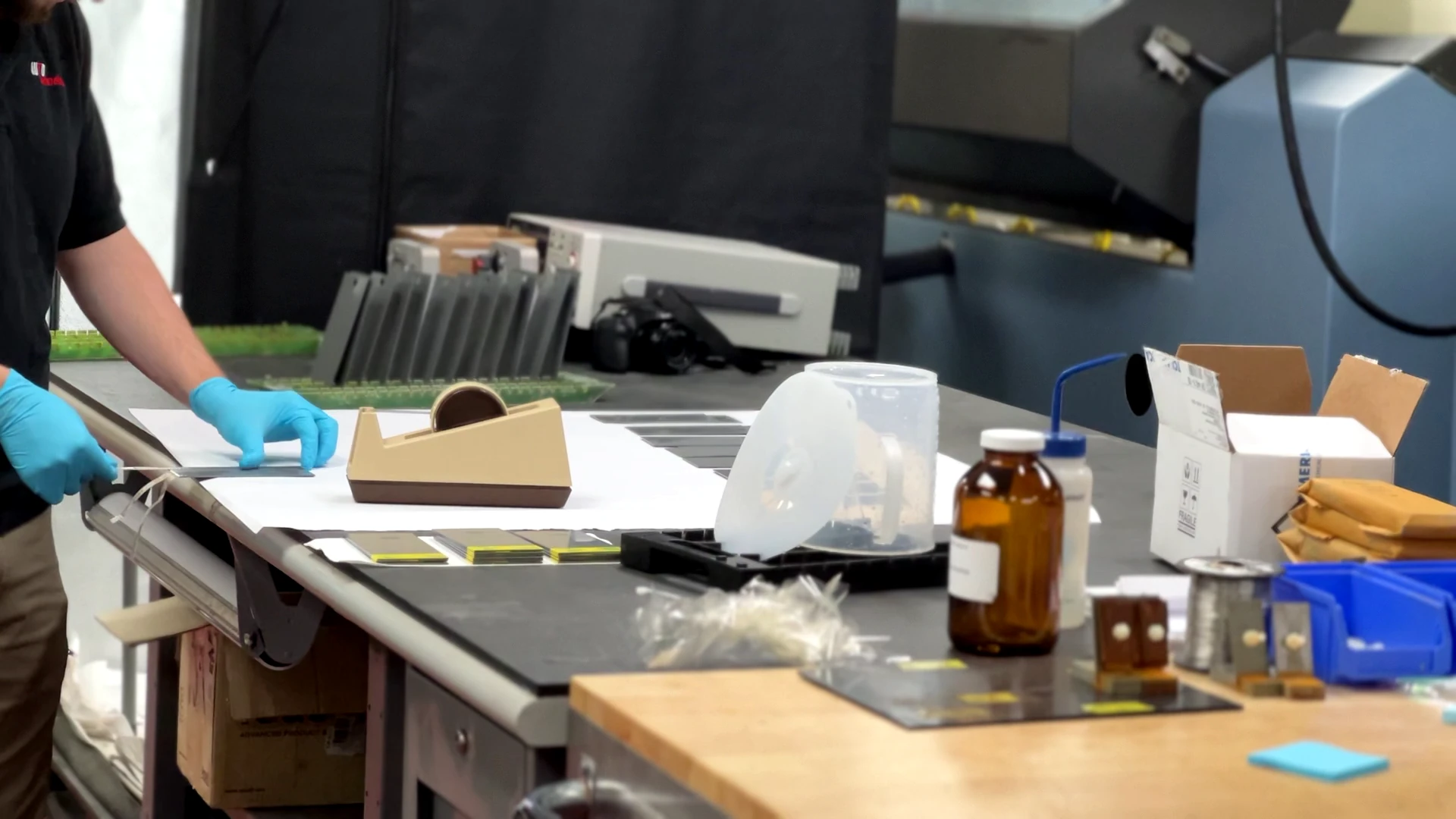
A technician preparing test samples for adhesion and coating evaluation in a laboratory workspace. Tape adhesion is shown as an example of a post-exposure evaluation; it is not a universal ASTM B117 requirement and is performed only when required by the governing specification, an internal procedure, or the customer's agreed test plan.
Purchasing a chamber is usually justified when testing is recurring, turnaround must remain under internal control, specimens or procedures require dedicated equipment, or annual test volume supports the capital and operating cost. For occasional testing, overflow work, program startup, or an immediate project, outsourcing ASTM B117 exposure may be more practical.
Consider Laboratory Testing When
- The organization does not have enough recurring volume to justify a dedicated chamber.
- Testing is needed before chamber purchase, installation, or operator training can be completed.
- An internal chamber is at capacity, under maintenance, or unavailable for the required duration.
- The project needs specimen preparation, exposure records, agreed reporting, or specified post-exposure evaluation in addition to chamber time.
- The laboratory wants to compare outsourcing costs with the full cost of chamber ownership and operation.
Define the full test program before requesting a quote. ASTM B117 establishes the exposure practice but not the universal test duration or acceptance criteria. Provide the governing specification, revision, specimen information, exposure duration, preparation instructions, inspection intervals, cleaning method, and required evaluation or reporting criteria.
ASTM B117 Salt Spray Chamber FAQ
What chamber conditions are required by ASTM B117?
ASTM B117 requires a 35 ± 2°C exposure zone, suitably conditioned clean compressed air, a 5 ± 1% sodium chloride solution by mass, collected-solution pH of 6.5 to 7.2, and fog collection of 1.0 to 2.0 mL per hour per 80 cm² based on an average collection period of at least 16 hours. The chamber must also prevent direct spray or lid condensate from reaching specimens and use materials that do not affect fog corrosiveness.
Does ASTM B117 require a water-jacketed salt fog chamber?
No. ASTM B117 does not mandate one chamber construction or heating method. Water- and air-jacketed arrangements are examples in the practice's nonmandatory apparatus guidance. A chamber is suitable when it consistently maintains the required exposure conditions without affecting fog corrosiveness.
Can both Auto Technology M Series and C Series chambers run ASTM B117?
Yes. Both series are designed for ASTM B117 operation. The M Series uses Auto Technology's traditional coated-steel, water-jacketed architecture with an external solution tank and a broader range of sizes. The C Series uses molded fiberglass construction, touchscreen controls, an integrated solution reservoir, and built-in condensing-humidity capability.
How do I choose the correct ASTM B117 chamber size?
Start with specimen dimensions, quantity, orientation, spacing, loading frequency, and exposure duration. Then confirm usable exposure-zone dimensions, collector placement, fixture requirements, lid clearance, laboratory footprint, utilities, and any future humidity or cyclic methods. Total cabinet volume alone does not establish usable specimen capacity.
Does ASTM B117 specify how long a test must run?
No. ASTM B117 provides the exposure practice but does not establish one universal duration. The governing material, coating, component, product, customer, or internal specification normally establishes the exposure period and acceptance criteria.
When does outsourcing ASTM B117 testing make more sense than buying a chamber?
Outsourcing can be practical for occasional testing, temporary capacity, an immediate qualification project, or organizations that do not want to install and maintain the necessary chamber, utilities, measurement equipment, supplies, procedures, and trained staff. Recurring high-volume testing and the need for direct scheduling control generally make chamber ownership more attractive.