ASTM B117 Salt Solution: Concentration
ASTM B117 involves several operating measurements, but salt concentration and pH are two areas where practitioners can simplify their work—or add preparation, verification, and documentation to their workload.
The removal of Table 3 from ASTM B117 made the choice of measurement method and temperature correction more important to understand. The table was not accurate for every measurement situation. Hydrometer calibration temperatures, reference-water temperatures, and the distinction between density and specific gravity can affect how a result is interpreted. Earlier Note 10 supplied a specific gravity interval at 25 °C and described alternative ways to determine concentration. The current Note 10 instead lists common methods—specific gravity hydrometers, salimeter hydrometers, refractometers, and titration—and allows users to select another appropriate method. Removing the table did not change the collected-solution concentration requirement; practitioners must use a suitable method and the correct conversion and temperature correction for their equipment.
Buying certified, pre-mixed solution reduces the work needed to establish that the starting solution is correctly prepared. Instead of weighing salt and water, mixing each batch, and checking the prepared concentration and pH, the laboratory receives solution with documented properties. Where the laboratory’s quality system and customer requirements permit acceptance based on the supplier’s certificate, that documentation can support acceptance before use. The laboratory still measures the collected fog solution during exposure as required by B117; certification does not replace those operating checks. View Auto Technology’s pre-mixed 5% salt solution — C173300.
Preparing solution in-house gives the laboratory control over batching, but also places responsibility for preparation and verification on the laboratory. Checking the prepared concentration and pH before use helps catch mixing problems before specimens are exposed. The laboratory then measures the collected fog solution during exposure to confirm the required conditions. Certified, pre-mixed solution offers a simpler starting point by reducing batch preparation work and the opportunity for mixing errors.
Several methods can establish salt concentration. For routine B117 checks, a NaCl refractometer is often the most practical choice because measurement is quick, requires only a few drops, and can report concentration directly. A salimeter hydrometer offers a simple, inexpensive alternative but requires more sample and careful temperature control or manual correction. Specific gravity hydrometers and pycnometers can also provide suitable results, but require a separate conversion into NaCl concentration. Electronic density meters can automate measurement and conversion, while titration determines chloride chemically; both generally involve more equipment, expense, or training.
Auto Technology’s laboratory uses refractometers that display both NaCl concentration and specific gravity. In our work with laboratories and in personnel training, we are also seeing more laboratories move to refractometers for convenient routine solution checks. This reflects our direct experience with those laboratories, rather than an industry-wide survey.
The best method for measuring concentration is the method the laboratory can operate reliably, with sufficient accuracy to evaluate the specified concentration range.
ASTM B117 is a practice that allows users to select an appropriate concentration-measurement method; it does not require every laboratory to purchase the same equipment. That flexibility applies to the method, while the solution requirements still apply. Calibration, verification, documentation, and any additional checks should suit the equipment and reflect the laboratory’s quality system, customer specifications, and accreditation or audit requirements. Known-concentration reference solutions can help verify the complete procedure, particularly when temperature corrections or external conversion data are used.
The collected solution must contain 4–6% NaCl by mass and have a pH of 6.5–7.2, measured at 23 ± 3 °C. Concentration and pH measurements are made on the collected fog solution during exposure; accepting the starting solution does not replace those checks.
This article covers salt-concentration measurement. pH measurement, adjustment, and the effects of heating and atomization will be covered separately in this article series.
1. NaCl refractometer
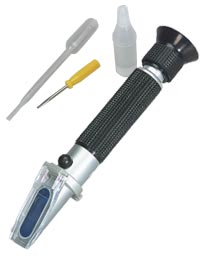
Auto Technology Salinity Refractometer — C280225
A NaCl refractometer uses visible light to estimate the percentage of salt dissolved in water. With an instrument that reports NaCl concentration by mass, its scale indicates grams of NaCl per 100 grams of solution. A reading of 5% means 5 grams of salt in 100 grams of total solution.
With a manual version, you place a few drops on the glass measuring surface and look through the eyepiece. Where the light and dark areas meet on the numbered scale indicates the salt concentration.
With a digital version, a sensor measures how the solution affects light, and the instrument calculates and displays the salt concentration.
The refractometers used by Auto Technology’s laboratory also display specific gravity. Both displayed values are derived from the same optical measurement using the instrument’s conversion relationships. Displaying both values is convenient, but does not provide two independent measurements.
Other dissolved substances can affect light too and cause an incorrect salt-concentration reading. That is why your water and solution must be free of contamination.
Temperature can affect the reading, so automatic temperature compensation is a useful feature. It corrects the reading using an established relationship between temperature, NaCl concentration, and how the solution affects light. That relationship is based on measurements of solutions with known salt concentrations at known temperatures. The correction works within the instrument’s specified temperature range.
Even with automatic temperature compensation, allow the drops and measuring surface to reach the same temperature before taking the reading. If warm drops are still cooling on a cold measuring surface, the temperature sensor or mechanical element may not yet reflect the drops’ temperature. Waiting for them to reach the same temperature allows the correction to work properly.
2. Salimeter hydrometer
Auto Technology Salimeter Hydrometer — C280220
A salimeter hydrometer is a glass float with a numbered scale on a narrow stem. The hydrometer uses the density of the solution to estimate the amount of salt dissolved in water.
You place the salimeter hydrometer in a cylinder containing the B117 solution and let the hydrometer float freely. A denser solution makes the hydrometer float higher; a less dense solution makes the hydrometer sink farther. Where the liquid surface meets the numbered scale indicates the reading.
The scale markings are based on an established relationship between NaCl concentration and solution density at the hydrometer’s specified calibration temperature. That relationship comes from measurements of solutions with known salt concentrations at known temperatures. The manufacturer uses that relationship to position the markings so each floating level corresponds to a concentration or percent-saturation value.
The scale must be checked before interpreting the reading. Some salimeter hydrometers report NaCl concentration by mass. On that scale, 5% means 5 grams of salt in 100 grams of total solution. Other salimeter hydrometers report percent saturation—how close the solution is to holding the maximum amount of dissolved salt at the specified temperature. A reading of 5% saturation does not mean 5% NaCl by mass.
Other dissolved substances can increase density too and cause an incorrect salt-concentration reading. That is why your water and solution must be free of contamination.
Temperature also affects density. The same solution becomes less dense as the solution warms, making the hydrometer sink farther even though the salt percentage has not changed, provided no water has evaporated or been added.
A standard glass salimeter hydrometer does not automatically compensate for temperature. The scale applies at the hydrometer’s specified calibration temperature. You can bring the solution and hydrometer to that temperature before measuring, or measure the solution’s actual temperature and apply the manufacturer’s correction chart, table, or formula. There is no single offset that applies to every hydrometer.
For a reliable reading, allow the salimeter hydrometer and solution to reach the same temperature. The hydrometer must float freely without touching the cylinder, and any bubbles attached to the hydrometer must be removed. The liquid curves where the liquid touches the stem; this curve is called the meniscus. Follow the manufacturer’s instructions on whether to read the top or bottom of the meniscus.
3. Specific gravity hydrometer
Auto Technology Specific Gravity Hydrometer — C280215
A specific gravity hydrometer is a glass float with a numbered scale on a narrow stem. A specific gravity hydrometer operates exactly like a salimeter hydrometer, but the scale reports specific gravity rather than salt concentration or saturation. The laboratory must measure specific gravity first, then convert that reading into NaCl concentration.
Step 1: Measure specific gravity
You place the specific gravity hydrometer in a cylinder containing the B117 solution and let the hydrometer float freely. A denser solution makes the hydrometer float higher; a less dense solution makes the hydrometer sink farther. Where the liquid surface meets the numbered scale indicates the specific gravity reading.
Specific gravity compares the solution’s density with the density of reference water (pure water whose density is used as the comparison value). A reading of 1.03 means the solution is 1.03 times as dense as the reference water. Specific gravity has no units.
The manufacturer specifies the measurement temperature and the pure-water comparison used for the scale. A marking of 60 °F/60 °F means you should measure the salt solution at 60 °F, and the resulting reading compares the solution’s density with the known density of pure water at 60 °F. A marking of 20 °C/20 °C means the same comparison is made at 20 °C. If the salt solution is measured at another temperature, an appropriate temperature correction is required.
ASTM B117 does not establish one universal temperature for specific gravity measurement. B117’s Note 12 explains that many hydrometers are calibrated at 15.6 °C (60 °F) and directs users to the manufacturer for the appropriate correction when measuring at another temperature.
For example, if a hydrometer is calibrated at 15.6 °C but the salt solution is measured at 20 °C, the observed reading requires the appropriate correction. Obtain that correction from the manufacturer or another verified source that applies to the hydrometer and NaCl solution. An online table is suitable only when the table’s temperature basis and application match the measurement.
A standard glass hydrometer does not automatically compensate for temperature. Some models include a thermometer; otherwise, use a separate thermometer. The simplest approach is to bring the solution and hydrometer to the manufacturer’s specified calibration temperature before taking the reading.
If you measure at another temperature, use the manufacturer’s correction chart, table, or formula for that hydrometer and application. The correction accounts for how temperature affects the measurement. When the instructions provide an offset, add or subtract the specified amount from the observed reading. Apply corrections only within the range covered by those instructions.
For a reliable reading, the hydrometer and solution must reach the same temperature. The hydrometer must float freely without touching the cylinder, and any bubbles attached to the hydrometer must be removed. The liquid curves where the liquid touches the stem; this curve is called the meniscus. Follow the manufacturer’s instructions on whether to read the top or bottom of the meniscus.
Step 2: Convert specific gravity into NaCl concentration
After obtaining the specific gravity reading and applying any required temperature correction, compare the result with reference data for NaCl solutions.
The reference table or formula connects specific gravity with known NaCl concentrations. Those relationships are based on measurements of solutions with known salt concentrations at known temperatures. A salimeter’s salt scale already incorporates this conversion; a specific gravity hydrometer leaves the conversion to the laboratory.
For example, ASHRAE’s Table 2A, “Physical Properties of Sodium Chloride Brines,” lists the following values at 20 °C:
| NaCl concentration by mass | Listed specific gravity |
|---|---|
| 4% | 1.0286 |
| 5% | 1.0358 |
| 6% | 1.0431 |
These values must be compared with readings expressed on the same solution-temperature and reference-water-temperature basis. A reading from a hydrometer calibrated at 60 °F/60 °F cannot simply be compared with a 20 °C table without the appropriate conversion.
The difference between density and specific gravity can be seen at the 6% concentration limit. The listed solution density at 20 °C is 1.0413 g/mL. Pure water at 20 °C has a density of approximately 0.9982 g/mL. Dividing 1.0413 by 0.9982 gives approximately 1.0432 for specific gravity on a 20 °C/20 °C basis. Using the rounded water density of 0.998 g/mL gives approximately 1.043. The published table lists 1.0431; small last-digit differences arise from rounding and the underlying reference values.
Density and specific gravity are different quantities. A pycnometer density result can be compared directly with matching NaCl density data at the same temperature. A specific gravity hydrometer result must be compared with matching specific gravity data, or converted to the density basis first.
As an additional reference check, the laboratory can measure a solution whose NaCl concentration is already known from accurate preparation by mass.
For example, the laboratory prepares a 5% NaCl reference solution by accurately weighing 5 grams of pure NaCl and 95 grams of water, accounting for salt purity and weighing uncertainty. The laboratory then measures the reference solution with the specific gravity hydrometer, applies any required temperature correction, and converts the specific gravity reading into NaCl concentration using the selected reference data.
The calculated concentration should agree with the known 5% concentration within an acceptance tolerance that accounts for uncertainty in both the reference solution’s preparation and the measurement procedure. This comparison checks the complete procedure: the hydrometer measurement, temperature correction, and conversion into salt concentration.
The laboratory can also check independently prepared 4% and 6% NaCl reference solutions to verify performance at B117’s acceptance boundaries. This is an example of an additional check the laboratory can use to support its procedure, rather than a separate reference-check requirement prescribed by B117.
Another additional check is to compare the concentration calculated from a specific gravity hydrometer reading with a reading from a suitable NaCl refractometer, salimeter hydrometer, or another verified concentration-measurement device. Apply each instrument’s required temperature corrections and compare results as NaCl percent by mass. Evaluate agreement using a tolerance that accounts for uncertainty in both methods.
Other dissolved substances can change density and cause an incorrect NaCl concentration result. The conversion therefore depends on using the required water and salt and preventing contamination.
4. Titration
Silver nitrate titration measures the amount of chloride in the solution through a chemical reaction. The laboratory then converts the measured chloride into an equivalent amount of NaCl and calculates the salt concentration by mass.
Step 1: Measure chloride content
The laboratory accurately weighs a sample of the B117 solution and gradually adds silver nitrate solution of known, verified concentration. The silver nitrate solution is called the titrant.
Silver ions react with chloride ions to form solid silver chloride. One silver ion reacts with one chloride ion. As silver nitrate is added, chloride is removed from the solution as a silver chloride precipitate.
The laboratory continues adding silver nitrate until the endpoint indicates that the chloride has been consumed. The endpoint can be detected manually using a suitable color indicator or electronically using an electrode that detects the change in electrical potential near the endpoint. An automatic titrator can control the addition, detect the endpoint, and record the volume used.
The laboratory determines the amount of chloride from the volume and concentration of silver nitrate required to reach the endpoint. Unlike a hydrometer or refractometer, this measurement relies on a chemical reaction rather than a relationship between salt concentration and density or light behavior.
Step 2: Convert chloride content into NaCl concentration
Each mole of NaCl contains one mole of chloride. Assuming the measured chloride comes from NaCl, the laboratory calculates the equivalent NaCl mass and divides that mass by the original sample mass:
NaCl concentration by mass (%) = calculated NaCl mass ÷ sample mass × 100.
For example, if titration determines that a 10-gram solution sample contains the equivalent of 0.50 grams of NaCl, the solution contains 5% NaCl by mass.
The laboratory can perform the calculation manually, in a spreadsheet, or through an automatic titrator’s software. The calculation must account for any dilution, the portion of diluted sample actually titrated, and any blank correction required by the procedure. Using a weighed sample gives a direct basis for calculating percent by mass. A sample measured only by volume requires its density to establish the corresponding sample mass.
Checks that support an accurate result
The silver nitrate concentration must be verified through standardization—a check against a reference containing a known amount of chloride. The accuracy of the sample weighing, titrant delivery, and endpoint detection also affects the result.
As an additional reference check, the laboratory can titrate independently prepared solutions with known NaCl concentrations, such as 4%, 5%, and 6%, and compare the calculated results with those known concentrations.
The calculation assumes the measured chloride comes from NaCl. Other chloride-containing substances would also be counted, and other substances that react with silver nitrate or interfere with endpoint detection can affect the result. The procedure therefore depends on using the required water and salt, preventing contamination, and controlling any relevant interferences.
5. Glass pycnometer
A glass pycnometer is a vessel with a precisely established internal volume at a specified temperature. The laboratory weighs the solution contained in that volume to calculate density, then converts the density into NaCl concentration using suitable reference data.
Step 1: Measure solution density
The laboratory weighs the clean, dry, empty pycnometer, including the stopper or other components used for the filled measurement.
The laboratory then fills the pycnometer with the B117 solution, avoiding trapped air bubbles. The solution and pycnometer are brought to the specified measurement temperature, and the final fill level is established according to the pycnometer’s instructions. Depending on the design, the volume is defined by a marked fill line or a stopper with a small opening through which excess solution escapes.
After removing solution from the outside of the pycnometer, the laboratory weighs the filled pycnometer. Subtracting the empty weight from the filled weight gives the mass of the solution.
The laboratory calculates density by dividing the solution mass by the pycnometer’s established volume at the measurement temperature:
Solution density = solution mass ÷ pycnometer volume.
For example, if a pycnometer has a calibrated volume of 25.000 mL at 20 °C and contains 25.850 grams of solution at that temperature, the calculated density is 1.0340 g/mL.
A glass pycnometer does not automatically measure or compensate for temperature. The calibration certificate or accompanying documentation identifies the temperature at which the calibrated volume applies. Both the solution density and the glass vessel’s volume change with temperature. The simplest approach is to measure at the pycnometer’s calibration temperature. Measurements at another temperature require an established volume correction or a volume calibration at that temperature.
Step 2: Convert density into NaCl concentration
The pycnometer procedure produces density, not salt concentration. The laboratory compares the calculated density with reference data showing the density of NaCl solutions at known concentrations and the same measurement temperature.
For example, ASHRAE’s Table 2A reproduces the following NaCl density values from the CRC Handbook of Chemistry and Physics:
| NaCl concentration by mass | Density at 20 °C |
|---|---|
| 4% | 1.0268 g/mL |
| 5% | 1.0340 g/mL |
| 6% | 1.0413 g/mL |
Using those data, the example density of 1.0340 g/mL corresponds to 5% NaCl by mass. Values between table entries can be converted using an appropriate interpolation or formula.
The density data must match the actual measurement temperature. Density measured at 25 °C cannot simply be compared with the 20 °C values without accounting for the temperature difference. Density values must also be distinguished from specific gravity values: the pycnometer calculation produces density in g/mL, so the laboratory uses the density column.
Checks that support an accurate result
The accuracy of the result depends on the calibrated pycnometer volume, balance performance, temperature control, correct filling, absence of bubbles, and prevention of evaporation. Follow the laboratory’s established weighing procedure, including any required weighing corrections. Liquid remaining on the outside would increase the measured weight without being part of the defined internal volume.
As an additional reference check, the laboratory can measure independently prepared solutions with known NaCl concentrations, such as 4%, 5%, and 6%. Comparing the calculated concentrations with the known concentrations checks the complete weighing, volume, temperature, and conversion procedure.
Other dissolved substances can change density and cause an incorrect NaCl concentration result. The conversion therefore depends on using the required water and salt and preventing contamination.
6. Electronic density meter
An electronic density meter measures the density of a solution. A density meter configured with a NaCl conversion can also calculate and display salt concentration by mass. Otherwise, the laboratory converts the density reading using suitable reference data.
Step 1: Measure solution density
A common electronic density meter uses a small U-shaped measuring tube. The laboratory fills the tube with the B117 solution, and the instrument makes the tube vibrate.
The time required for each vibration depends on the mass of the solution inside the tube. A denser solution places more mass in the same tube volume and generally makes the tube vibrate more slowly.
The instrument measures the vibration period and calculates density using calibration constants established with materials of known density, commonly air and pure water. The resulting density reading is reported in units such as grams per milliliter.
Temperature affects both the solution’s density and the measuring tube’s behavior. Many laboratory density meters control the measuring tube’s temperature and wait for a stable measurement. Other models measure temperature and apply corrections according to the instrument’s design. The laboratory must follow the manufacturer’s instructions for temperature control, equilibration, and correction.
Step 2: Convert density into NaCl concentration
The relationship between density and NaCl concentration is based on measurements of solutions with known salt concentrations at known temperatures.
When a suitable NaCl conversion is installed and selected, the density meter uses the measured density and temperature to calculate salt concentration. The laboratory must confirm that the selected conversion reports NaCl percent by mass.
For example, a density of 1.0340 g/mL at 20 °C corresponds to approximately 5% NaCl by mass using the reference data discussed above. A density meter with the appropriate conversion can display that concentration directly.
If the instrument reports only density, the laboratory performs the conversion separately using a NaCl reference table or formula that matches the measurement temperature. Correcting the instrument’s response to temperature does not, by itself, convert density into salt concentration.
Checks that support an accurate result
The measuring tube must be clean and completely filled with solution. Air bubbles can distort the reading because the tube contains both liquid and gas rather than only the solution. Residue from a previous sample can also affect the result.
The laboratory checks the density measurement using suitable references of known density. As an additional check of the complete procedure, the laboratory can measure independently prepared 4%, 5%, and 6% NaCl solutions and compare the reported concentrations with the known concentrations.
Other dissolved substances can change density and cause an incorrect NaCl concentration result. The conversion therefore depends on using the required water and salt and preventing contamination.
How heating to 35 °C affects salt concentration
Salt concentration: Heating alone does not change percent NaCl by mass, assuming no evaporation, dilution, or material loss.
For example, 50 g salt plus 950 g water remains 5% by mass at both 23 °C and 35 °C. Its volume, density, and refractive index change, however. An uncorrected refractometer or density measurement may therefore report a different apparent concentration.
If water evaporates, the actual concentration increases because the water mass decreases while the salt remains.