
FORD L-467 CYCLIC CORROSION TESTING SERVICES

Auto Technology Company performs Ford TM 00.00-L-467 and CETP 00.00-L-467 accelerated cyclic corrosion testing for materials, components and assemblies. ATC reproduces the method's direct salt downfall, controlled cooling, wet-to-dry transition and extended weekend climate exposure. Laboratory capacity ranges from compact chambers for panels and hardware to walk-in chambers for large assemblies.

Complete L-467 Test Execution
Specimen planning, production orientation, fixturing, programmed exposure, scheduled inspections and documented results.
Direct Spray and Climate Control
Moving spray-bar downfall, rapid cooling, controlled condensation and the slow diffusion-drying transition required by the Ford cycle.
Ford Gauge-Loss Verification
Exposure verification with the specified coated steel panels, independent climate monitoring and documented chamber qualification.
The exact Ford requirement must be established before testing begins.
TM 00.00-L-467 and CETP 00.00-L-467 are not identical, and the standard itself does not assign every product's duration, inspection schedule or acceptance criteria. Send ATC the cited revision together with the governing drawing, material specification or engineering requirement. ATC will review the callout and identify any open test conditions before exposure.
Ford's Main Laboratory Cyclic Corrosion Method
Ford uses TM 00.00-L-467 as its main laboratory accelerated cyclic corrosion method for components and materials. It is the laboratory counterpart to Ford's full-vehicle corrosion program, TM 00.00-R-343. L-467 brings the salt loading and controlled climatic portions of the vehicle exposure into a repeatable component test.
L-467 is used for development, validation, material comparison and supplier testing, but the applicable Ford engineering requirement defines the article-specific duration and acceptance criteria. Where a full-vehicle R-343 result and a laboratory L-467 result conflict, the vehicle-level requirement controls.
Typical Test Articles
Fasteners, brackets, hinges, latches, stampings and hardware.
Painted, plated, conversion-coated and e-coated materials.
Mixed-metal joints, weldments, subassemblies and structural parts.
Production components requiring cosmetic, functional or perforation-corrosion assessment.
Engineering Applications
Ford and Volvo supplier qualification and component validation.
Comparison of pretreatments, coatings, plated finishes and corrosion-protection systems.
Investigation of mixed-metal joints, crevices, edges, fasteners and production-process changes.
Benchmark testing outside the Ford supply chain when L-467's direct-downfall exposure is selected as the agreed method.
L-467 is not conventional salt fog.
The method applies a dilute sodium chloride solution as direct spray or rainfall during a wet stage, then controls cooling, condensation and gradual drying. Continuous atomized salt fog does not reproduce the specified exposure.
Material-specific Ford methods: L-467 is not automatically the correct procedure for every material system. For example, Ford directs painted aluminum testing to TM 00.00-L-3190. ATC reviews the governing material or component specification before treating L-467 as the applicable method.
CETP 00.00-L-467 and TM 00.00-L-467
The CETP and TM use the same basic seven-day corrosion cycle, but they are different controlled documents. The TM is Ford's later global laboratory method; it adds verification and monitoring requirements that are not written into the CETP in the same way.
| Requirement | CETP 00.00-L-467 | TM 00.00-L-467 |
|---|---|---|
| Document framework | Earlier Ford/Volvo common engineering test procedure. | Later Ford global laboratory test method. |
| Exposure cycle | Five weekday wet/transition/elevated-climate cycles followed by the 48-hour weekend hold. | Retains the same fundamental weekly sequence. |
| Chamber verification | Uses the earlier CETP equipment, spray-distribution and climatic-control requirements. | Adds the six-week coated-panel gauge-loss qualification and periodic requalification. |
| Climate monitoring | Uses the CETP's original climatic tolerances and recording provisions. | Requires independent temperature and relative-humidity monitoring and uses revised mean climatic tolerances. |
| Test selection | Use the document and revision named by the governing drawing or engineering requirement. A CETP callout should not be silently converted to the TM program. | |
The Ford L-467 Seven-Day Cycle
A standard week contains five weekday wet/transition/dry cycles followed by a continuous 48-hour weekend exposure at elevated temperature and humidity. The program is intentionally built around repeated wetting, salt transport, condensation and controlled drying rather than continuous salt deposition.
| Period | Stage | Nominal Conditions | Purpose |
|---|---|---|---|
| Days 1–5 | Wet stage | 6 hours near 25 °C, with 0.5% NaCl direct spray near the beginning, middle and end | Loads exposed surfaces and crevices with dilute salt while maintaining a wet test environment. |
| Days 1–5 | Transition | 2.5 hours: approximately 25 to 40 °C at high humidity, then 40 to 50 °C while RH falls toward 70% | Produces condensation and slow diffusion drying without prematurely stripping the wet film. |
| Days 1–5 | Elevated climate | 15.5 hours at 50 °C and 70% RH | Completes the daily corrosion and drying period under controlled temperature and humidity. |
| Days 6–7 | Weekend hold | 48 continuous hours at 50 °C and 70% RH | Extends the elevated climatic exposure without weekday salt application. |
These are the defining nominal stages of the general method. The cited revision, product requirement and any approved modification control the final program. Ford also defines a modified interior-body exposure in which the normal climatic cycles continue but salt is applied only on Mondays.
Direct Salt Downfall, Rapid Cooling and Controlled Drying
Salt coverage, wet time, cooling, humidity and airflow all affect the result. Reaching the temperature and relative-humidity setpoints alone does not establish a valid exposure. The chamber must deliver solution as direct downfall and complete the prescribed transitions without drying the specimens too early.
Moving Direct Spray
A moving or oscillating rail with overlapping fan-pattern nozzles distributes solution across the chamber. Atomizing salt-fog nozzles are not an acceptable substitute.
Measured Downfall
The nominal average application is 5 L/m² during each six-hour wet period. Local collection and overall average limits are checked across the usable test space.
Fresh Test Solution
The 0.5% sodium chloride solution is delivered directly and is not recirculated for reuse. Water quality, concentration and delivery condition are controlled and recorded.
Cooling performance
At the beginning of the wet stage, the chamber and its load must cool from the preceding 50 °C/70% RH condition. The Ford method calls for the chamber to fall below 30 °C during the first 30 minutes and reach 25 °C within one hour. ATC plans load density and airflow so the chamber can achieve this transition with the actual specimens installed.
Wet-to-dry transition
After the six-hour wet stage, the program rises toward 40 °C at approximately 95% RH before moving to 50 °C and reducing humidity toward 70% over the next two hours. This gradual transition allows water to diffuse from joints and crevices instead of forcing an abrupt surface dry-off.
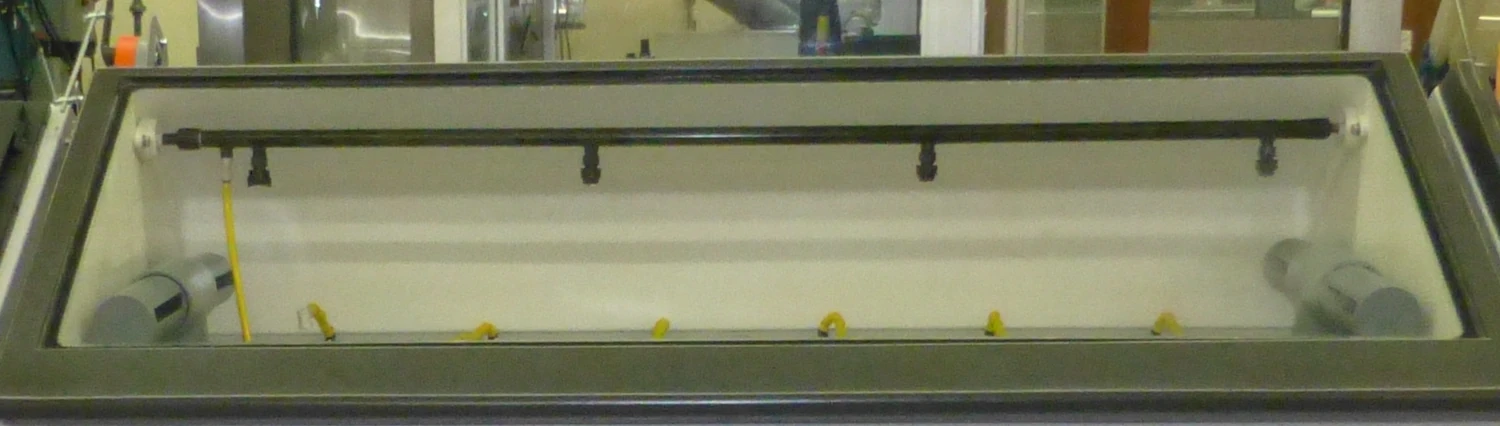
Ford's Gauge-Loss Chamber Verification
The current Ford laboratory method uses a distinctive coated-panel gauge-loss strategy to verify the combined severity of the exposure. A minimum of three specified e-coated cold-rolled-steel panels are prepared with a controlled uncoated area, positioned in the chamber and exposed for six weeks. Loss of steel thickness in the exposed area is then measured.
Specified Verification Panel
- ACT Test Panels part 61934 or the Ford-specified equivalent.
- Cold-rolled steel, nominally 3 × 4 × 0.032 inches.
- Bonderite 958 / Parcolene 90 pretreatment and Aqua EC 4027 e-coat.
- A controlled bare area on one face, oriented toward the bottom during exposure.
Qualification Result
- Average gauge loss for each panel: 150 to 250 µm after six weeks.
- Thickness loss measured by the applicable Ford micrometer or ultrasonic procedure.
- Qualification repeated quarterly and after a new exposure situation changes equipment, load, airflow or chamber homogeneity.
- Independent temperature and humidity records support the verification.
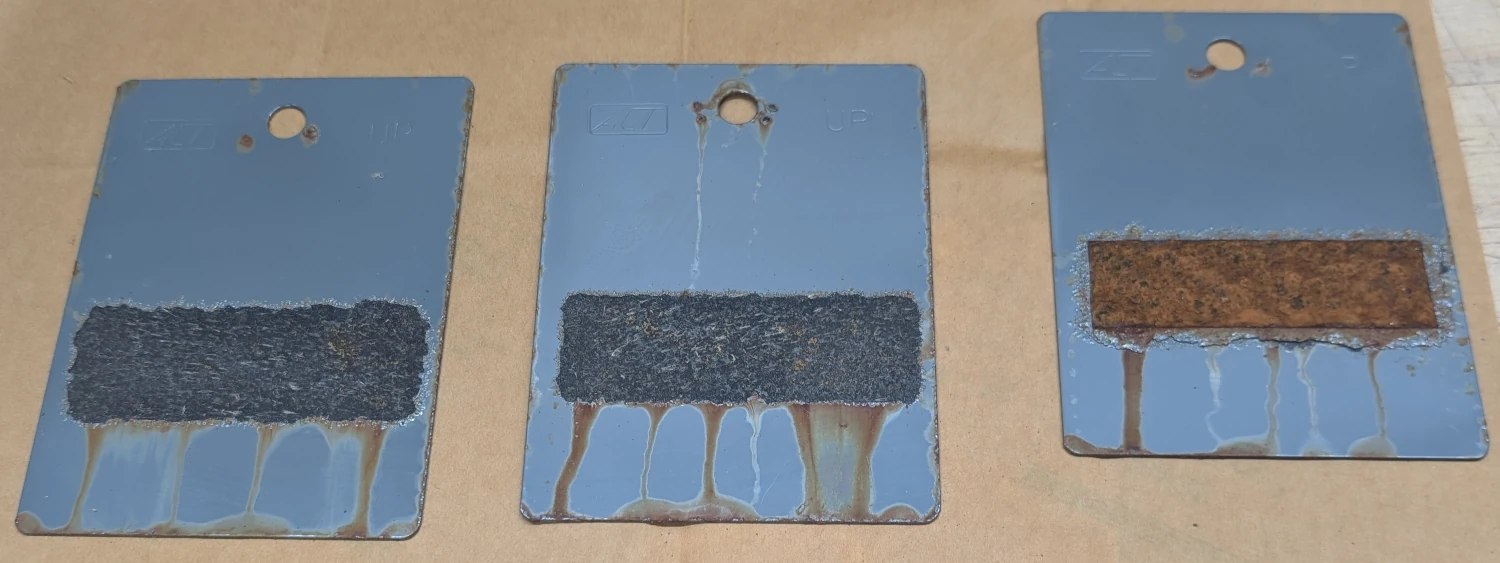
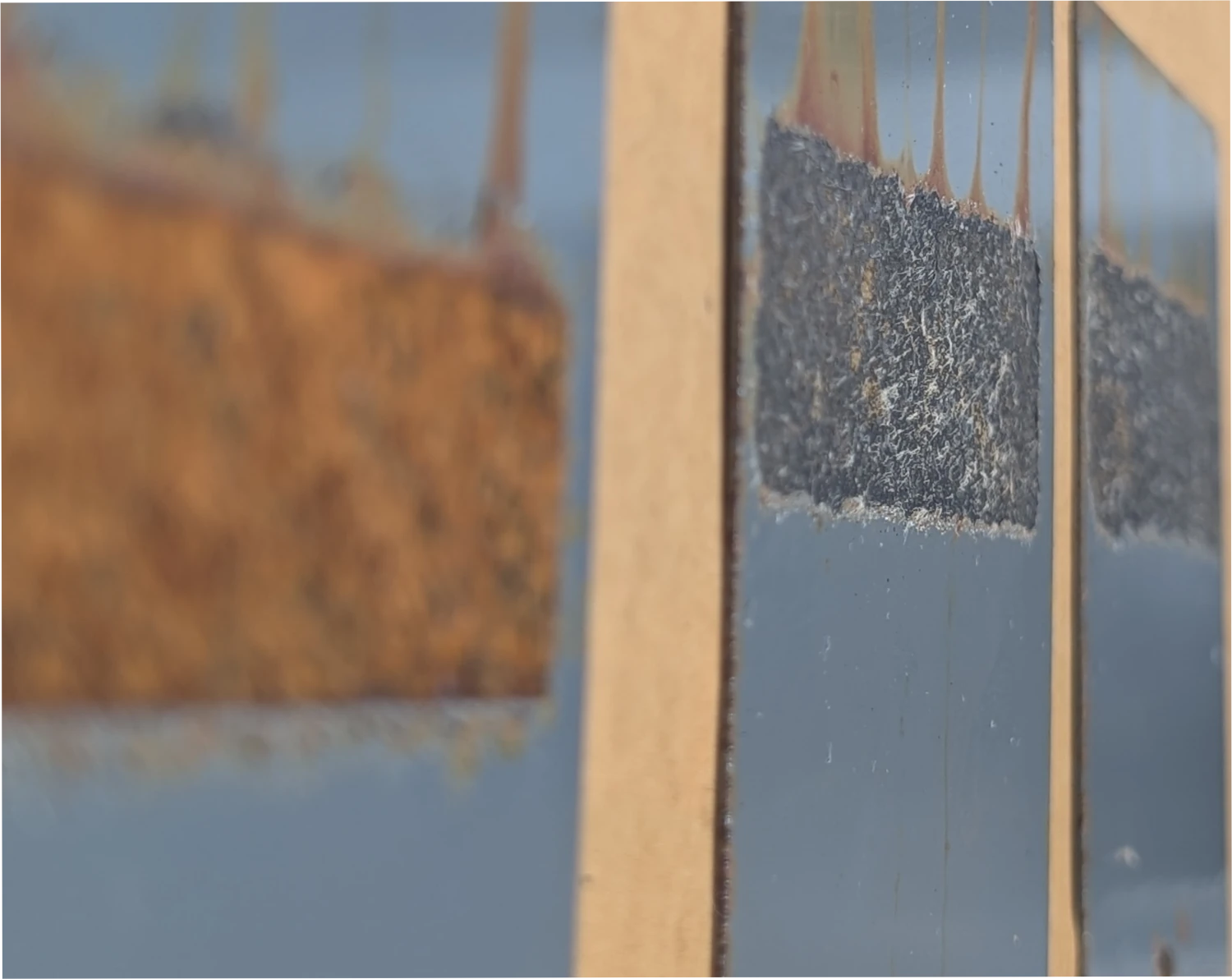
Ultrasonic Gauge-Loss Measurement
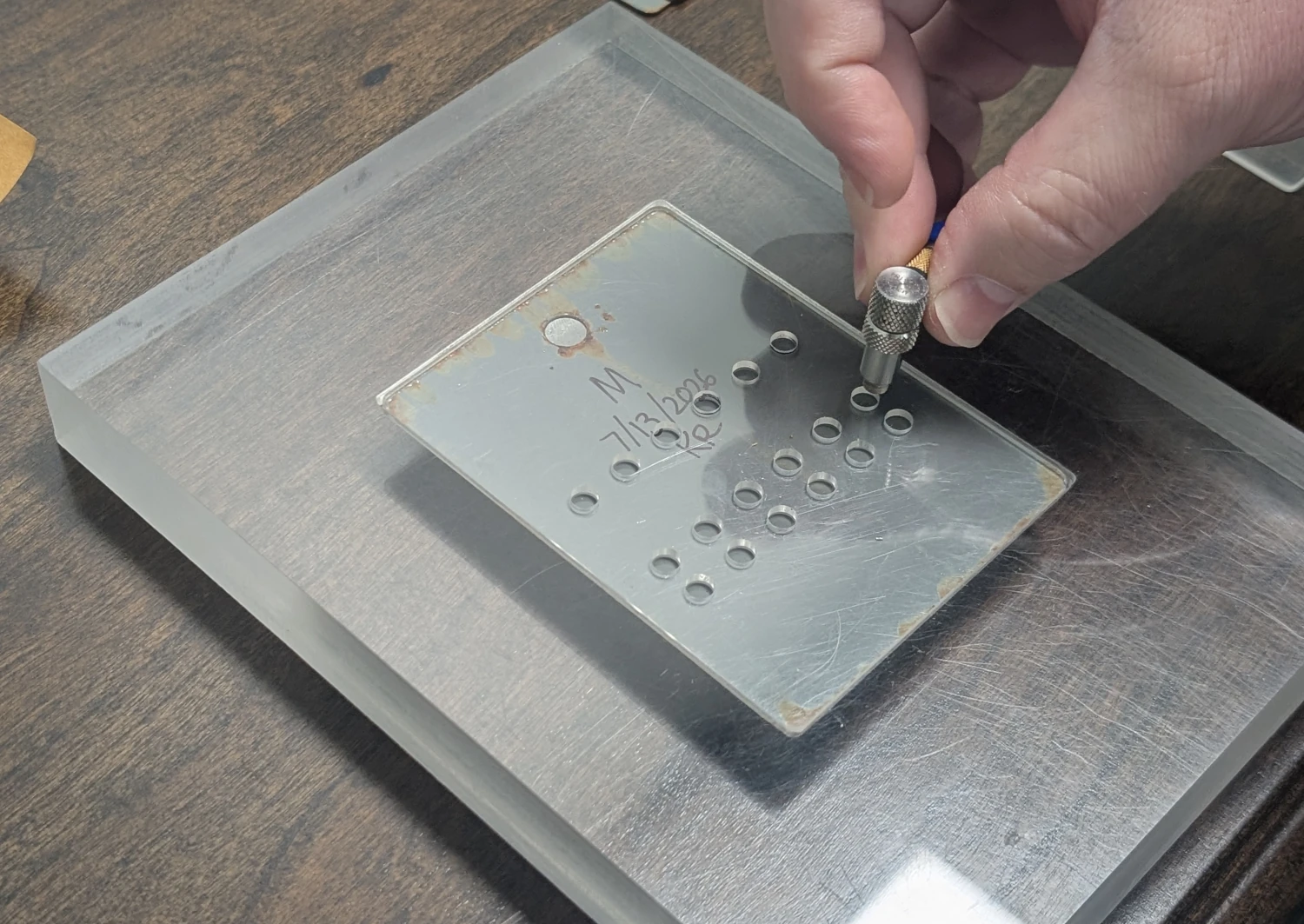
After exposure and cleaning, each Ford gauge-loss coupon is secured in a dedicated panel holder or measurement base. A matching measurement template fits over the holder and establishes the probe locations across the exposed area. The template keeps the ultrasonic probe in repeatable positions while the holder prevents the panel from shifting during measurement.
ATC uses an ultrasonic thickness-gauge kit with the appropriate probes to measure the remaining steel thickness at the defined template locations. The gauge-loss panel, holder, measurement template, ultrasonic gauge and probes function as one measurement system, allowing results to be compared among locations on a panel, among the required panels and across successive chamber-qualification runs.
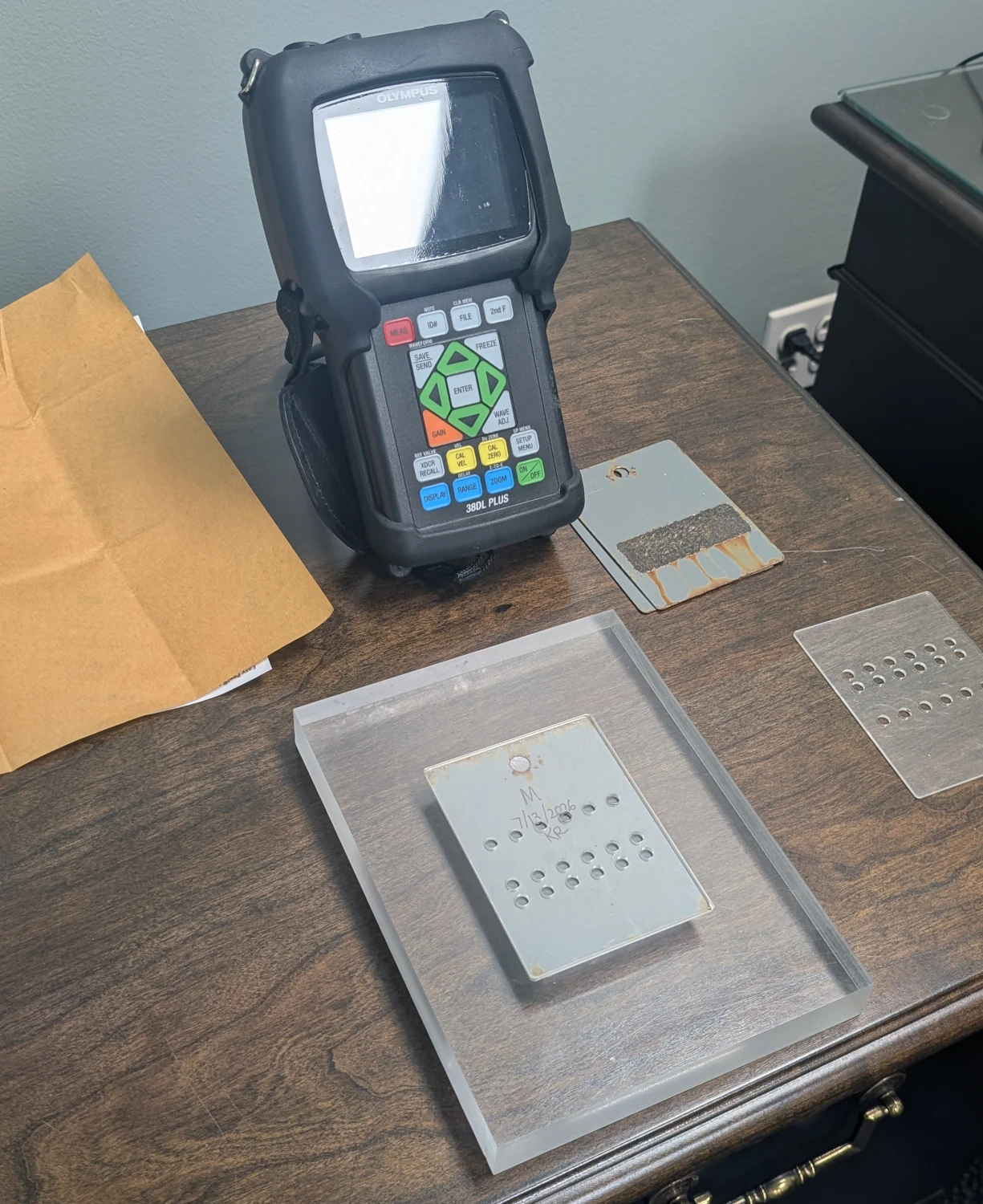
What the gauge-loss result captures
The gauge-loss panels are used to qualify the chamber, not to determine the duration of a component test. After six weeks of exposure, each panel must show an average steel thickness loss of 150 to 250 µm. Results outside that range can indicate a problem with spray coverage, cooling, humidity, drying, airflow or chamber loading. The governing Ford component or material requirement defines how long the customer’s parts remain in test.
How ATC Builds and Runs an L-467 Program
| Step | ATC Activity | Program Control |
|---|---|---|
| 1 | Review the callout | Confirm TM or CETP revision, duration, specimen preparation, inspections, acceptance criteria and reporting needs. |
| 2 | Plan the load | Document production orientation, spacing, masking, drainage, fixture material and representative assembly condition. |
| 3 | Verify the exposure space | Confirm direct-spray coverage, downfall collection, airflow, cooling capacity and chamber uniformity for the intended load. |
| 4 | Prepare the solution | Control sodium chloride concentration, water quality, solution delivery and non-reuse requirements. |
| 5 | Program and monitor | Run the seven-day sequence with chamber controls and independent temperature/RH monitoring. |
| 6 | Inspect at agreed intervals | Photograph and record cosmetic, coating, galvanic, crevice, perforation or functional observations as required. |
| 7 | Report the program | Provide the test basis, configuration, exposure records, observations, deviations and results needed for engineering review. |
Small Components Through Walk-In Assemblies
ATC's laboratory has small and large cyclic corrosion chambers, including walk-in capacity. Chamber selection is based on specimen size, thermal mass, production orientation, drainage, spray coverage and the room needed to maintain representative airflow around the load.
Small Chambers
Efficient programs for coupons, fasteners, brackets, coated panels, hardware and small production parts.
Component Chambers
Flexible capacity for larger parts, mixed specimen sets, representative fixtures and production assemblies.
Walk-In Chambers
Room for large subassemblies, structural components and substantial test loads while preserving access, spacing and orientation.
Information to provide for a quote
- The complete Ford standard designation and revision.
- The governing drawing, material specification or engineering callout.
- Specimen dimensions, mass, quantity, substrate, finish and production orientation.
- Required preparation, damage, scribing, masking, cycling duration and interim inspections.
- Evaluation method, acceptance criteria, reporting format and desired schedule.
- Any nonstandard loading, electrical, mechanical or functional operation required during exposure.
ATC can provide exposure-only work, scheduled photographic documentation or a more complete program with preparation, inspections, gauge-loss verification and engineering-ready reporting. Any departure from the cited requirement is identified and agreed before the test begins.
From Ford APG Testing to Global L-467
Before Ford acquired Volvo Cars in 1999, Ford already had a paired vehicle-and-laboratory corrosion program. The APG procedure was Ford's proving-ground vehicle exposure; APGE, also identified as FLTM BI 123-01, was its laboratory counterpart. Published Ford work used APG and APGE to compare precoated steels and to relate chamber conditions to vehicle microenvironments.
Ford also participated with other automakers and steel producers in the cooperative work that produced SAE J2334. That program added broad field correlation, designed experiments and multi-laboratory round-robin data to the industry's understanding of cyclic wet, salt and dry exposures. It did not replace Ford's APG/APGE system or become Ford's primary internal vehicle test.
After the Volvo acquisition, Ford and Volvo worked toward a common global procedure. The present TM retains the direct-downfall and controlled-climate cycle while adding explicit gauge-loss qualification and independent climate monitoring. L-467 is now used throughout the Ford/Volvo supply chain and by independent laboratories, coating suppliers, fastener manufacturers and researchers when this type of exposure is specified.
L-467 and SAE J2334 are related by technical history, not interchangeable by default.
Both reflect the automotive industry's move away from continuous salt fog, but their electrolytes, application methods, climatic stages, control coupons and acceptance framework differ. Substitution requires approval from the responsible engineering authority.
Technical sources
- SAE 932364, Ford APG cyclic-test evaluation.
- SAE 2001-01-0646, Ford field and proving-ground microenvironment study.
- SAE 970734, nine-laboratory evaluation of the proposed J2334 test.
- SAE 2003-01-1234, update on development of SAE J2334.
- SAE 2003-01-1238, comparison of vehicle and accelerated perforation-corrosion tests.
- SAE J2334, Cosmetic Corrosion Lab Test.
Ford L-467 Testing FAQ
Is Ford L-467 a salt spray test?
L-467 is a cyclic corrosion method that includes scheduled direct salt downfall, controlled cooling, condensation, humid transition and elevated-temperature exposure. It is not continuous neutral salt fog, and an atomizing fog system does not reproduce the required direct spray.
What is the difference between Ford R-343 and L-467?
R-343 is Ford's full-vehicle corrosion test. L-467 is the corresponding laboratory method for materials, components and assemblies. It reproduces the salt-loading and climatic portion of the vehicle exposure under controlled laboratory conditions; vehicle-level results take precedence where the two conflict.
How long does an L-467 test run?
L-467 defines the repeating exposure, but the governing component or material requirement defines the required number of weeks, interim inspections and acceptance criteria. ATC confirms those items during test planning.
Are CETP 00.00-L-467 and TM 00.00-L-467 the same?
They share the same basic cycle but contain meaningful differences in tolerances, monitoring and chamber-verification requirements. The test should be run to the exact revision cited by the governing requirement.
What do the Ford gauge-loss panels control?
The coated panels verify that the chamber produces the required overall corrosion response after six weeks. After exposure and cleaning, each panel is secured in a dedicated holder and measured with an ultrasonic gauge and probe through a locating template. The panels qualify and periodically recheck the exposure; they do not set the end point of every component test.
Does L-467 define the component's pass/fail requirement?
Not by itself. L-467 defines the exposure and chamber controls. The governing drawing, material specification or engineering requirement supplies the duration, inspection points, evaluation method and acceptance criteria.
Can companies outside Ford's supply chain use this method?
Yes. ATC can run L-467 for coating suppliers, material developers, component manufacturers and other industries when the method is selected as the agreed exposure. The customer must still define duration, evaluation and acceptance requirements.
Is SAE J2334 equivalent to Ford L-467?
No. The methods share a field-correlated cyclic-corrosion philosophy, and Ford participated in the cooperative development of J2334, but the procedures have different solutions, application systems, climate sequences and controls. One should not replace the other without engineering approval.
Bring Ford L-467 Testing In-House
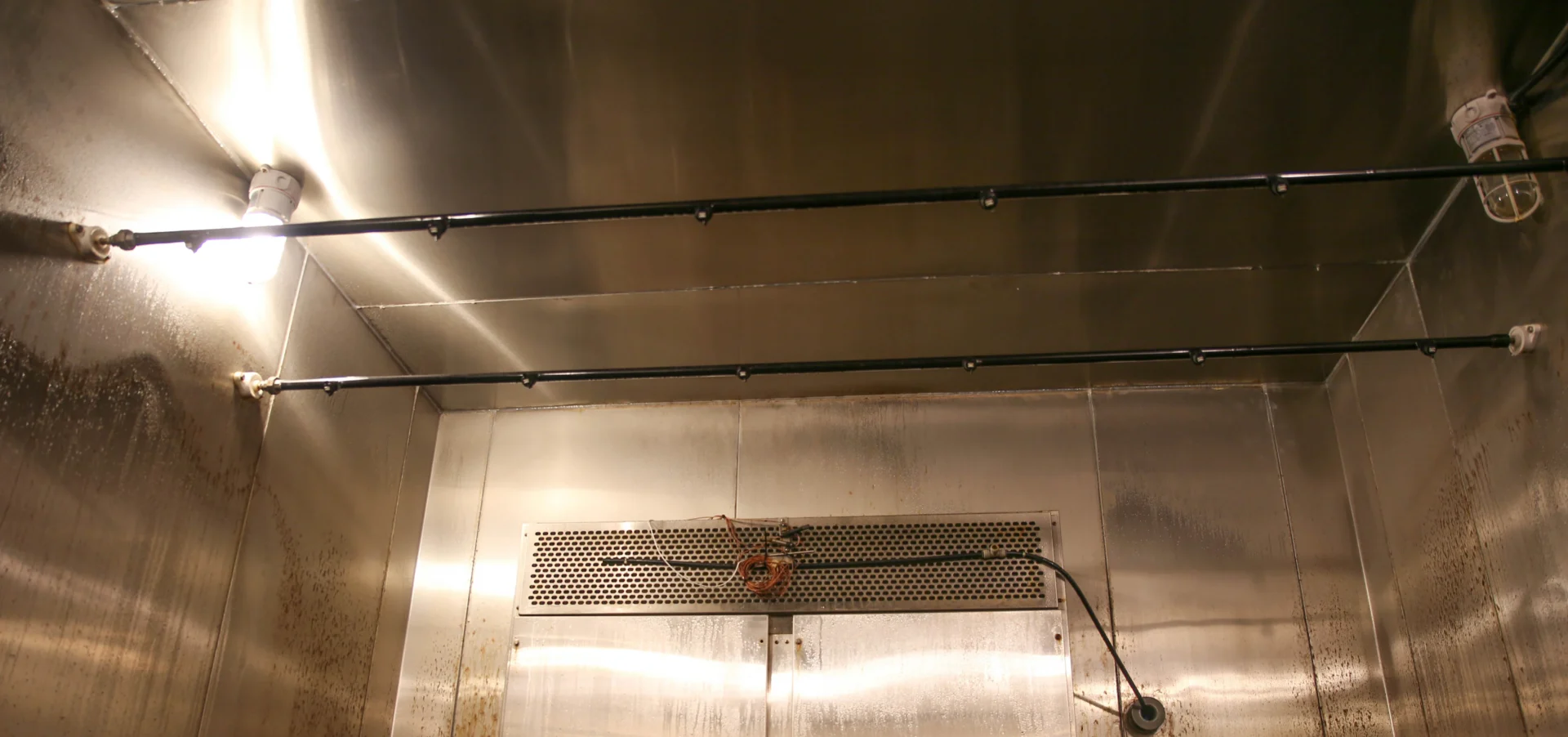
Auto Technology designs and manufactures cyclic corrosion systems that can be configured for Ford TM and CETP 00.00-L-467. ATC offers smaller chambers for panels and hardware, larger cabinets for production components, and walk-in systems for major assemblies and high-volume loads.
Small and Standard Systems
Right-sized chambers for development laboratories, supplier validation, coated panels, fasteners and component programs.
Large and Walk-In Systems
Custom usable volumes, access and loading arrangements for large subassemblies, structural parts and representative production loads.
L-467 Configuration
Moving direct-spray delivery, controlled RH transitions, forced cooling, airflow management, data recording and provisions for independent monitoring.
Configure the Chamber Around the Actual Test Load
Final chamber selection depends on the Ford revision, specimen envelope, thermal mass, airflow, direct-spray coverage, utilities and facility conditions. ATC can use its laboratory experience to help define a system that performs the method with the intended production load installed.
Need a test now instead? Visit the ATC Materials and Corrosion Testing Laboratory or contact ATC to discuss chamber sizing and configuration.