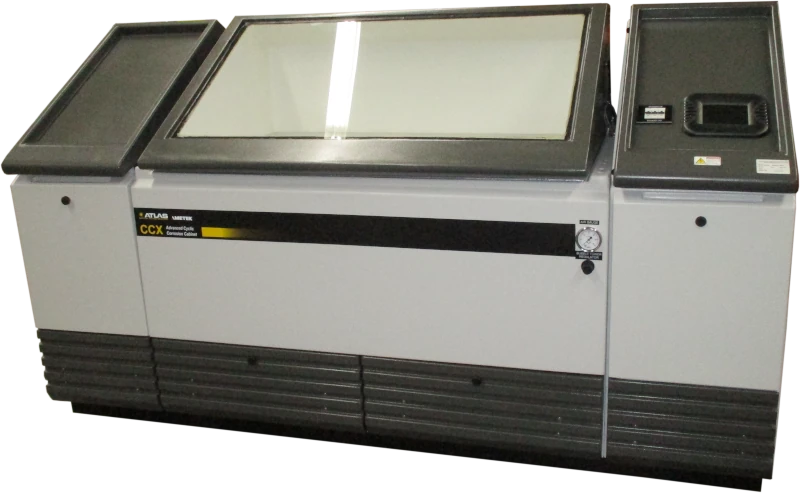
GMW 14872 Cyclic Corrosion Test Chamber – A Series Size 20
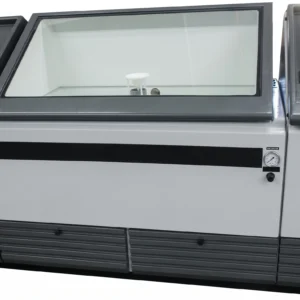
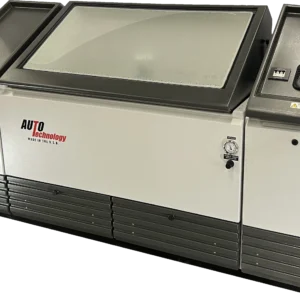
The Auto Technology A Series Size 20 is a configurable GMW 14872 cyclic corrosion test chamber with approximately 20 ft³ (594 L) of usable internal test volume. This configuration uses touchscreen controls, direct salt-solution spray, controlled humidity and dry-off, and air-operated cover lifters that expose specimens to actual laboratory ambient air during the ambient stage.
- Ambient Stage: Automated cover opening for direct exposure to qualifying laboratory ambient conditions
- Solution Application: Adjustable direct spray for thoroughly wetting the required component areas and corrosion coupons
- Control System: Integrated touchscreen control of spray, cover lifters, humidity, temperature, dry-off, and cycle timing
- Method Configuration: Built around the specified Method, Exposure, vehicle area, mounting location, spray frequency, and documented deviations
GMW 14872 is not one fixed exposure. Final chamber configuration must be based on the applicable engineering specification, drawing, component location, exposure target, and required test options.
Description
The A Series Size 20 GMW 14872 Cyclic Corrosion Test Chamber is configured for laboratories evaluating automotive components and assemblies using
GMW 14872, Cyclic Corrosion Laboratory Test.
It provides approximately 20 ft³ (594 L) of usable test volume and combines direct salt-solution spray, true laboratory ambient exposure, high-temperature humidity, controlled dry-off, corrosion-coupon monitoring, and touchscreen test control.
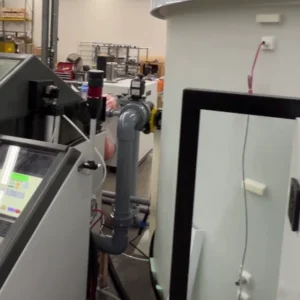
Air-operated cover lifters opening a corrosion chamber for direct exposure to laboratory ambient air.
True Ambient Exposure
Air-operated cover lifters open the chamber during the ambient stage so specimens are exposed directly to qualifying laboratory air.
Method-Specific Spray
Direct solution spray is configured around specimen geometry, mounting orientation, splash exposure, and required application frequency.
Touchscreen Operation
The A Series uses an integrated touchscreen rather than the full PC-based control interface used on the X Series.
Request a GMW 14872 Size 20 Quote
Provide the applicable GMW 14872 revision, Method, Exposure, vehicle area, mounting location, spray frequency, specimen dimensions, and any specified deviations.
GMW 14872 Is Not One Fixed Test Configuration
GMW 14872 combines salt-solution exposure, ambient conditions, high-temperature humidity, and high-temperature dry-off. However, the required exposure is tailored to the component, vehicle area, mounting location, splash protection, cosmetic or functional objective, selected Method, and any specified deviation.
The applicable engineering documentation must identify the required configuration. A laboratory should not select the Method or spray frequency based solely on available chamber time or equipment convenience.
| Selection variable | What it affects |
|---|---|
| Method 1, 2, or 3 | Applicable coupon mass-loss target and permitted cycle range |
| Vehicle area | Underbody, underhood, exterior, secondary-surface, or interior exposure |
| Mounting location | Splash exposure, spray frequency, and coupon target associated with the component location |
| Exposure 0, A, B, C, D, or E | Initial-delivery, cosmetic, or functional exposure objective |
| Specified deviation | Additional contaminant, thermal, mechanical, electrical, rinse, or other component-specific stress |
Configuration requirement: The A Series chamber must be configured around the exact GMW 14872 callout. Some deviations or combined-stress programs may require additional hardware or a more extensively configurable X Series chamber.
GMW 14872 Base 24-Hour Cycle
One GMW 14872 cycle is 24 hours. The base cycle consists of approximately eight hours at ambient conditions, approximately eight hours at high temperature and high humidity, and approximately eight hours of high-temperature dry-off.
| Stage | Duration | Conditions |
|---|---|---|
| Ambient stage | Approximately 8 hours | 25°C ±3°C and 45% RH ±10%; first salt application occurs at the beginning of this stage |
| Humid stage | Approximately 8 hours | Ramp within approximately 1 hour to 49°C ±2°C and approximately 100% RH, then maintain for approximately 7 hours |
| Dry-off stage | Approximately 8 hours | Ramp within approximately 3 hours to 60°C ±2°C and no more than 30% RH, then maintain for approximately 5 hours |
Ramp times affect corrosion acceleration and are included within the applicable stage duration. Significant deviations must be documented and approved by the parties concerned.
Air-Operated Cover Lifters for True Ambient Exposure
The A Series GMW 14872 configuration uses air-operated cover lifters to open the chamber during the ambient stage. Opening the cover exposes the specimens directly to the laboratory environment rather than creating an artificial ambient condition inside a closed chamber.
This approach follows the original open-rack methodology in which sprayed parts dried through exposure to laboratory ambient air. The 2022 method defines the required ambient conditions but does not mandate a specific means of producing them.
Facility condition: An open-cover ambient stage is valid only when the laboratory environment can maintain 25°C ±3°C and 45% RH ±10% around the test specimens. Room conditions and recovery time after salt application must be monitored and documented.
Why the cover lifters matter: They automate the transition between a closed, controlled chamber and direct room-air exposure while preserving the programmed 24-hour sequence.
Direct GMW 14872 Salt-Solution Spray
GMW 14872 requires the salt solution to be sprayed directly onto the test samples and corrosion coupons until the required areas are thoroughly wet and dripping. The application must visibly rinse away salt accumulation from previous sprays without removing corrosion products or damaging coatings.
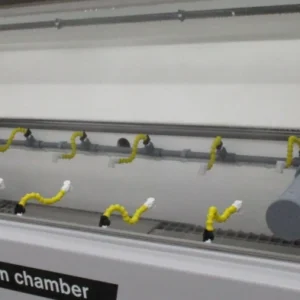
Low-velocity, high-volume cascading spray used to wet the required specimen surfaces without high-pressure impingement.
Spray Coverage
Nozzle position is configured to wet focal areas based on the component geometry and intended in-service orientation.
Application Frequency
The required schedule may be four sprays per cycle, one spray per cycle, or one spray every five cycles depending on the specified location and exposure.
Spray Spacing
When multiple sprays are specified, subsequent applications should occur approximately 1.5 hours apart, with at least one hour between applications.
Specimen orientation: Representative production parts should be positioned to reproduce their known in-service orientation. When that orientation is unknown or flat panels are used, the method generally calls for an upward-facing position of 20° ±5° from vertical.
GMW 14872 Complex Salt Solution
The base GMW 14872 solution is an approximately 1% complex salt mixture prepared using ASTM D1193 Type IV water.
| Solution component | Concentration by mass |
|---|---|
| Sodium chloride, NaCl | 0.9% |
| Calcium chloride, CaCl2 | 0.1% |
| Sodium bicarbonate, NaHCO3 | 0.075% |
Mixing requirement: The calcium chloride or sodium bicarbonate must be dissolved separately in water before it is added to the other solution components. Adding all solid materials together in a dry state can produce an insoluble precipitate.
High-Humidity Exposure and Dry-Off
After the ambient stage, the chamber ramps to the high-temperature humid condition and then transitions to the high-temperature dry-off stage. The A Series coordinates heating, humidity generation, draining, ventilation, and air circulation through the programmed cycle.
High-humidity operation inside an Auto Technology cyclic corrosion chamber.
Humid Stage
- 49°C ±2°C
- Approximately 100% RH
- Ramp within approximately one hour
- Approximately eight-hour total stage
Dry-Off Stage
- 60°C ±2°C
- No more than 30% RH
- Ramp within approximately three hours
- Approximately eight-hour total stage
Humidity method: GMW 14872 permits water fog, wet-bottom humidity, or steam-generated humidity. The selected A Series humidity configuration must produce the required specimen wetness and environmental conditions for the applicable setup.
Corrosion-Coupon Mass-Loss Monitoring
GMW 14872 does not determine exposure solely by elapsed test time. Corrosion coupons monitor the average general bare-steel corrosion produced by the chamber. The applicable mass-loss target must be reached within the cycle range specified for the selected Method, vehicle area, mounting location, and Exposure.
The coupon rack is placed near the test specimens so the coupons receive the same base environmental exposure. Coupons are typically removed and evaluated at predetermined intervals during the test.
A Series Touchscreen Controls
The A Series uses an integrated touchscreen control system to sequence the Size 20 chamber through salt-solution application, cover opening and closing, humid exposure, dry-off, and repeated daily cycles.
The chamber program is configured around the required GMW 14872 spray schedule and environmental stages. The operator does not need to manually open the cover or initiate each programmed transition.
| A Series | X Series |
|---|---|
| Integrated touchscreen control | Full PC-based control interface |
| Configured for defined cyclic spray, ambient, humidity, and dry-off sequences | Greater configuration range for advanced options, combined stresses, and more complex test programs |
| Appropriate when the specified GMW 14872 version fits the selected A Series hardware package | Appropriate when the method requires capabilities beyond the selected A Series configuration |
A Series and X Series chambers perform the same basic GMW 14872 environmental sequence when configured for it. The principal differences are the control platform and the range of available system capabilities.
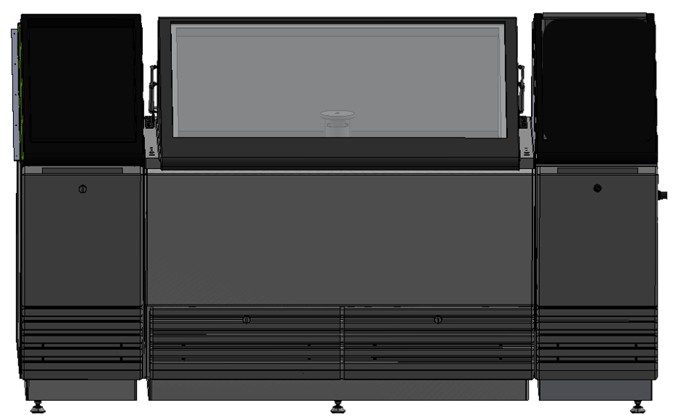
A Series Size 20 Test Chamber
The Size 20 provides laboratory-scale capacity for automotive components, assemblies, coated panels, and corrosion coupons. Racking and nozzle placement are selected around the actual test objects so the required areas receive solution while preserving drainage, humidity exposure, and airflow.
Usable test volume
Approximately 20 ft³
Approximately 594 liters
Internal dimensions
50 × 29 × 25 in
127 × 73 × 64 cm
Configure a Size 20 Chamber for GMW 14872
Specify the GMW 14872 revision, Method, Exposure, vehicle area, mounting location, spray frequency, specimen geometry, facility ambient conditions, and required deviations.
GMW 14872 Size 20 Chamber FAQ
What is GMW 14872?
GMW 14872 is an accelerated laboratory cyclic corrosion method for assemblies and components. It combines salt-solution application, ambient exposure, high-temperature humidity, and high-temperature dry-off.
Is GMW 14872 run the same way for every component?
No. The required Method, Exposure, spray frequency, coupon mass-loss target, cycle range, and deviations depend on the component, vehicle area, mounting location, splash protection, and evaluation objective.
How does the A Series provide the GMW 14872 ambient stage?
Air-operated cover lifters open the chamber and expose the test specimens directly to laboratory ambient air. The laboratory must maintain the required 25°C ±3°C and 45% RH ±10% conditions around the specimens.
Does GMW 14872 require the chamber cover to open?
The 2022 method defines the ambient temperature, relative humidity, and duration but does not mandate a specific method for producing those conditions. The A Series uses cover lifters to reproduce the original open-air approach instead of synthesizing ambient conditions inside a closed chamber.
How often is salt solution applied during GMW 14872?
Application frequency depends on the specified vehicle area, mounting location, Method, and Exposure. Depending on the callout, the schedule may require four sprays per cycle, one spray per cycle, or one spray every five cycles.
What is the difference between the A Series and X Series for GMW 14872?
Both chamber series can perform the basic GMW 14872 spray, ambient, humidity, and dry-off sequence when properly configured. The A Series uses integrated touchscreen controls. The X Series uses a full PC-based interface and supports a broader range of advanced configurations and combined-stress options.
Can the Size 20 chamber be customized for GMW 14872 deviations?
The Size 20 can be configured for the specified version of GMW 14872 when the required hardware and test load fit the A Series platform. Deviations involving contaminants, additional stresses, or specialized handling must be reviewed before the chamber is quoted.
Why are corrosion coupons required?
Coupons monitor the general bare-steel corrosion produced by the chamber. The applicable mass-loss target must be achieved within the permitted cycle range for the selected Method, vehicle location, and Exposure.
What is the capacity of the A Series Size 20?
The Size 20 provides approximately 20 ft³ or 594 L of usable test volume with internal dimensions of 50 × 29 × 25 inches.
What information is needed to quote a GMW 14872 chamber?
Provide the applicable revision, Method, Exposure, vehicle area, mounting location, salt-application schedule, specimen dimensions, loading quantity, facility ambient conditions, and any specified deviations.
Related products
-

A Series Size 20 Cyclic Corrosion Chamber
Contact Us to Configure Your Chamber -
SAE J2334 Immersion Cyclic Corrosion Test Chamber – X Series Size 40
Contact Us to Configure Your Chamber -
Ford L-467 / CETP 00.00-L-467 Cyclic Corrosion Test Chamber – X Series Size 40
Contact Us to Configure Your Chamber -
MIL-STD-810 Method 509.7 Salt Fog Chamber – C Series Size 20
Contact Us to Configure Your Chamber