
A History of Corrosion Testing
A History of Corrosion Testing
From salt fog to cyclic testing—and the continuing problem of predicting what will happen outside the laboratory.
Move a vehicle from the dry highways of Nevada to Cleveland’s salted winter roads and the problem becomes visible quickly. Salty water reaches seams, fasteners, stone chips, and places that never quite dry. A finish that looked sound in the showroom begins to blister. Rust spreads beneath paint. Eventually, what began as cosmetic damage can reach the metal beneath it.
Manufacturers have spent more than a century trying to reproduce that deterioration in the laboratory because waiting years for a vehicle, coating, or material to fail outdoors is rarely practical. The difficulty is that making metal corrode quickly is much easier than making it corrode quickly for the same reasons it does in service. Much of the history of corrosion testing is therefore a history of acceleration followed by correction: industry develops a faster test, compares it with actual performance, discovers where the laboratory exposure diverges from the field, and then tries to build a better one.
1914–1954: The Rise of Salt Fog
Early accelerated corrosion testing began with a practical problem: outdoor exposure took too long. A manufacturer comparing protective coatings might otherwise have to wait through seasons or years before meaningful differences appeared. John A. Capp’s 1914 work on metallic protective coatings helped establish salt fog as one answer. ASTM issued the tentative salt spray standard B117-39T in 1939, and the method continued to evolve over the following decades, including adoption of a 5% sodium chloride solution in the 1954 version. The familiar salt spray test was not invented in a single step; it developed as laboratories learned how to create a repeatable corrosive environment. [1]
In a neutral salt spray exposure, a chamber maintains a warm environment while an atomizer turns salt solution into a fine fog. Specimens remain continuously exposed under controlled conditions. ASTM B117 defines how that apparatus is operated, while the product specification or test agreement determines how long the specimens remain in the chamber and what constitutes acceptable performance. That separation is important. B117 provides an exposure environment; it does not, by itself, define the service life of the product inside it. [2]

For comparison and quality control, that controlled environment became enormously useful. Trouble began when the same result was treated as a direct forecast of outdoor durability. ASTM itself cautions that salt spray results alone seldom correlate with performance in natural environments. One thousand hours in a cabinet does not automatically equal a particular number of years on a road, bridge, ship, or industrial structure. Establishing that relationship requires exposure data for the materials and environments in question. [2]
That distinction became increasingly important as corrosion protection improved. A severe laboratory environment could quickly reveal that one coating was different from another, but speed was not enough if the test changed the mechanism of deterioration or ranked materials differently from actual service. The automotive industry would encounter that problem directly as road salt use expanded and vehicle designs changed.
1950s–1980s: Road Salt Changes the Question
Postwar vehicle design and winter road maintenance made the shortcomings of simple laboratory exposures harder to ignore. In his 1977 paper Vehicle Corrosion in Perspective, Michael C. Belangie described corrosion as the result of both increasingly aggressive environmental exposure and changes in the vehicles themselves. Deicing salts mattered, but so did thinner steel, body construction, seams, joints, drainage, and places where moisture and contamination could accumulate. The corrosive environment was not simply the amount of salt placed on the road. It was the environment created when that salt interacted with the design of the vehicle. [3]
Salt water acts as an electrolyte, allowing the electrochemical reactions involved in corrosion to proceed more readily. But a vehicle does not remain uniformly wet. Water enters a seam and drains slowly. Dirt holds moisture against a surface. A stone chip breaks a coating and exposes the metal beneath it. One area dries while another remains damp. As water evaporates, dissolved salts become more concentrated and eventually remain as deposits that can become active again when humidity rises or fresh water arrives. Corrosion products also change as the environment changes, sometimes forming deposits that slow further attack and sometimes providing little protection.
A continuously wet salt fog cabinet removes much of that variation. That can matter particularly when comparing plain steel with zinc-coated steel. Zinc is valuable partly because it can corrode preferentially and protect exposed steel nearby, but the behavior of zinc depends strongly on the surrounding environment and on the corrosion products that form on its surface. If an accelerated test consumes zinc unrealistically, prevents representative drying, or produces the wrong deposits, it can give a misleading picture of how galvanized material will perform on a vehicle. Later SAE research specifically identified the difficulty existing accelerated tests had in reproducing field rankings of automotive materials. [5]
By the 1970s, the broader problem of accelerated testing was already well recognized. A 1973 National Bureau of Standards review discussed continuous and cyclic exposures and warned against assuming that accelerated aging had a universal relationship with outdoor performance. A test could omit an important stress, introduce one that did not exist in service, or intensify a real stress until the material failed by a different mechanism. The laboratory could then provide a faster answer without providing the right answer. [4]
This changed the direction of corrosion-test development. The question was no longer simply how to expose a specimen to more salt or make rust appear sooner. Researchers increasingly asked whether the laboratory reproduced the sequence of conditions that controlled corrosion outside the laboratory. That led toward cyclic testing: deliberate combinations of salt application, high humidity, drying, temperature changes, and other stages intended to reproduce important parts of the service environment. The value of such a cycle would have to be demonstrated by comparing its results with what actually happened in the field.
1984–2001: Building SAE J2334 from Field Evidence
One of the most consequential attempts to solve that problem came from a coordinated automotive and steel-industry research program. The 2001 Galvatech paper documenting SAE J2334’s interlaboratory precision traces the effort to a corrosion task force established by the American Iron and Steel Institute’s Automotive Applications Committee in 1984. The work later joined with the SAE automotive corrosion group, with support from the Auto/Steel Partnership beginning in 1995. Vehicle manufacturers, steel producers, coating suppliers, testing organizations, and equipment specialists participated. [5]
The important starting point was not the chamber. It was the vehicle. Researchers evaluated a defined set of ten material systems that included painted plain steel and steel with metallic coatings. Their field program included five-year pickup-truck exposures in Montreal, Quebec, and St. John’s, Newfoundland, while a subset of materials was also evaluated on front license-plate brackets on vehicles in the United States. Those exposures established a real-world reference against which laboratory methods could be judged. [5]
The laboratory challenge was therefore more demanding than producing visible corrosion. Researchers wanted the accelerated test to reproduce the relative performance of the materials seen outdoors. They also compared the character of the damage and the corrosion products that formed. On painted specimens, one important measurement was scribe creep: the distance corrosion and coating separation spread from a deliberate scratch through the paint. The scribe provided a controlled break in the coating from which underfilm corrosion could develop, allowing the laboratory and field specimens to be compared on a common basis. [5]
The resulting SAE J2334 cycle deliberately combined different environmental stages. The historical cycle described in the 2001 paper used six hours at 50°C and essentially saturated humidity, followed by a 15-minute salt-application stage and then 17 hours 45 minutes at 60°C and 50% relative humidity. The salt solution contained sodium chloride, calcium chloride, and sodium bicarbonate rather than sodium chloride alone. These conditions should not be substituted for the requirements of the applicable current standard; their historical importance is that the researchers were building the cycle around observed corrosion behavior rather than simply increasing the severity of continuous fog. [5]
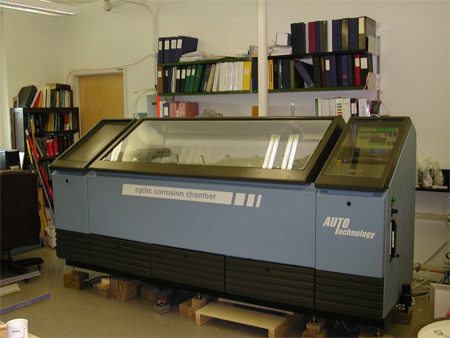
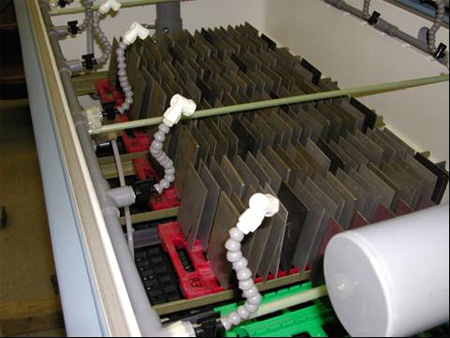
Developing a representative cycle did not end the problem. The test also had to produce comparable results when different laboratories, operators, and chambers ran it. The first interlaboratory exercise in 1997 showed better repeatability within laboratories than reproducibility between them. Follow-up work therefore examined salt delivery, humidity generation, solution checks, reference specimens, and other sources of variation. The 2001 paper describes a 15-laboratory program, with results from 13 laboratories available when it was written. Material rankings were reasonably consistent, but the amount of measured damage still varied between laboratories. [5]
That work is as important to the history of J2334 as the cycle itself. A corrosion test does not become useful merely because its stages appear realistic on paper. The apparatus has to produce those conditions consistently enough that results can be compared, and the resulting corrosion has to continue agreeing with the material behavior the test was designed to represent. Kevin Smith of Auto Technology Company was a coauthor of the 2001 paper, documenting ATC’s participation in that interlaboratory effort. [5]
2000s–2020s: Cyclic Testing Expands Beyond a Single Method
J2334 did not produce one universal replacement for salt fog. Instead, cyclic testing developed into a family of methods designed around different materials, vehicle programs, components, and qualification needs. Ford, GM, and other manufacturers established their own exposures. These tests share the idea that corrosion is influenced by changing environmental conditions, but they do not use identical schedules, salt applications, humidity controls, or acceptance criteria. Calling two methods “cyclic” does not make them interchangeable.
Ford’s CETP 00.00-L-467, for example, combines salt application with controlled temperature and humidity changes and distinct drying periods. A 2024 experimental study presented at the Automotive Corrosion Symposium measured corrosion activity during Ford, GMW 14872, and another cyclic exposure. During the Ford cycle, the measured corrosion activity changed as the environment changed, including increased activity around spraying and drying and little activity during the dry weekend period. The transitions were not simply pauses between important stages; they were part of the exposure. [6]
GMW 14872 illustrates another development: using reference metal specimens to check whether the exposure itself is delivering the intended corrosive severity. A mass-loss coupon is a standardized metal specimen weighed before exposure and again after its corrosion products have been removed according to the prescribed procedure. The difference provides a direct measurement of how much metal was consumed. U.S. Army laboratory guidance incorporating GMW 14872 requires mass-loss controls during cyclic exposure. [7]
That measurement complements the chamber’s environmental instrumentation. Temperature and relative humidity describe conditions in the test space, while the reference coupon records the effect those conditions had on a known material. Neither measurement replaces the other. A chamber can appear to reach its programmed setpoints while still applying salt incorrectly, drying too slowly, or otherwise producing an exposure with unexpected corrosive severity. At the same time, matching the expected loss of a bare steel coupon does not prove that every coated assembly, crevice, fastener, mixed-metal joint, or moisture trap will behave identically. The exposure and the test article remain separate pieces of evidence.
Automotive cyclic methods eventually moved beyond automotive development programs. The 2019 revision TT-C-490G, for example, incorporated GMW 14872 cyclic testing within qualification requirements for specified pretreatment types while retaining salt spray requirements elsewhere in the specification. MIL-DTL-53022F with Amendment 1, dated April 2021, likewise specifies GMW 14872 exposures for particular epoxy-primer types alongside ASTM B117 salt spray and atmospheric exposure requirements. These examples do not show a wholesale military replacement of salt fog. They show cyclic corrosion becoming one tool among several where its particular exposure and validation history were useful. [8] [9]
The same process continues as vehicle materials change. Beginning in 2016, manufacturers and testing organizations in China worked on a new automotive corrosion test known as CATCH—Corrosion Accelerated Test with Controlled Humidity. That work contributed to the development of T/CSAE 130-2020 and continued with research focused on aluminum materials. [10]
The reason for that continued development is straightforward: a corrosion cycle validated against one group of materials cannot automatically be assumed to represent another. Painted steel, aluminum, advanced coatings, adhesive joints, and mixed-metal assemblies can respond differently to the same environment. Aluminum joined to steel, for example, introduces galvanic interactions that depend on electrical contact, coating condition, retained electrolyte, geometry, and the relative areas of the connected metals.
Corrosion methods therefore continue to evolve for the same reason cyclic testing emerged in the first place. As materials and vehicle designs change, laboratory exposures have to be checked against the failures engineers are actually trying to understand. Standardization can make a test repeatable; comparison with field and service performance establishes what that repeatability means.
Software Extends the Same Search for Earlier Answers
The newest step in this history is not another chamber cycle but an attempt to move corrosion decisions earlier in product development. In a 2024 Automotive Corrosion Symposium presentation, GM Defense described the use of material filters, coating simulations, design reviews, and previous vehicle-test data as tools for reducing development cost and identifying potential corrosion problems before physical prototypes are complete. These methods can make product development more efficient, but they do not eliminate the need to establish how a prediction relates to actual corrosion. [11]
A digital model can help an engineer identify a pocket likely to retain water, a joint with poor drainage, or a potentially unfavorable combination of metals. A material list can be screened for galvanic compatibility. Simulations can help evaluate whether electrocoat—paint deposited from a liquid bath using electrical current—will reach recessed areas and where trapped air or retained liquid may leave insufficient protection. Finding those problems during design can avoid tooling changes, prototype rework, and unnecessary physical tests later. [11]
What software cannot do on its own is establish the relationship between a modeled condition and long-term service corrosion. That relationship has to come from evidence. The same lesson that emerged from continuous salt fog applies here: reproducing the output of a laboratory test is not enough if that laboratory test has not been shown to represent the service condition of interest. A model calibrated against an unrepresentative physical test can reproduce that test accurately while carrying its limitations forward.
The problem becomes more difficult as the prediction becomes more ambitious. Identifying a water-retaining flange is different from predicting exactly how quickly coating failure, pit growth, metal loss, or perforation will occur there over years of use. A vehicle accumulates stone chips, dirt, repairs, aging sealers, mechanical movement, seasonal salt deposits, and repeated wet-dry cycles in combinations that differ from location to location. Those effects may be modeled individually. The harder task is establishing their actual magnitude and sequence well enough to support a quantitative durability claim.
The GM Defense presentation itself shows why physical observations remain central. Its hose-clamp example uses proving-ground exposure to distinguish a moisture-retaining flat clamp from a design that permitted better drying, and the presentation identifies estimation of corrosion rate without physical data as a major challenge. In that example, the physical result is not an obsolete step waiting to be replaced. It is the evidence that gives the design conclusion meaning. [11]
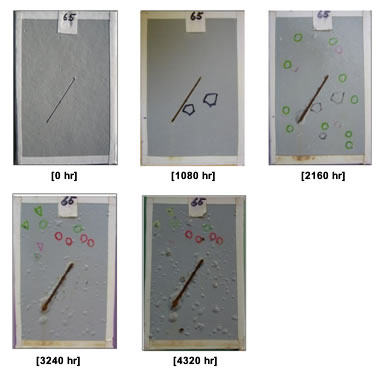
The appropriate physical measurement depends on the prediction being made. It may be metal loss, pit depth, scribe creep, blistering, loss of adhesion, coating thickness, galvanic attack, or continued component function. A bare steel coupon can determine whether a chamber exposure has the expected severity. It cannot establish the life of an entire coated assembly. A proving-ground observation can reveal a drainage problem. It cannot automatically establish the behavior of every material used elsewhere on the vehicle.
Algorithms do not rust. The parts do.Software can reduce the number of poor designs that reach physical testing and can help engineers decide where limited testing resources should be concentrated. Its usefulness therefore depends not on eliminating physical evidence, but on making better use of it.
What the History of Corrosion Testing Shows
The development of corrosion testing has been driven by a consistent industrial need: obtain useful answers sooner. Salt fog provided a practical way to compare materials without waiting years for outdoor exposure. Its limitations became clearer when vehicle experience showed that continuous wetting could produce corrosion unlike the changing conditions found on the road. Cyclic testing responded by reproducing more of those changes, but methods such as SAE J2334 gained value because researchers compared them with field exposures and then tested whether different laboratories could reproduce the results—not merely because the cycles were more complicated.
Ford, GM, military qualification programs, and newer cooperative methods extended that approach rather than ending it. Different materials and applications required different exposures, and reference specimens helped laboratories determine whether those exposures were being delivered consistently. Software now moves the same effort further upstream by allowing engineers to examine corrosion risks before hardware exists, but it does not change the underlying requirement. A prediction becomes useful when there is evidence connecting it to the physical behavior it is intended to predict.
Auto Technology’s participation in the SAE J2334 interlaboratory program places the company within that development history. The lesson from that work remains relevant to every corrosion chamber and every new predictive tool: define the engineering question, reproduce the conditions that matter, measure the resulting damage, and determine how closely that result represents what happens outside the laboratory. [5]
References and Image Sources
- Auto Technology Company. Corrosion Test Chamber History , section “1914–1954: The Standard Salt Spray Test Takes Shape.” Historical chronology references Thomas S. Doppke and Arthur W. Bryant, The Salt Spray Test—Past, Present, and Future , SAE Technical Paper 831815, 1983.
- ASTM International. ASTM B117-19: Standard Practice for Operating Salt Spray (Fog) Apparatus , scope and significance and use. Cited for the practice’s stated purpose and limits, not as the current operating edition.
- Michael C. Belangie. Vehicle Corrosion in Perspective . Transportation Research Record 651, 1977.
- Larry W. Masters, Winthrop C. Wolfe, Walter J. Rossiter Jr., and James R. Shaver. State of the Art on Durability Testing of Building Components and Materials . National Bureau of Standards, NBSIR 73-132, March 1973, sections 6.1.5 and 7.1.1.
- Frank W. Lutze, Duncan C. McCune, R. J. Shaffer, Kevin Smith, Larry S. Thompson, and Herbert E. Townsend. Interlaboratory Testing to Evaluate Improvements in the Precision of the SAE J2334 Cyclic Corrosion Test. Proceedings of the 5th International Conference on Zinc and Zinc Alloy Coated Steel Sheet, Galvatech ’2001, edited by M. Lamberights, Verlag Stahleisen, Düsseldorf, 2001.
- Victoria Avance and Fritz Friedersdorf. Real-time Measurement of Electrocoat, Powder Coat, and Organic Coatings for Atmospheric Galvanic Corrosion Protection . Automotive Corrosion Symposium, April 11, 2024, slides 10–17.
- Thomas A. Considine. Standard Operating Procedure for Accelerated Corrosion Testing at ARL . U.S. Army Research Laboratory, ARL-TN-0855, November 2017, sections 3.1 and 5.2.1.2.
- U.S. Department of Defense. TT-C-490G , September 9, 2019, sections 3.6 and 4.8.10.
- U.S. Department of Defense. MIL-DTL-53022F with Amendment 1 , April 15, 2021, sections 4.18.1–4.18.3.
- Sunny Sun, Q-Lab. Introducing Corrosion Accelerated Test with Controlled Humidity (CATCH) for Aluminum Materials in Automotive Applications. Presentation describing the CATCH development program, T/CSAE 130-2020, and subsequent work involving aluminum materials.
- Elliot Smith, GM Defense. Virtual Tools for Corrosion Engineering. Automotive Corrosion Symposium, April 8, 2024, slides 2–13.
Additional image sources: Federal Highway Administration, Improved Corrosion-Resistant Steel for Highway Bridge Construction , FHWA-HRT-11-062, November 2011, chapter 5, figures 30–31; and Performance Evaluation of One-Coat Systems for New Steel Bridges , FHWA-HRT-11-046, figure 27. Salt fog chamber photograph: Auto Technology Company.

