Honda’s Proactive Recall
The best corrosion programs do not simply evaluate whether a part rusts. They help manufacturers identify vulnerabilities, validate corrosion protection systems, and address potential issues before they become widespread customer problems.
Honda’s recent voluntary action involving corrosion at rear subframe suspension mounting points highlights the value of advanced corrosion testing, immersion-based wetting methods, freeze-thaw exposure, and long-term durability validation programs.
According to Honda’s recall notice (NHTSA Recall Number 26V-365), vehicles operated in regions where de-icing agents are heavily used may experience premature corrosion at the rear subframe suspension mounting points.
Rather than waiting for potential failures to occur in the field, Honda voluntarily initiated a recall, inspection program, reinforcement campaign, and repair process intended to address the issue before it develops into a larger safety concern.
The more important story is not the recall itself. The more important story is what it tells us about the role of advanced corrosion testing, durability validation, and proactive engineering.
Corrosion Testing Exists to Find Problems Before Customers Do
Corrosion failures are among the most difficult durability challenges facing vehicle manufacturers. A component may spend years exposed to moisture, de-icing chemicals, temperature changes, and environmental contaminants before a weakness becomes visible.
Manufacturers cannot wait ten or fifteen years to determine whether a corrosion protection system is adequate.
Instead, they rely on advanced corrosion laboratories, durability programs, and accelerated environmental testing methods designed to compress years of exposure into a manageable testing timeframe.
Honda has long been recognized for maintaining one of the automotive industry’s most sophisticated corrosion and durability programs. Honda publicly documents dedicated corrosion testing facilities that utilize salt-water exposure, environmental chambers, and accelerated durability testing to evaluate the long-term effects of corrosion on vehicle structures and safety-related components.
The company’s proprietary corrosion methodologies are designed to evaluate the combined effects of chloride exposure, moisture, temperature cycling, and long-term environmental exposure on vehicle durability.
These methods are designed to identify weaknesses in coatings, welds, seams, brackets, suspension structures, subframes, and corrosion protection systems long before those weaknesses appear in customer vehicles.
Immersion Matters
One of the most important objectives of any corrosion test is ensuring that corrosive solution reaches the locations most likely to fail.
Corrosion engineers are not attempting to recreate a highway inside a laboratory chamber. They are attempting to expose weaknesses consistently, repeatably, and in a way that produces meaningful durability data.
This is one reason immersion-based wetting is such a powerful engineering tool.
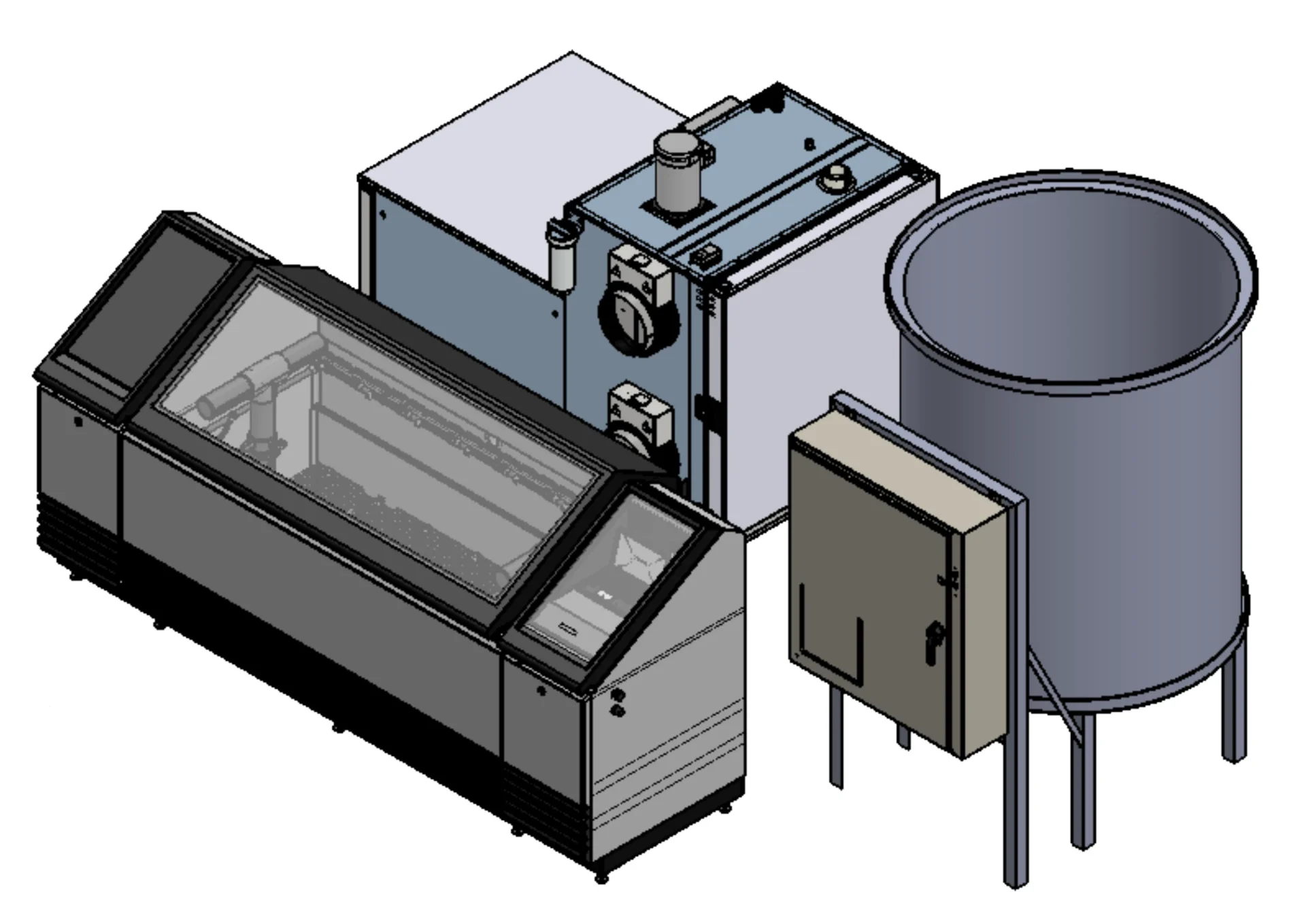
Unlike many environmental exposures, immersion ensures that corrosive solution reaches every corrosion-sensitive location consistently. Welds, seams, interfaces, brackets, mounting points, suspension structures, and other complex geometries receive a known exposure, reducing many of the variables associated with spray coverage and helping engineers identify vulnerabilities before vehicles reach the field.
The component involved in Honda’s recall—the rear subframe suspension mounting points—is exactly the type of structure corrosion engineers focus on when developing accelerated corrosion tests.
These locations contain complex geometries, multiple interfaces, and corrosion-sensitive features that must remain structurally sound throughout the life of a vehicle.
For corrosion engineers, ensuring that salt solution consistently reaches these areas during testing is critical.
Freeze-Thaw Exposure Matters
Honda’s use of freeze-thaw exposure is equally important.
Repeated freezing and thawing can challenge coatings, seam sealers, joints, interfaces, and corrosion protection systems in ways that warm-weather exposure cannot.
Moisture trapped within complex structures is repeatedly subjected to temperature changes, creating additional durability stresses that may reveal weaknesses not immediately apparent under constant conditions.
When combined with immersion, humidity, drying, and cyclic corrosion exposure, freeze-thaw conditions help engineers evaluate how corrosion protection systems perform under a broader range of environmental stresses.
Advanced Corrosion Testing Helps to Identify Problems Early
Honda has not publicly disclosed exactly how this condition was identified.
However, it is reasonable to conclude that the company’s extensive corrosion testing, durability validation, field monitoring, engineering analysis, and long-term commitment to corrosion research likely contributed to identifying the potential issue in advance.
The purpose of advanced corrosion testing is to identify vulnerabilities, understand failure mechanisms, validate corrosion protection systems, and provide manufacturers with the information needed to take corrective action before a corrosion issue becomes a widespread safety problem.
Honda’s recent recall demonstrates the value of identifying and addressing potential corrosion concerns before they become widespread field failures.
Sources
-
Honda Recall Information – NHTSA Recall Number 26V-365 (Campaign AOU)
https://owners.honda.com/service-maintenance/recalls/ -
Associated Press Coverage
https://apnews.com/article/honda-acura-recall-safety-nhtsa-b435e89c8961bc3874652b8a6402f2ca -
Honda R&D Facilities – Corrosion Test Facilities
https://global.honda/en/tech/serial/Hondas_RandD_Facilities_part07/