
X SERIES PRECISION CYCLIC CORROSION TEST CHAMBERS

The X Series Precision Cyclic Corrosion Chamber is a fully computer-controlled, configurable platform built for laboratories running advanced OEM and international corrosion standards. Designed for serious qualification work, the X Series supports complex cyclic workflows including fog, direct spray, dry-off, ambient transitions, immersion, and low-temperature operation when configured with the required options.

Image shown: Size 110 X Series chamber equipped with the optional spray bar system.
Built for Real Corrosion Transitions
Advanced cyclic work depends on controlled wetting, humidity exposure, drying, ambient steps,
and temperature transitions rather than one continuous environment.
Built Around Your Test Method
Chamber configuration is matched to the exact standard — including cooling, spray, immersion,
and transition requirements — instead of forcing a fixed platform.
Built and Supported in the USA
Built in Ohio with a knowledgeable support team, reliable parts availability, and long-term support
for serious corrosion testing programs.
Tell us your standard, revision level, chamber size target, sample geometry, required transitions, whether you need immersion or direct spray, and any facility constraints.
Chamber Design
The X Series is called the X Series because it can be configured to do whatever the method requires. Most suppliers sell corrosion boxes. The X Series is a corrosion platform.
You can buy multiple pieces of equipment to cover spray, immersion, cooling, humidity, and control—or you can configure one X Series system to handle it.
Everything in One Platform
The X Series can be configured with PC controls, mechanical cooling, immersion, spray systems, full RH control, data logging, multiple sizes, custom ports, custom power, and racking—all in one system.
Trusted for OEM Automotive Corrosion Testing
X Series chambers support automotive corrosion testing programs used by major manufacturers including GM, Ford, Stellantis, Honda, Toyota, and other global OEMs and Tier suppliers. Built from decades of accelerated corrosion testing experience, the X Series is designed for cyclic corrosion methods such as SAE J2334, GMW 14872, Ford CETP, and other OEM corrosion standards used throughout the automotive industry. These programs require controlled environmental transitions, immersion capability, salt spray, humidity, drying, and repeatable corrosion cycling beyond what a basic salt fog chamber can provide.
Standards and Configurations
The X Series is intended for laboratories running advanced corrosion methods where test validity depends on chamber configuration, programmed sequencing, and controlled transitions. The matrix below reflects common method-driven configuration guidance based on real-world X Series implementations.
Important: The X Series is typically specified around the exact method and revision level. Required packages can change based on direct spray, ambient transition, immersion, climate-control needs, and low-temperature requirements.
| Standard | Mechanical Cooling | Advanced Climate Control | Swaying Spray Bar | Direct Spray | Cover Lifters, Automated | Immersion |
|---|---|---|---|---|---|---|
| Ford CETP L-467 | X | X | ||||
| GMW 14872 | X | X | ||||
| GMW 3172 9.4.7 | Cooled Solution | X | ||||
| GMW 3172 9.4.8 | X | Recommended | ||||
| Hyundai / Kia MS 600-66 CCT A | Recommended | X | ||||
| Hyundai / Kia MS 600-66 CCT B | X | X | Recommended | |||
| Hyundai / Kia MS 600-66 CCT C | X | X | Recommended | X | ||
| IEC 60068-2-52 1–6 | X | |||||
| IEC 60068-2-52 7 & 8 | X | |||||
| ISO 14993 | X | |||||
| ISO 16701 A & B | Recommended | X | ||||
| Nissan NES M0007 CCT I, II, IV | Recommended | |||||
| SAE J2334 | X | Required | Recommended | Optional | ||
| Toyota TSH1555G A & B | Recommended | X | Recommended | X | ||
| Toyota TSH1555G C | Recommended | X | Recommended | |||
| Volkswagen PV 1210 | Recommended | X | Recommended | |||
| Volvo STD 423-0014 | Required | X | ||||
| Volvo VCS 1027, 149 | Required | X | Optional |
Multiple solution guidance: If multiple solutions will be used, an extra tank and/or a dedicated chamber is recommended. If solutions will be mixed on site, the mixing tank package is recommended to simplify handling and improve workflow.
Advanced Climate Control room note: This package requires an ambient temperature-controlled environment of 25 °C ± 5 °C. That is an important distinction when comparing the X Series to simpler external cooling approaches that can force more of the heat-management burden onto the room itself.
X Series Models, and Sizes
The X Series platform is available in multiple chamber sizes so the configuration can be matched to your parts, throughput, and required exposure geometry.
How big are your parts? How many parts do you need to test at a time? Start there when selecting chamber size. Internal volume, usable dimensions, loading pattern, and final installed footprint should all be reviewed together.
| Model | Internal Volume | Internal Dimensions (in) | Internal Dimensions (cm) | External Dimensions (in) | External Dimensions (cm) |
|---|---|---|---|---|---|
 20
20View Drawings ↗ |
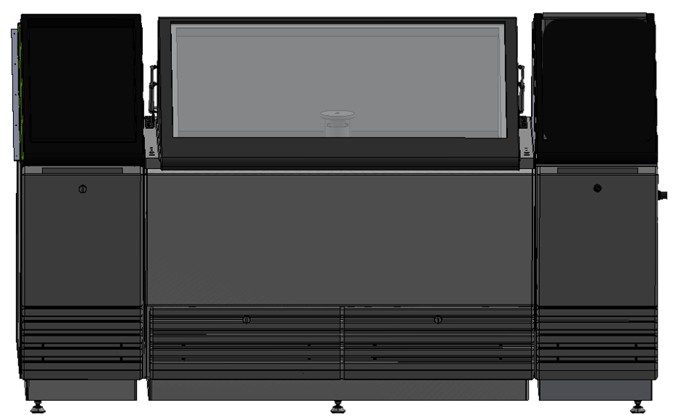
20 ft³ / 594 L | 50 × 29 × 25 | 127 × 73 × 64 | 95 × 43 | 242 × 110 |
| 30 | 30 ft³ / 891 L | 75 × 29 × 25 | 191 × 74 × 64 | 120 × 43 | 305 × 110 |
 40
40View Drawings ↗ |
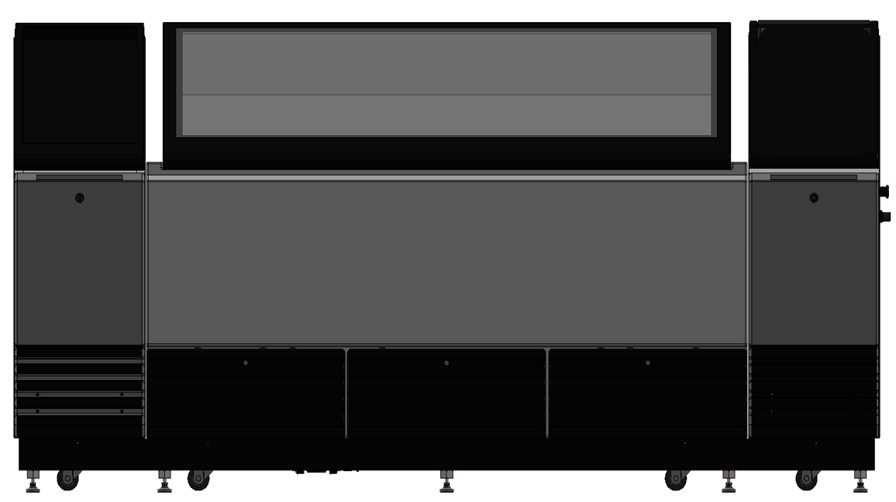
39 ft³ / 1106 L | 75 × 36 × 25 | 191 × 92 × 64 | 120 × 50 | 305 × 127 |
| 90 | 90 ft³ / 2550 L | 76 × 45 × 45 | 193 × 115 × 116 | 132 × 68 | 336 × 173 |
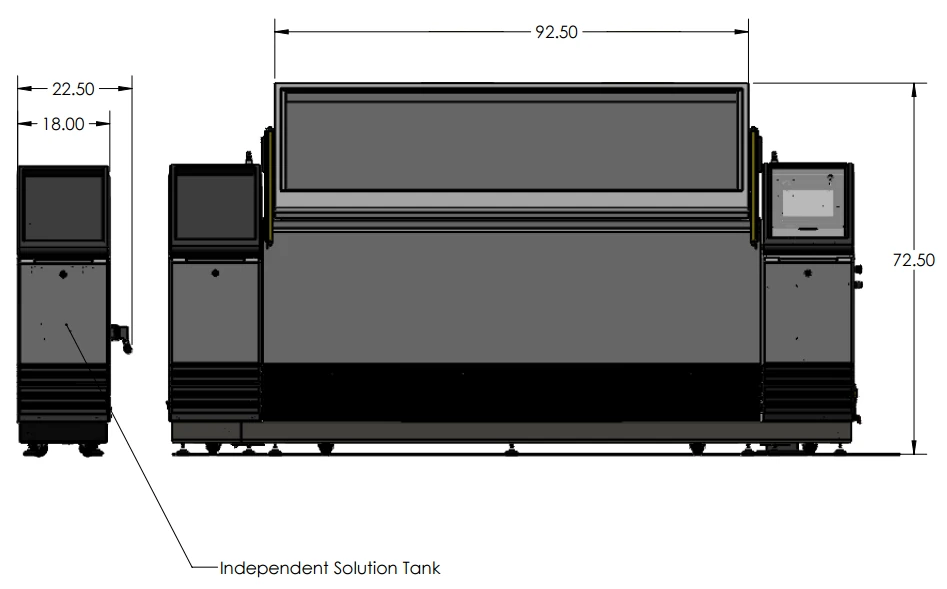 110
110View Drawings ↗ |
112 ft³ / 3194 L | 89 × 73 × 30 | 227 × 186 × 77 | 137 × 85 | 348 × 216 |
Footprint and layout note: Listed external dimensions represent the base chamber only. Actual installed footprint varies with customization and can increase depending on mechanical cooling systems, LN2 packages, immersion equipment, additional tanks, control cabinets, exhaust routing, and required service access clearance. Final layout should be confirmed during quotation and facility planning.
Custom walk-in cyclic corrosion chambers and specialized configurations are available upon request.
Add-Ons, Accessories, and Support Items
The X Series is not a one-configuration chamber. It is a method-driven corrosion platform that is built around the actual way the test runs.
In practice, the wrong option package does not just make the chamber less convenient. It can change the mechanism being produced at the specimen surface. That is why the X Series is configured around the required corrosion method, revision level, transition profile, specimen geometry, and facility constraints rather than forcing every program into the same cabinet layout.
Specify the method first, then the chamber. X Series configurations should be driven by the actual corrosion standard, revision level, required transitions, electrolyte application method, specimen load, and lab environment — not by a generic chamber package.
DI water and ventilation are not optional details. Proper bubble tower operation requires clean, pressurized DI water. Poor water quality, low supply pressure, or contamination can affect fog generation, collected solution quality, pH stability, and repeatability.
Quality ventilation also matters. Corrosive exhaust should be properly managed through an appropriate scrubber, exhaust connection, room ventilation plan, or power-vent arrangement. Undersized or poorly routed ventilation can damage ducting, affect lab conditions, and create installation problems after the chamber is already in place.
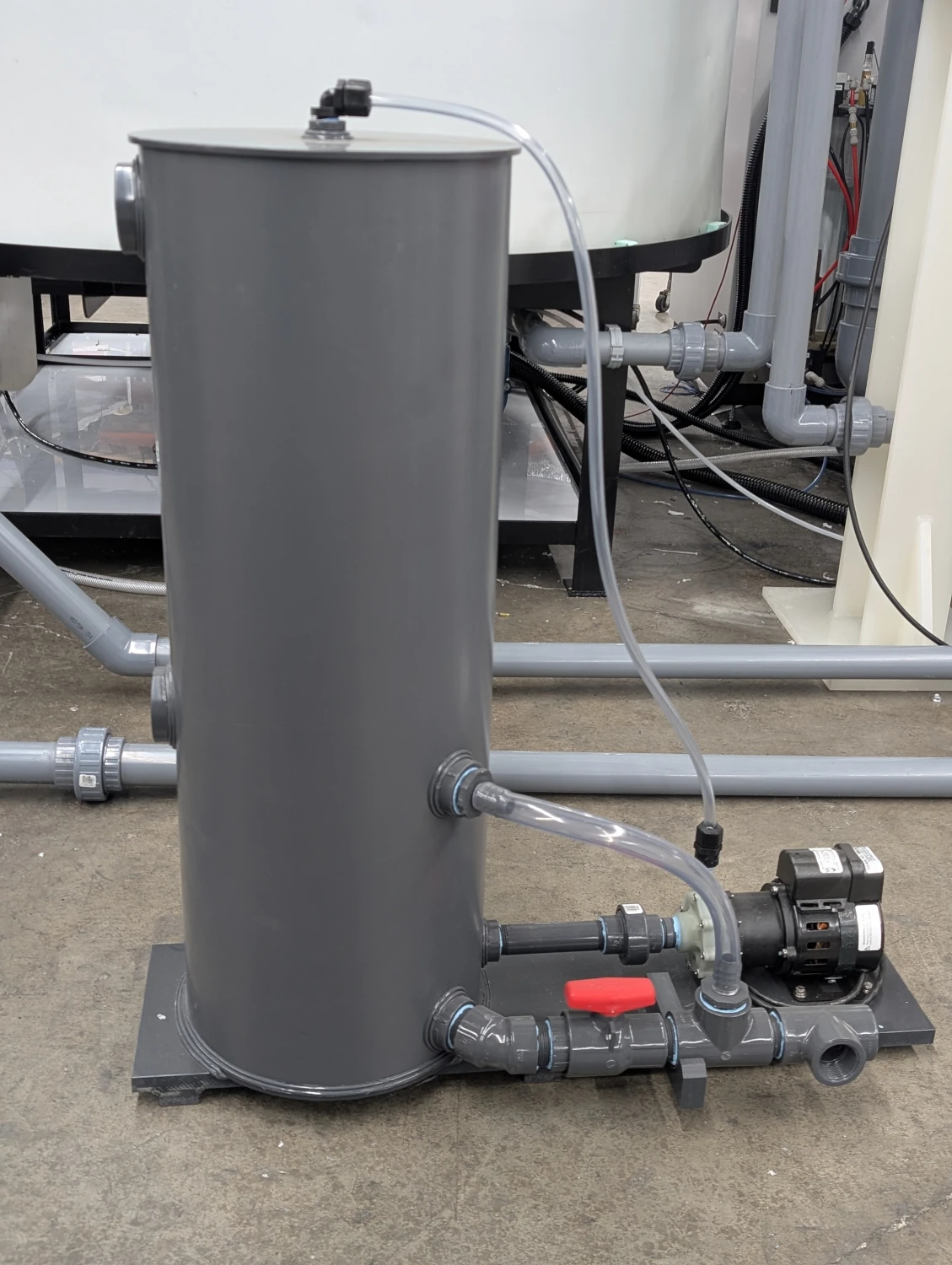
Recirculating scrubbers help protect ducting and manage corrosive exhaust in high-capacity corrosion labs.
Spray Options
The X Series can be configured for traditional fog exposure, direct spray, or higher-coverage specialized spray systems depending on the procedure. Those are not interchangeable choices. The way electrolyte reaches the specimen influences salt loading, film formation, drainage behavior, and ultimately the corrosion mechanism being produced.
Electrolyte application matters: SAE / AISI development work identified electrolyte delivery method as a governing variable. Immersion produced the most controlled and repeatable loading, while spray and fog introduced progressively more variability. Reported ranking: immersion > heavy spray > fog > light spray.
Deluxe solution sprayers in operation, showing the higher-coverage direct spray arrangement used when the method requires more than fog alone.
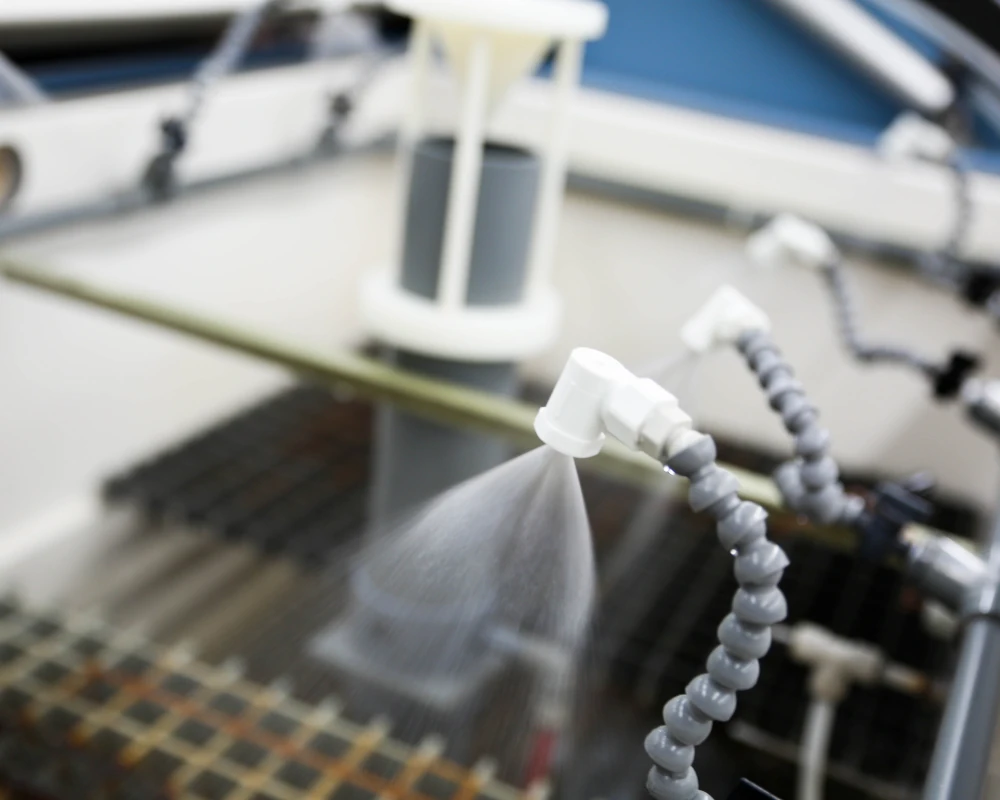
This configuration shows how traditional fog generation can be combined with adjustable direct-spray nozzles when the standard requires more than continuous fog alone.
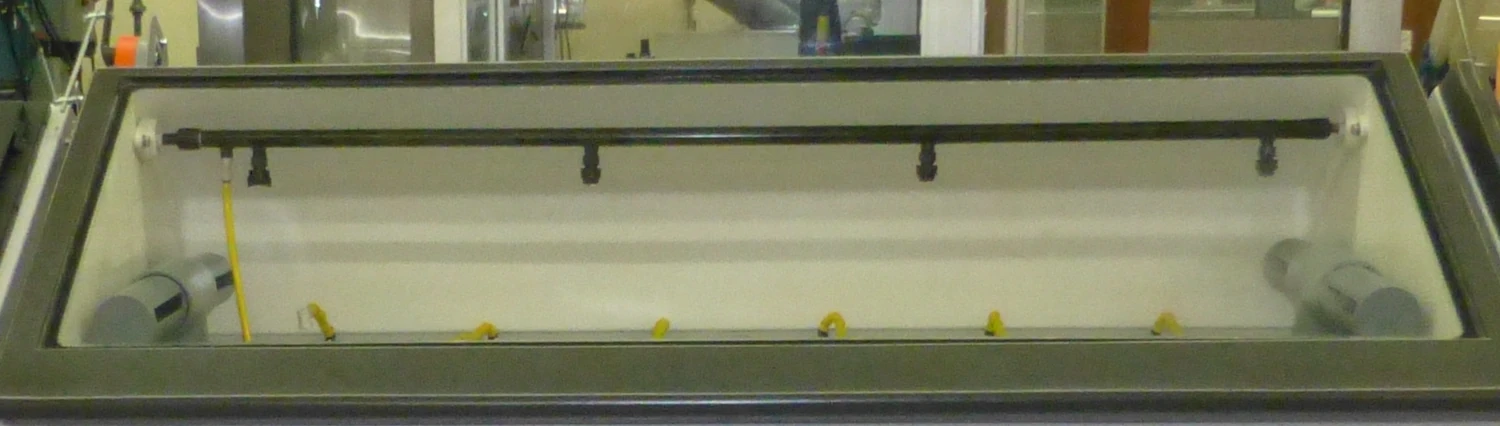
Oscillating spray-bar hardware is used where Ford- or Volvo-style procedures require controlled moving spray coverage rather than static impingement or fog alone.
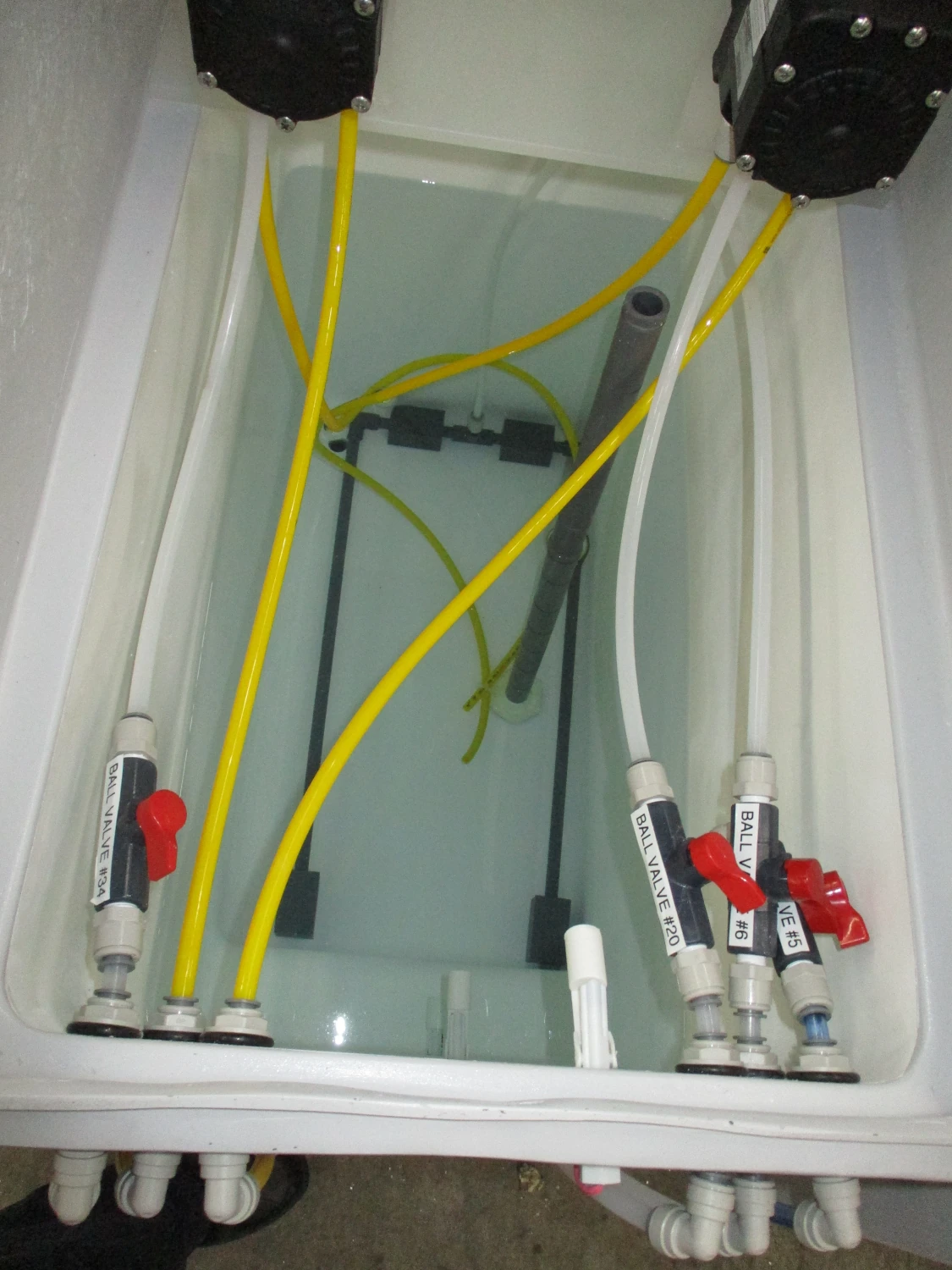
The mixing tank convenience package simplifies on-site solution preparation and transfer with marked levels, fill controls, pumping, and air sparging for more consistent spray-system workflow.
Immersion Options
For methods that include immersion steps, the X Series can be fully equipped.
Why immersion is emphasized: mmersion was identified in SAE development work as the most repeatable way to establish controlled electrolyte loading at the specimen surface. Immersion-based loading produces a more controlled and reproducible wetting condition than spray or fog.
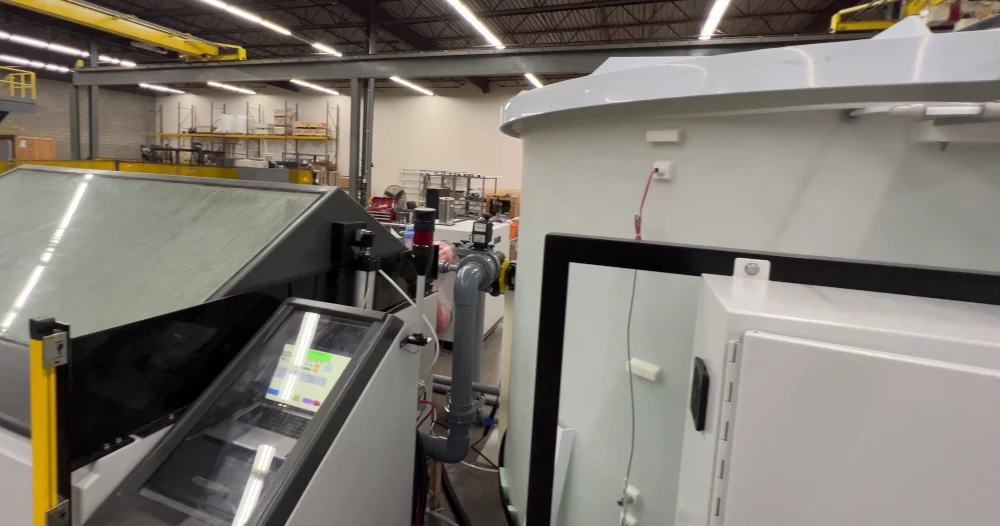
This chamber setup shows how immersion hardware and computer controls work together when the programmed cycle includes automated solution transfer.
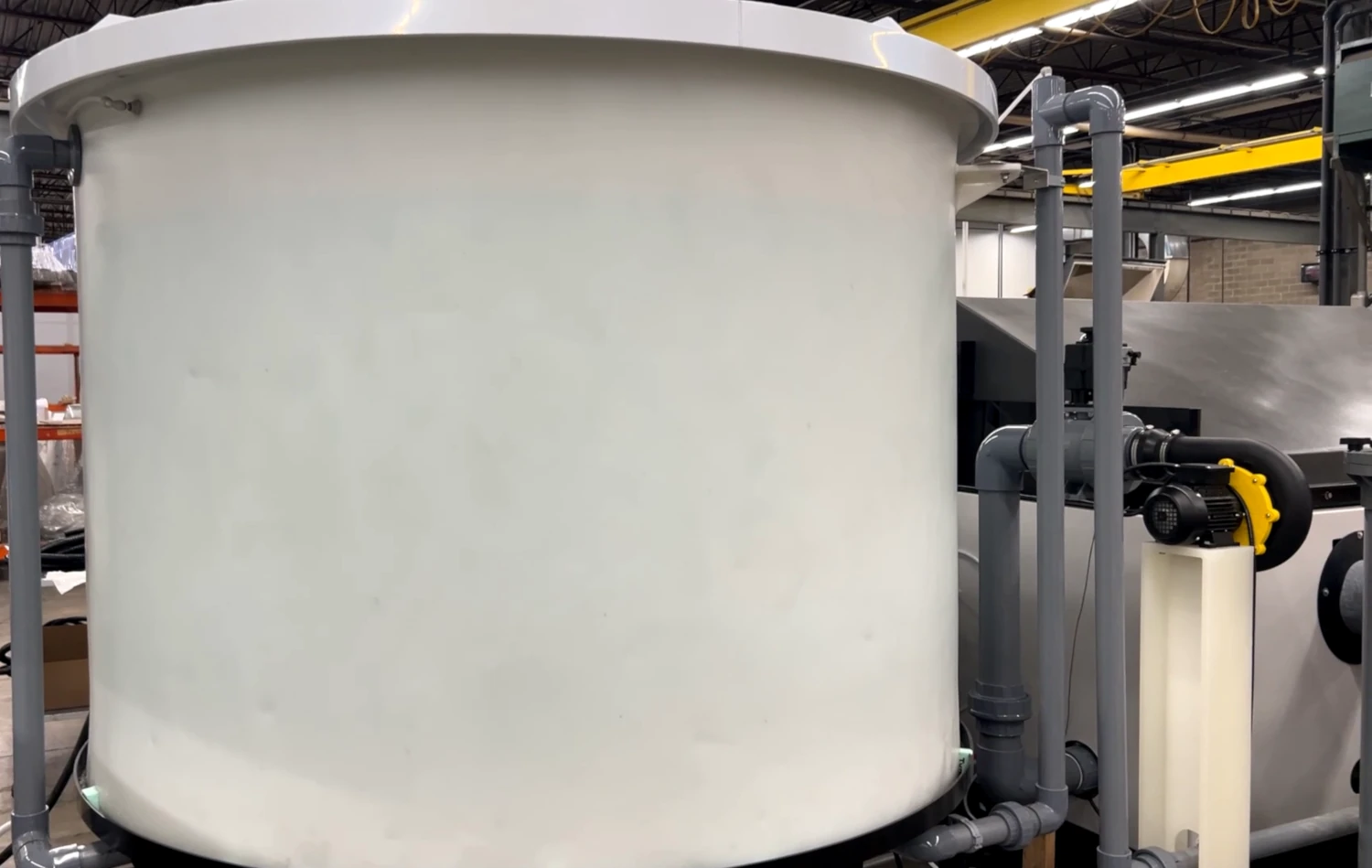
Heated solution tanks, transfer plumbing, and dedicated pumps support repeatable immersion steps without relying on manual fluid handling between cycle phases.
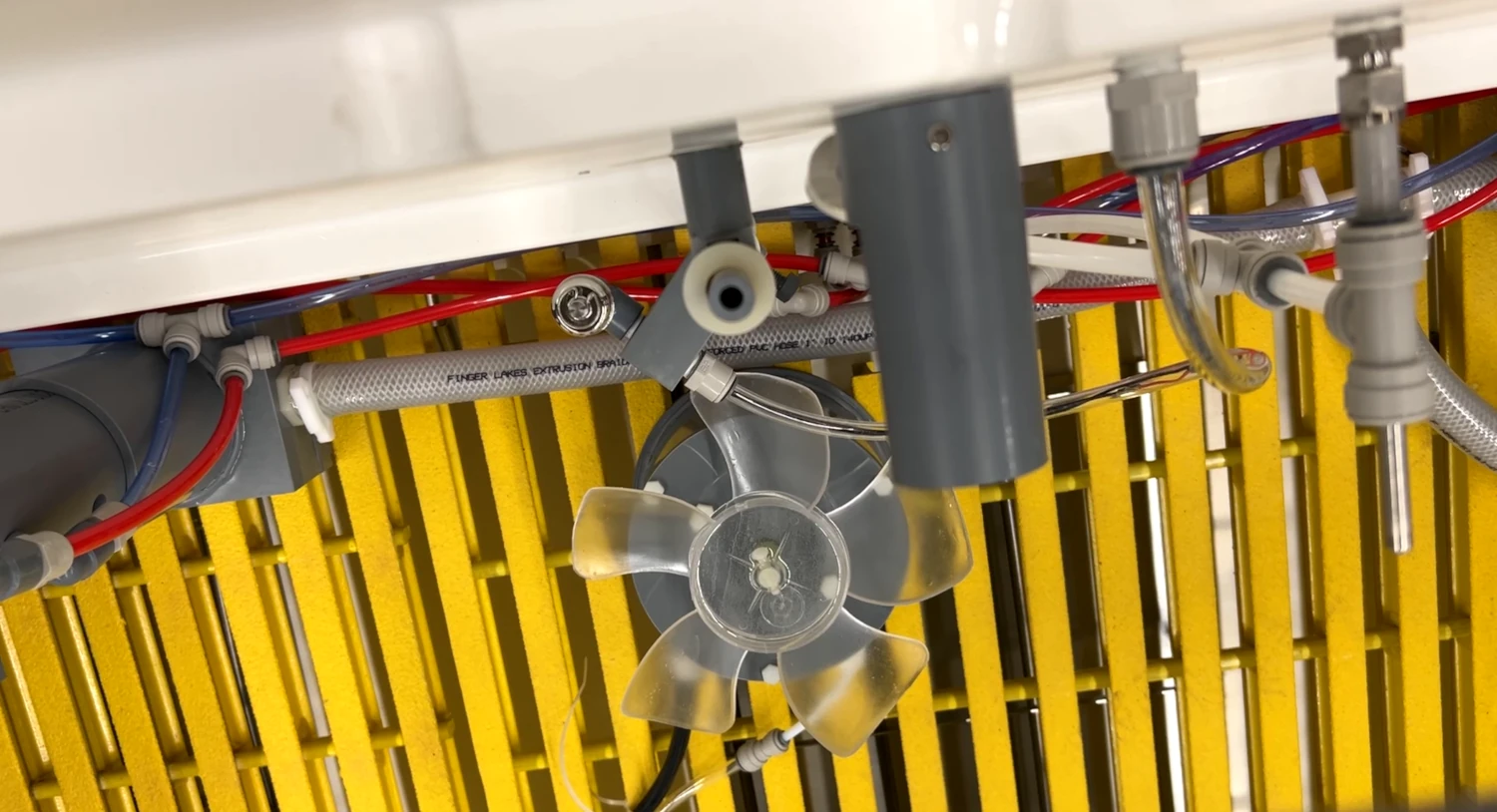
The interior view highlights the kinds of hardware tied to immersion fill protection, ruggedized sensing, and repeatable chamber operation during demanding liquid-transfer cycles.
Mechanical Cooling
Temperature-transition requirements vary widely by method. Some programs require compact cooling arrangements, some require larger-capacity refrigeration packages, and some can use air-assisted cooling to support faster pull-downs where full refrigeration is not required. The X Series can be configured with a variety of mechanical cooling options depending on chamber size, required low-temperature range, transition speed, immersion hardware, and installation layout.
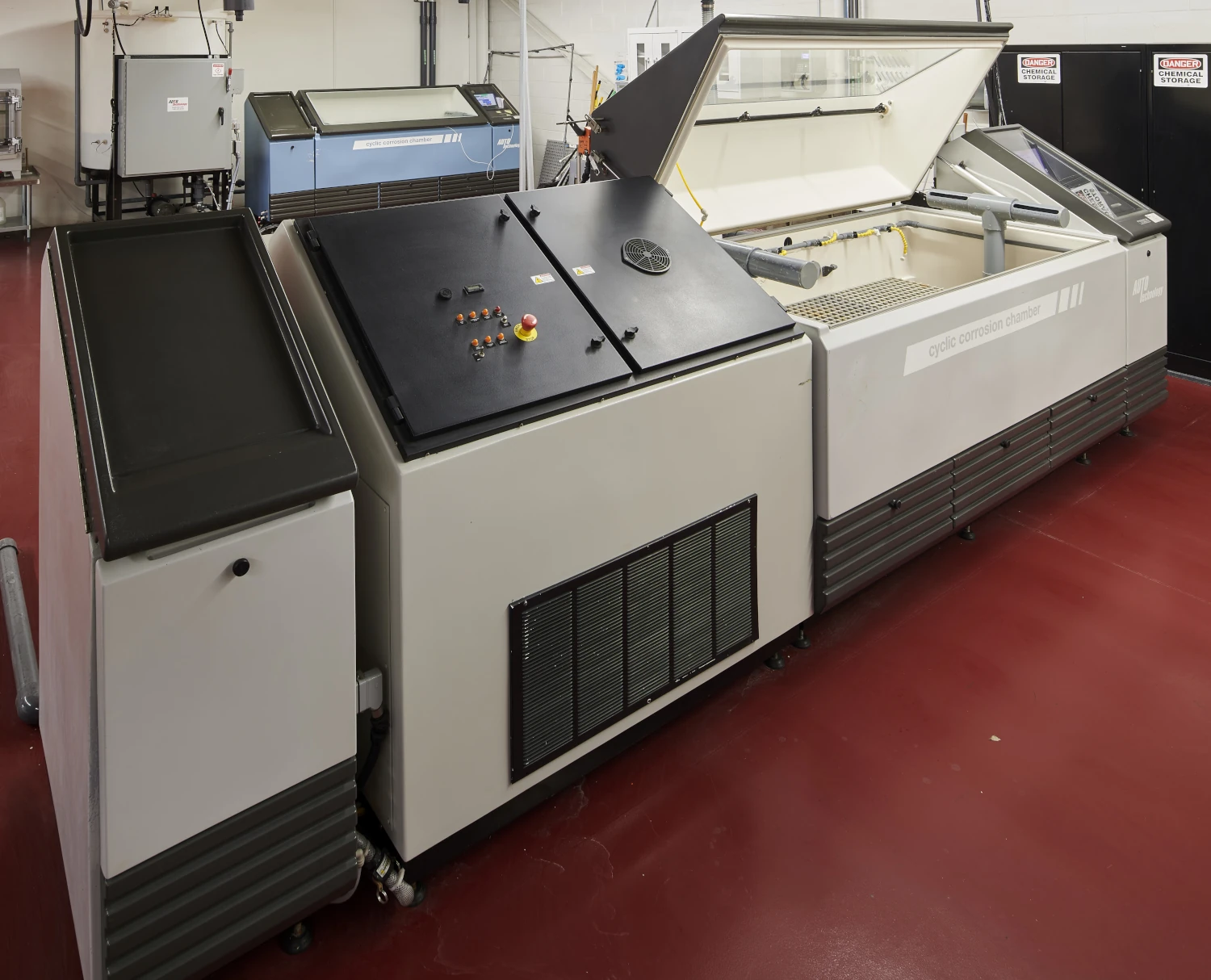
Compact mechanical cooling arrangements can be used where the chamber package requires controlled low-temperature performance without the footprint of a larger refrigeration system.
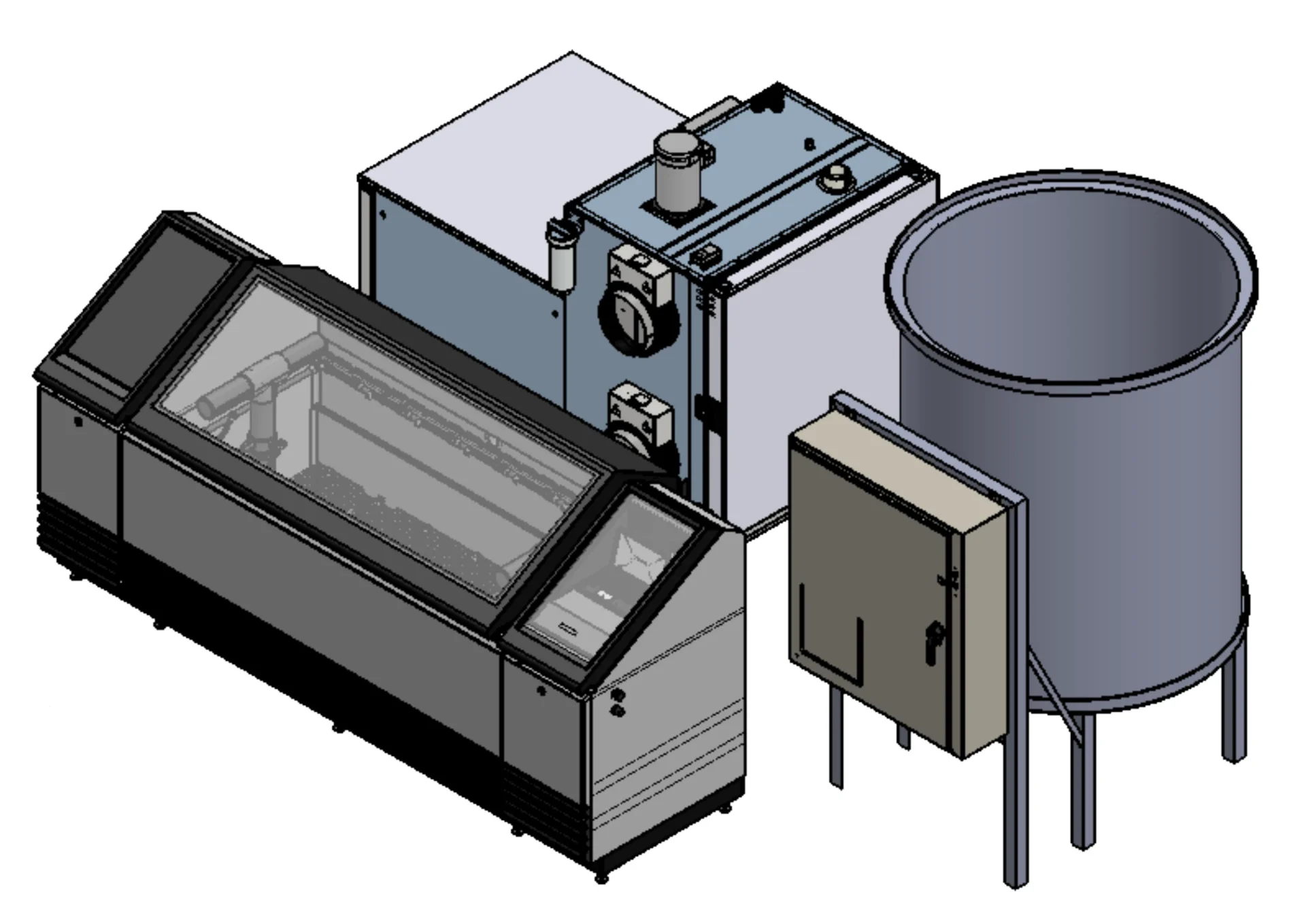
Larger-capacity Gen 2 mechanical cooling packages are used where the method requires deeper low-temperature capability, faster freezing transitions, or coordinated operation with immersion-based heat-exchange hardware.
Mechanical cooling note: Mechanical cooling supports lower-temperature steps and provides greater control over transition timing.
RH Control & Advanced Climate Control
This option category supports repeatable humidity control and better environmental stability. The corrosion mechanism depends on how long specimens remain wet, how they dry, and what actual humidity conditions are present between solution-loading events.
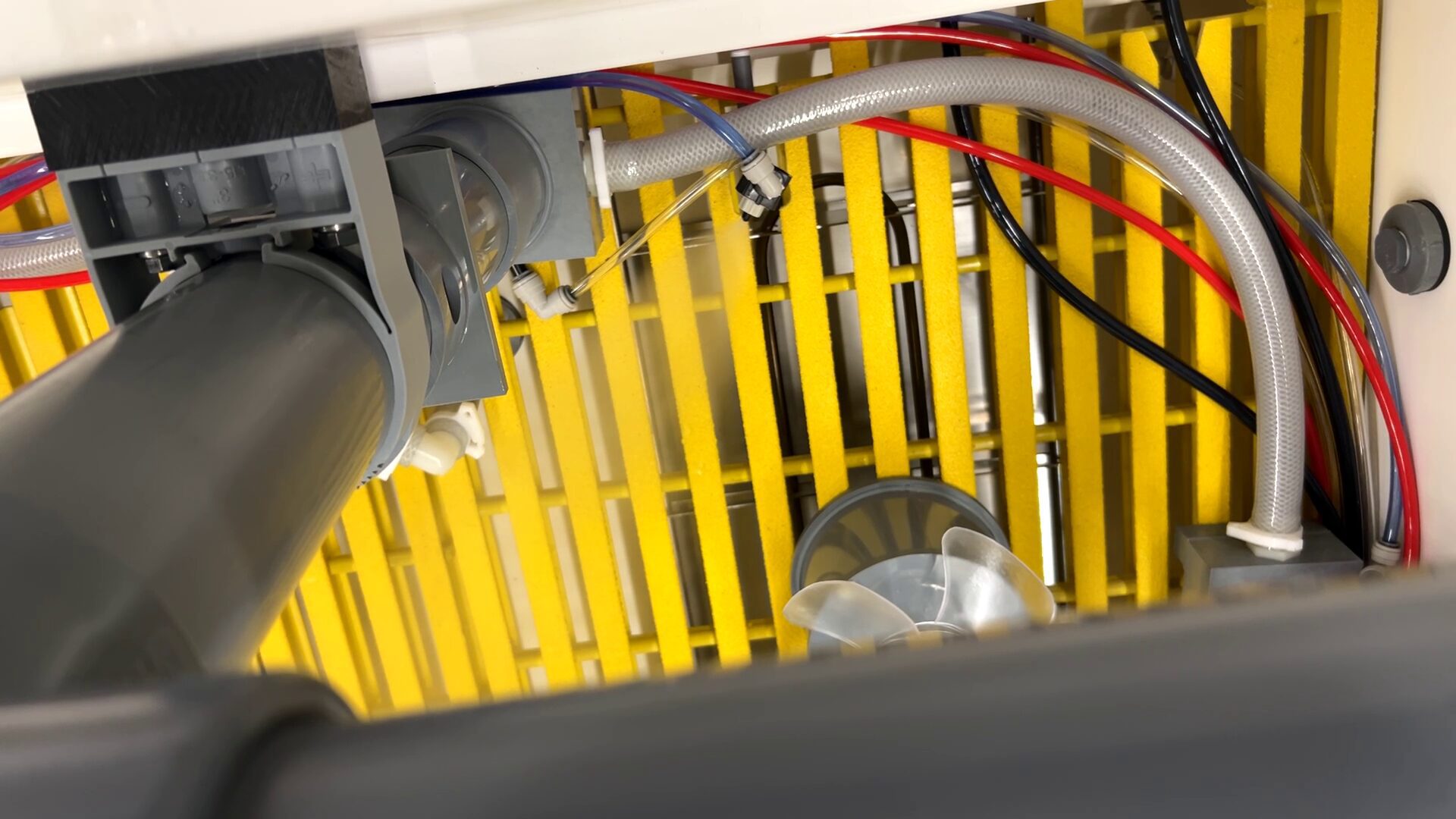
Inside an X Series Size 110, humidity control is built directly into the chamber. Internal air circulation, moisture management, controlled heat, and ambient air transitions work together to achieve stable RH control without dumping excess heat into the lab environment.
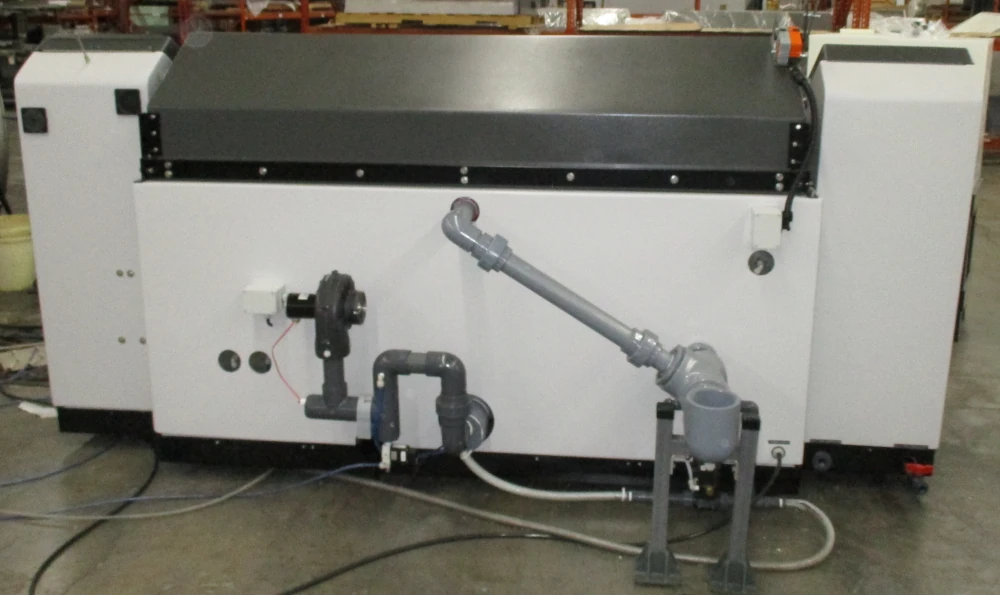
An auxiliary blower and vent arrangement can support rapid cooling transitions where the method does not require full mechanical refrigeration but still depends on faster heat removal.
Ambient transition note
Some cyclic methods depend on true ambient exposure between controlled phases. In those cases, automated cover lifters are not a convenience item — they are part of reproducing the required transition rather than simulating it inside a closed cabinet.
Automated cover lifters in operation at the Auto Technology Test Lab, supporting programmed ambient transition steps.
Racking and Sample Handling
Racking should be matched to specimen size, loading density, and required exposure pattern. That becomes especially important when larger assemblies, mixed parts, soft support materials, or externally connected components are being considered. The X Series supports a range of sample-handling hardware, along with optional access ports where parts, sensors, hoses, wiring, or other external systems must pass through the chamber wall during testing.
Standard with a new X Series chamber: bottom-level fiberglass racking for basic specimen support in the exposure zone. Additional support bars, support rods, support angles, slotted racks, heavy-duty shelves, and optional access ports are available depending on specimen geometry, loading requirements, and the need to connect test hardware through the chamber wall.
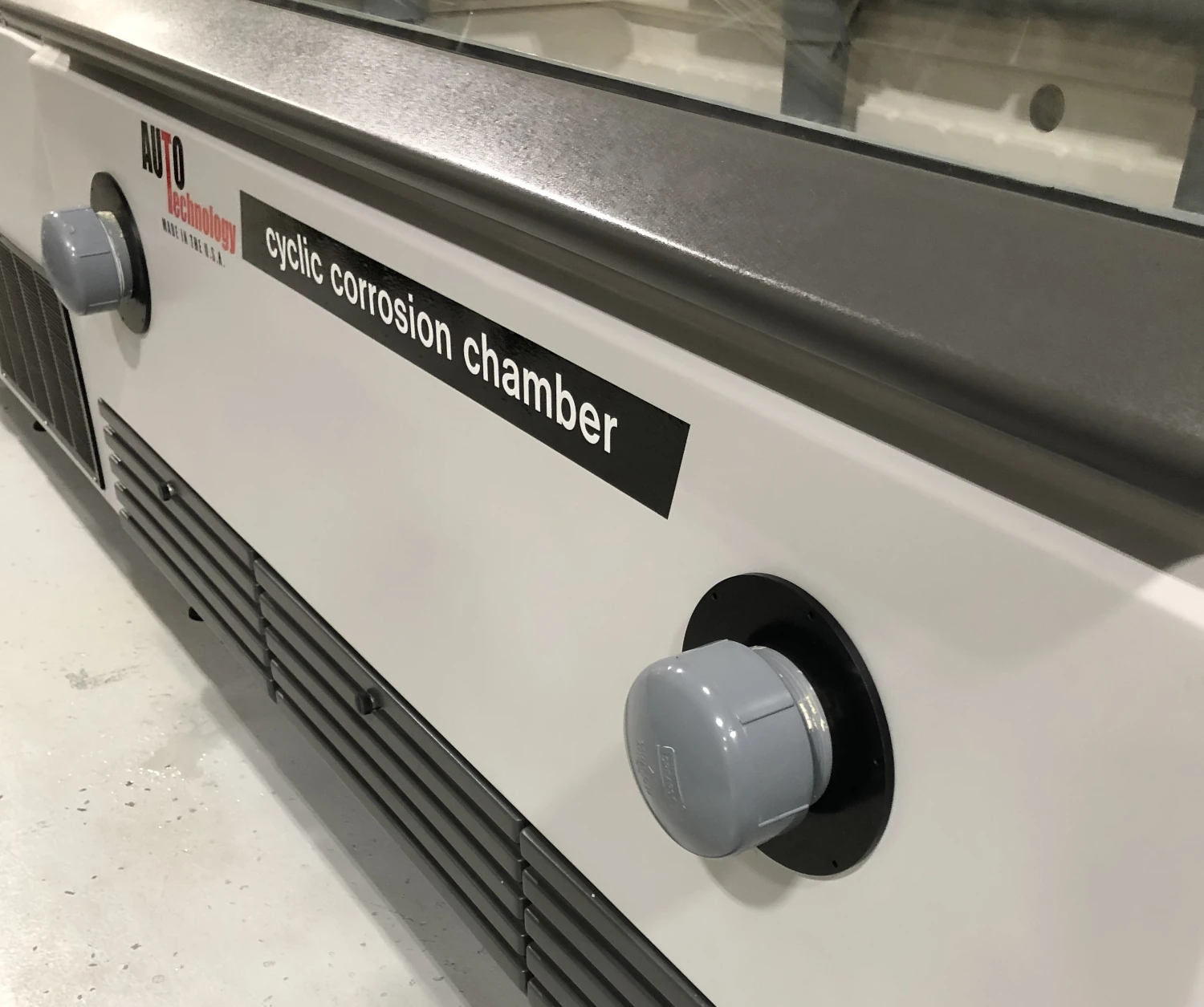
Optional dual 4-inch access ports allow parts, cables, hoses, sensors, wiring, or other externally connected hardware to pass through the chamber wall during testing.
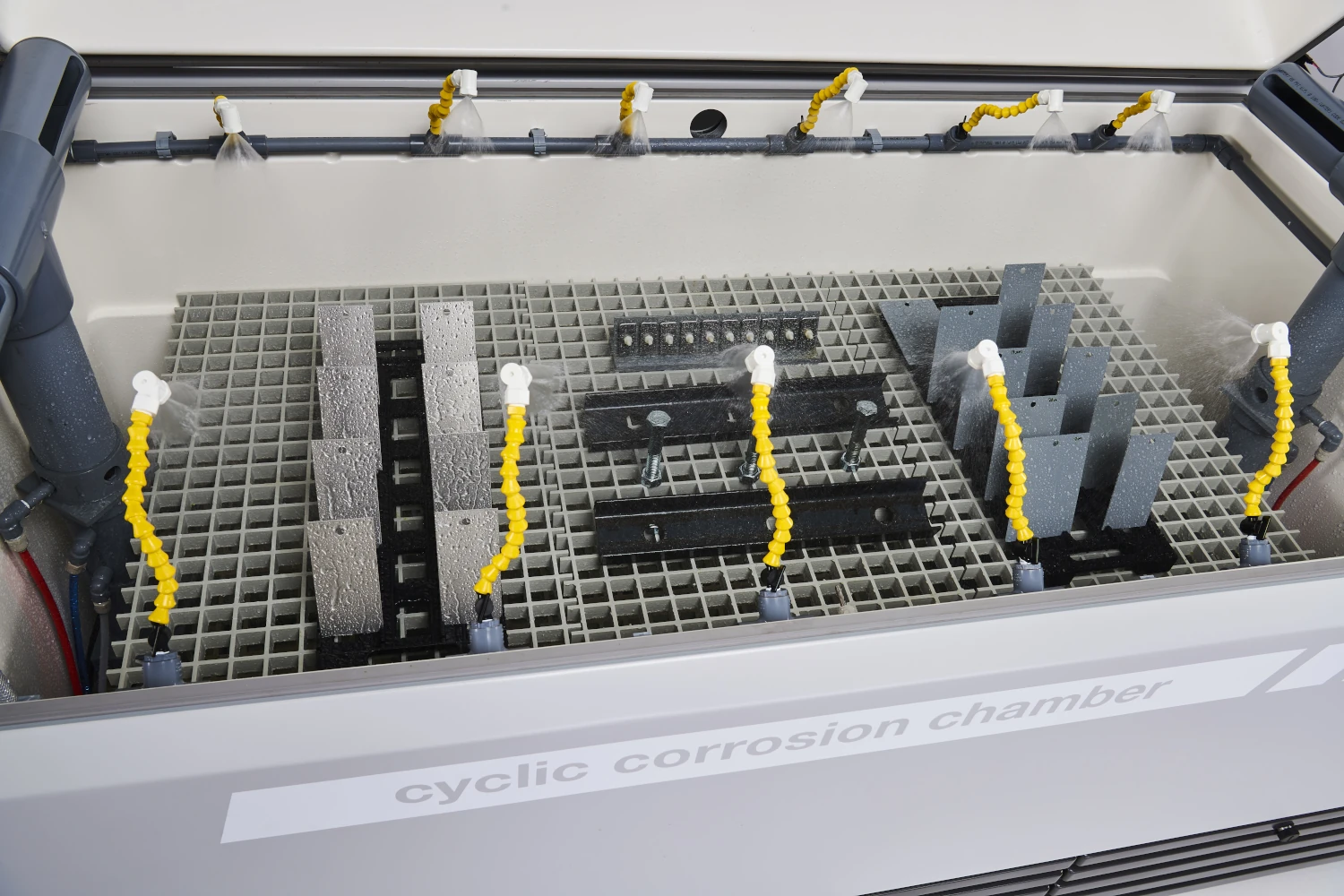
Heavy-duty shelving and horizontal dispersion towers open up usable loading space for larger parts and assemblies while still supporting controlled spray or fog distribution.
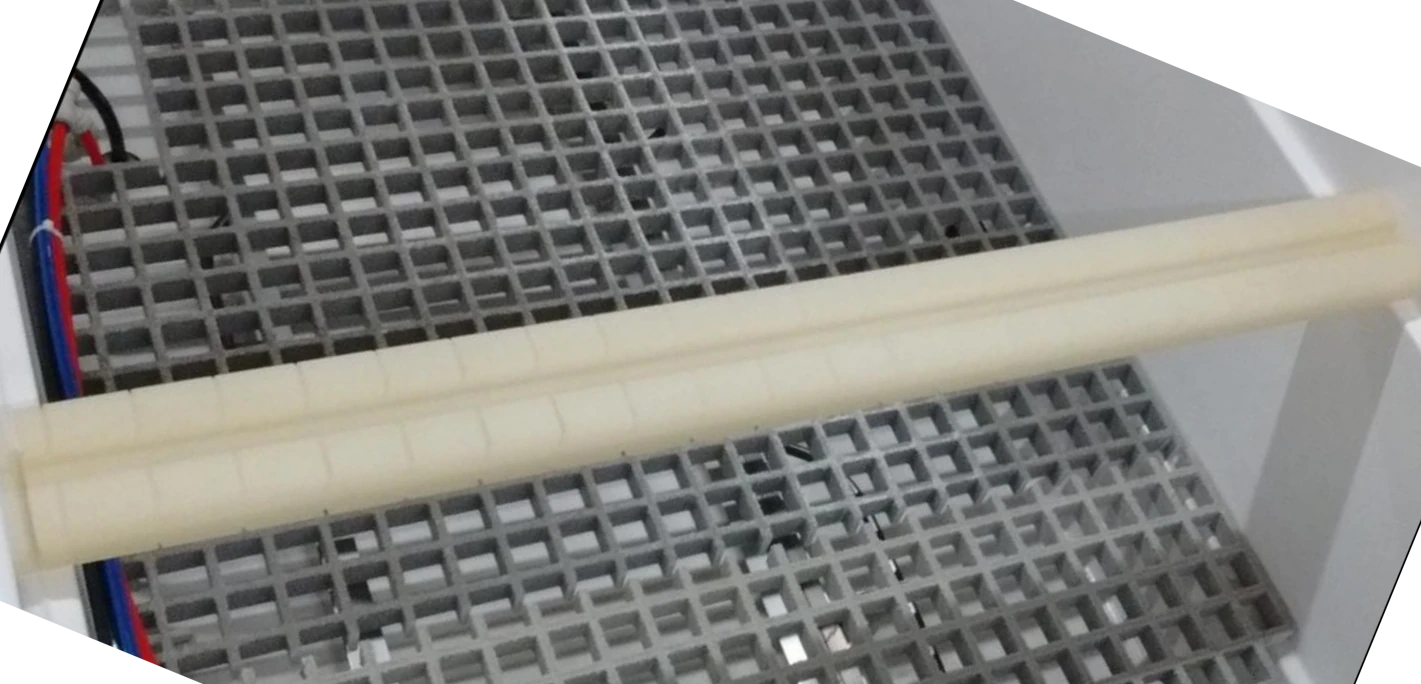
Slotted support bars provide controlled-angle panel positioning for standard test panels and are best supported on heavy-duty shelves.

Fiberglass rods provide a suspension point for larger or irregular samples where hanging geometry is preferred.
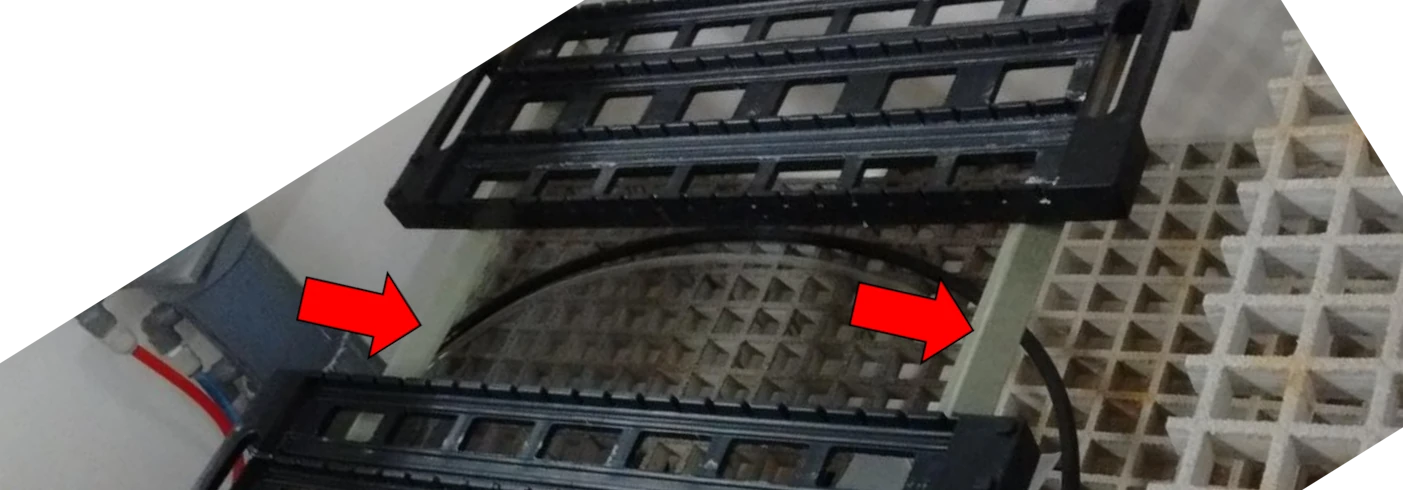
Fiberglass support angles can be used for samples, condensate collection tubing, or to support a slotted rack structure.
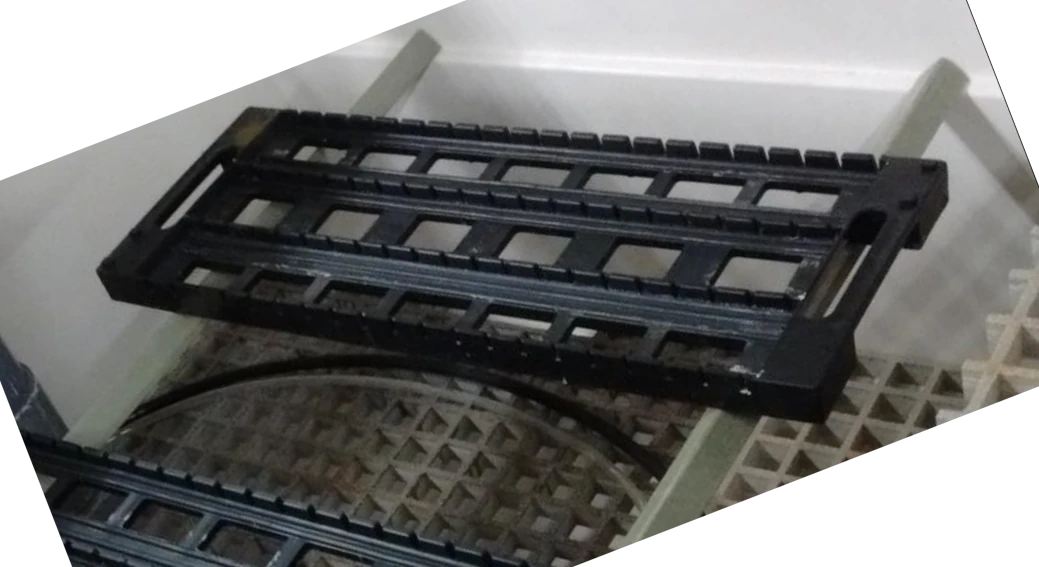
The slotted support rack is a high-capacity panel-loading option for repeated programs using standard coupons or panels.
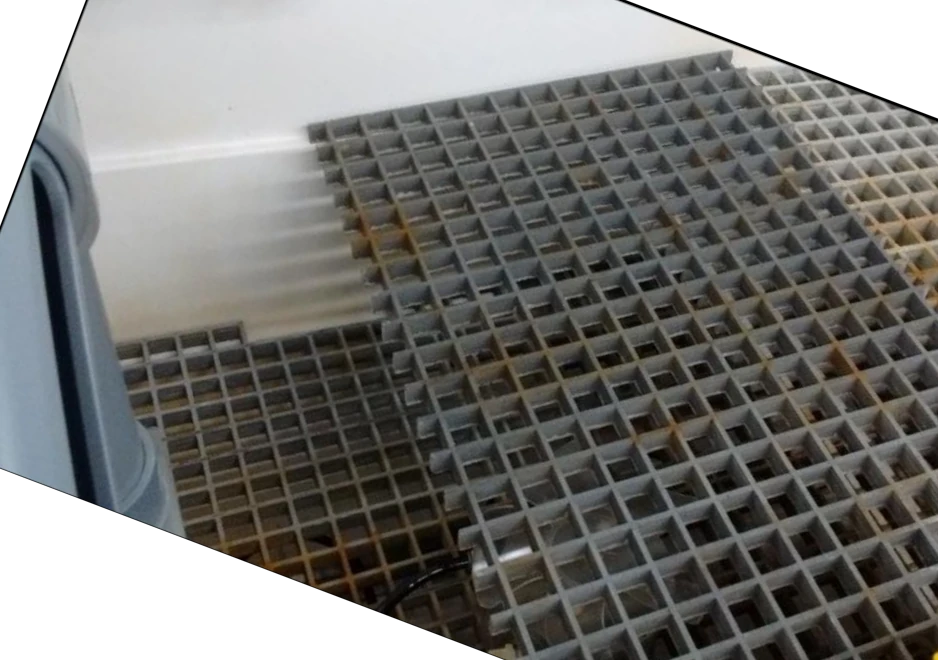
Heavy-duty mid-level shelves increase loading flexibility, support softer bar materials, and improve usable chamber layout for mixed sample loads.
All Options
The table below consolidates the major X Series options discussed above into one place for quick review.
| Description | Notes |
|---|---|
| Advanced Climate Control Package | Provides advanced controls for humidity and temperature where methods depend on controlled RH and environmental stability |
| Automated Air Lifters | Allows the cover to open automatically for programmed ambient cycles where real ambient exposure is part of the method |
| Cabinet Full Level Switch | Float switch that shuts off solution flow into the exposure zone when the cabinet becomes full during an immersion cycle, supporting unattended testing |
| Correct Calibration Certification | Specify the documentation and traceability level required for the applicable quality system |
| Custom Power Configurations | Available based on facility electrical requirements and chamber package |
| External Condensate Collection | Allows condensation samples to be collected without opening the exposure zone cover |
| Extra 60-Gallon Tank | Additional movable reservoir similar to the included 60-gallon solution reservoir |
| Fiberglass Support Angles | 1 in × 1 in L-shaped fiberglass brackets for supporting samples, collection tubing, or rack structures; not intended for a total load over 20 lb per bracket |
| Fiberglass Support Rods | 1/2 in diameter fiberglass rods used to suspend samples in the exposure zone; not intended for a total load over 20 lb per rod |
| Heavy Duty Mid-Level Shelves | Fiber-composite corrosion-resistant shelves that add sample space at the middle level of the cabinet while helping distribute heated air as it rises |
| Horizontal Dispersion Tower System | Used where more open usable center loading space is needed in chambers with a central fog dispersion tower |
| Immersion Overflow Port | Helps prevent cabinet overfill during immersion cycles |
| Immersion Tank | Separate immersion tank for dedicated immersion testing controlled through the X Series PC platform |
| Mechanical Cooling | Provides temperature and humidity control, allows cabinet temperatures as low as -30 °C (-22 °F), supports a full humidity-control range, and increases transition control |
| Mixing Tank Convenience Package | Automatic-fill mixing tank option with volume marker for cleaner solution handling and more consistent spray-system workflow |
| Optional Access Ports | Allows parts, cables, hoses, sensors, wiring, or other externally connected hardware to pass through the chamber wall during testing |
| Oscillating Spray Rod | Specialized direct impingement / spray arm arrangement for Ford- and Volvo-designed tests |
| Power Vent Installation Kit | Recommended for exhaust runs longer than 15 ft to actively pull exhaust from the chamber and help maintain proper test conditions |
| Racking Matched to Your Samples | Sample handling should be selected around panels, mixed hardware, larger assemblies, and required exposure geometry |
| Reservoir Overflow Protection & Volume Marker Tube | Provides a visible volume marker and controlled overflow point during autofill cycles |
| Scrubber / Jet Exhaust & Recirculation System | Recommended for labs without ventilation; city water supply required |
| Slotted Support Bars | Slotted polypropylene bars with central drainage channel for standard 3 × 6 in or 4 × 12 in panels; available with 15° or 6° saw cuts at 1.5 in spacing |
| Slotted Support Rack | Fiberglass rack for test panels; holds two rows of panels with 20 slots per row for a total of 40 panels; requires fiberglass support angles if not set on heavy-duty shelves |
| SO2 Testing / Adder Package | Injects metered customer-supplied sulfur dioxide into the condensing fog stream |
| Solution Spray - Basic | Provides direct impingement / spraying of corrosive solution from the 60-gallon reservoir onto samples |
| Solution Spray - Deluxe | Provides substantially more spray coverage than the basic version through additional nozzles and an upgraded pump |
| Solution Spray Recirculation System | Reduces solution consumption by recirculating testing solution through the solution spray systems |
Support-bar note: Because slotted polypropylene support bars are relatively soft, it is strongly recommended that they be placed on the heavy duty shelves for added support.
Consumables, Training, and Certification
Auto Technology also supplies the parts, consumables, and corrosion test solutions needed to keep X Series chambers running properly. Customers can purchase chamber supplies, replacement parts, prepared solutions, and related support items directly from our equipment parts store.
That support matters because long-duration cyclic corrosion testing is rarely limited by the cabinet alone. Labs also need reliable solution supply, routine replacement parts, correct calibration documentation, and operator training that keeps the chamber running the way the method expects it to run months and years after installation.
| Description | Notes |
|---|---|
| ASTM B117 Salt Solution – 55 Gallons | Prepared solution for routine corrosion testing |
| CASS Salt Solution – 55 Gallons | Prepared solution for copper-accelerated acetic acid salt spray programs |
| Deionized Water – 55 Gallons | Bulk DI water support where needed for solution prep or chamber operation |
| Maintenance Kit | Routine replacement and service parts to keep the chamber operating correctly |
| NIST Calibration Certificate | Traceable calibration documentation for quality-system support |
| Training Class | Hands-on chamber setup, operation, and maintenance training |
Solution handling note: If multiple solutions will be used, an extra tank and/or dedicated chamber is recommended. If solutions are mixed on site, the mixing tank package is recommended.
Installation, Utilities, and Facility Requirements
The X Series is configurable, but proper performance still depends on correct utilities, correct installation, clean dry compressed air, and appropriate exhaust and room conditions.
Important: Advanced cyclic methods depend on the actual environment created at the specimen surface. Poor utility quality, poor air quality, or improper exhaust and room conditions can directly affect transition behavior, humidity control, drying, and repeatability.
Electrical
Important: improper electrical installation can affect chamber performance and compromise test validity. Final electrical requirements should always be confirmed against factory drawings and the specific chamber package ordered.
- A qualified electrician must provide a lockable fused disconnect switch with slow-blow fuses in full operator view of the chamber.
- The disconnect must not be mounted directly to the cabinet.
- Run conduit and cable sized appropriately for the quoted chamber amperage and voltage.
- Voltage, phase, and amperage vary by model and configuration, especially where immersion is included.
- In areas with poor supply quality, a noise / surge suppressor is required.
| Model | Configuration | 208/1/60 | 208/3/60 | 240/1/60 | 240/3/60 | 460/3/60 |
|---|---|---|---|---|---|---|
| 20 | Standard | 35A | 30A | 30A | 26A | 16A |
| 20 | With Immersion | — | 68A | — | 61A | 31A |
| 30 | Standard | 44A | 40A | 38A | 34A | 20A |
| 30 | With Immersion | — | 77A | — | 69A | 36A |
| 40 | Standard | 44A | 40A | 38A | 34A | 20A |
| 40 | With Immersion | — | 77A | — | 69A | 36A |
| 90 | Standard | 53A | 53A | 47A | 47A | 25A |
| 90 | With Immersion | — | 165A | — | 155A | 75A |
DI Water
- DI water must be ASTM D1193 Type IV.
- Connection is typically 3/8 in. O.D. for NC-20 / 30 / 40 / 90 and 1/2 in. O.D. for NC-110.
- Typical required pressure is 15–30 psi (103–207 kPa).
Compressed Air
- Provide a clean, dry, oil-free compressed air source sized for the ordered chamber package.
- Compressed air connection is typically 3/8 in. O.D. for NC-20 / 30 / 40 / 90 and 1/2 in. O.D. for NC-110.
- Typical required supply pressure is 65–85 psi (448–586 kPa).
- An industrial-grade oil / water separator is required on the supply line.
Clean, dry air is extremely important. If the chamber is supplied with contaminated or wet compressed air, fog generation, pneumatic operation, transition behavior, and overall repeatability can suffer.
Ventilation and Drainage
- Chambers must vent outdoors through a wall or roof connection.
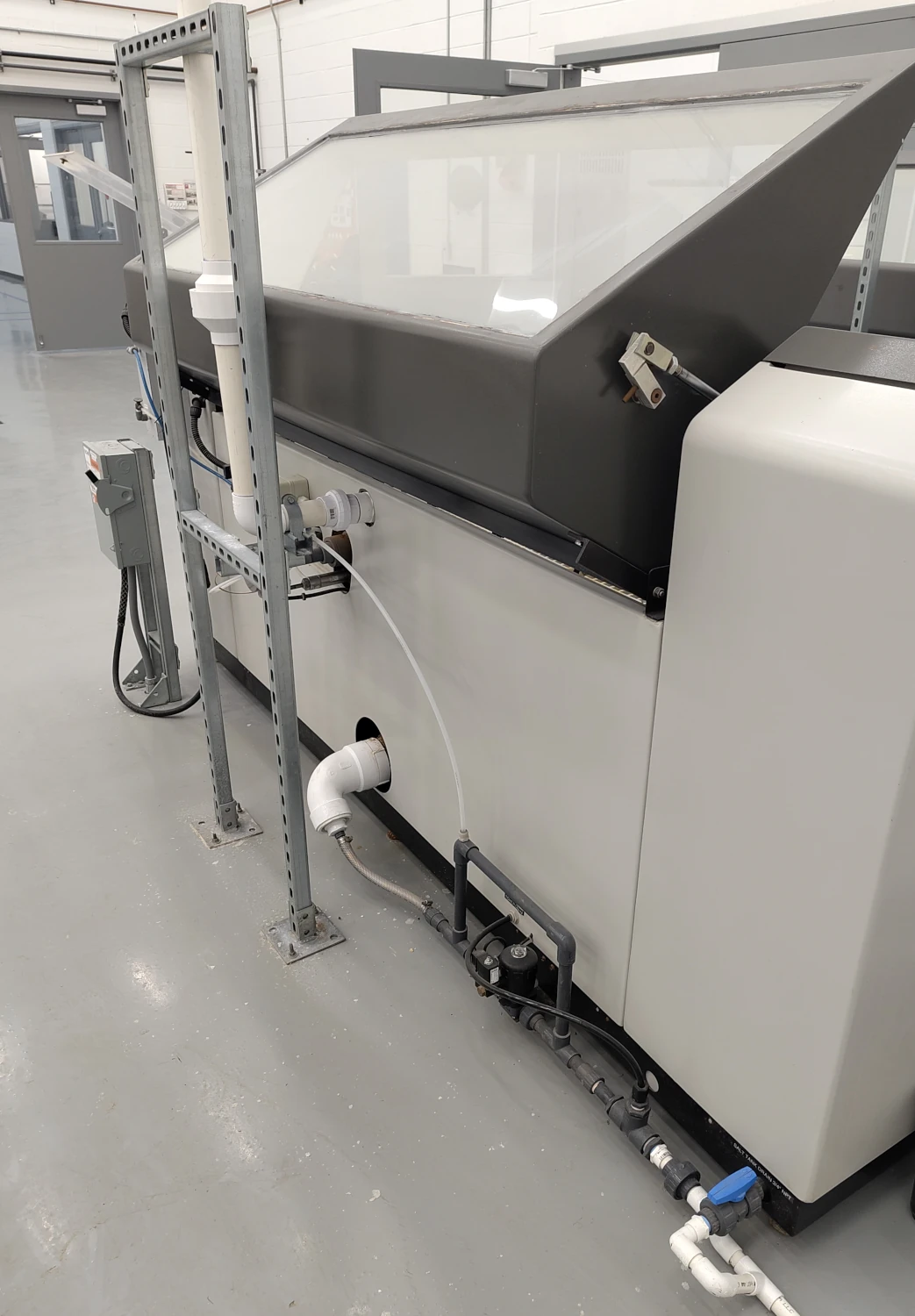
- Vent connection size is typically 2 in. CPVC for NC-20 / 30 / 40 / 90 and 4 in. CPVC for NC-110.
- Runs longer than 15 ft (4.5 m) require an inline blower / power vent.
- Never connect chamber exhaust into a duct or plenum shared with other equipment.
- Vent piping should be properly supported and sloped to prevent condensate buildup.
- Cabinet drains are gravity-fed and should discharge loosely over an open floor drain rather than being hard-plumbed.
Rear utility note: Confirm exhaust routing, drain routing, rear access, and vibration control during facility planning.
Room Conditions
- Room temperature should be maintained at 20–25 °C (68–77 °F).
- Room humidity should be maintained at 45 ±10% RH, non-condensing.
- Never allow conditions near the cabinet to reach 0 °C (32 °F) or humidity above 60%.
- The room should be climate-controlled, low dust, and free of corrosive or toxic atmospheres.
- Advanced Climate Control requires an ambient-controlled room of 25 °C ± 5 °C.
Need room-prep help? See the corrosion chamber room requirements guide for room planning, utility prep, and final placement guidance.
Commercial Information
- Please specify voltage and phase when ordering
- Units are custom-built to meet customer specifications
- Shipping: F.O.B. Origin — Strongsville, Ohio
- Lead times depend on production load and receipt of down payment
Standard shipping arrangements can be coordinated by Auto Technology, or the customer may arrange its own freight carrier. If customer-managed shipping is preferred, carrier details should be supplied at the time of order so the system can be prepared for pickup.
For a broader overview of laboratory layout, utilities, ventilation, and spacing, see our corrosion chamber room requirements guide.
Additional Video
Extreme Environment Control: Inside the X Series NC 110.
Frequently Asked Questions
What makes the X Series different from a more limited cyclic chamber?
The X Series is Auto Technology’s more advanced PC-controlled cyclic corrosion platform. It is intended for laboratories that need more configuration flexibility, more advanced transitions, and more precise control over multi-step corrosion workflows.
Why does the X Series emphasize transitions so heavily?
Advanced cyclic corrosion methods are built around the idea that corrosion is driven by changing conditions rather than one constant environment. Controlled wetting, humidity exposure, drying, ambient steps, and temperature transitions are part of the corrosion mechanism being reproduced. The X Series is designed for methods where those transitions are part of the validity of the test.
Why is immersion called out so strongly on this page?
Because electrolyte application method matters. Where the procedure is built around immersion, immersion provides a more controlled and repeatable electrolyte-loading condition than trying to approximate that step with a different application method. The X Series can be configured to reproduce that immersion step directly with dedicated tanks, transfer plumbing, and programmed controls.
Can the X Series be customized around a specific OEM corrosion standard?
Yes. The X Series is specifically suited to standards-driven configuration. Depending on the method, the chamber may be equipped with mechanical cooling, advanced climate control, direct spray, immersion, automated cover lifters, extra tanks, SO2 addition, or specialized spray systems.
Does the cooling unit have to sit beside the chamber?
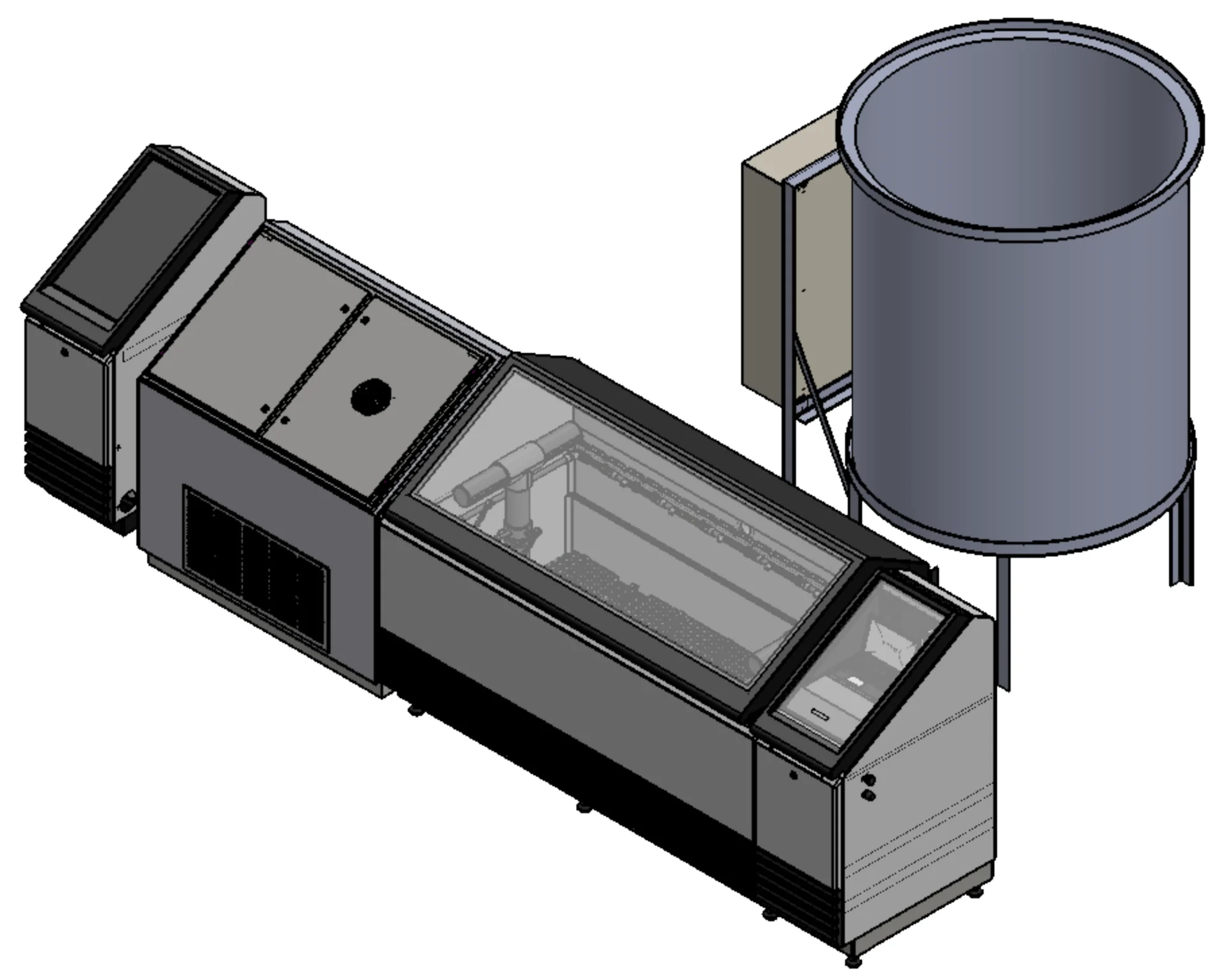
No. The image shown is just one possible installation layout. Cooling equipment placement depends on chamber size, required performance, available floor space, and facility constraints. Units may be positioned beside, behind, or otherwise arranged to suit the final installation.
Can the X Series support immersion and low-temperature steps?
Yes, when ordered with the proper packages. Immersion options, overflow protection, full-level controls, mechanical cooling, and LN2 adders can all be incorporated depending on the required procedure.
Are support bars, support rods, support angles, and shelves available?
Yes. Auto Technology can provide fiberglass support angles, fiberglass support rods, slotted polypropylene support bars, slotted support racks, heavy-duty mid-level shelves, and other racking hardware to match the specimen geometry and exposure pattern.
What comes standard for specimen support?
A new X Series chamber comes standard with bottom-level fiberglass racking for basic specimen support in the exposure zone. Additional racking and sample-handling hardware can be specified based on your sample geometry and loading requirements.
What if I do not know which configuration my standard requires?
Start with the exact standard, revision level, sample geometry, and whether the method uses fog, spray, immersion, ambient exposure, or low-temperature steps. Auto Technology can then help specify the right X Series configuration.
Need a Chamber Configured for Your Test Method?
Whether you are qualifying coatings, launching a new lab, or supporting demanding OEM corrosion programs, the X Series is built to be configured around the actual method you need to run.
Share your standard, revision level, chamber size target, sample mix, and required options so we can help specify the right system.