Can Lower-Chromium Bridge Steel Match 11%-Chromium Stainless Bridge Steel?
An FHWA-sponsored research team used experimental bridge steels, modified SAE J2334 cyclic corrosion testing at Old Dominion University, and a fully automated Auto Technology cyclic corrosion chamber to find out.
The answer was no. The experimental steels containing 5% to 9% chromium corroded less than conventional weathering steel, but none matched the corrosion resistance of the commercial 11%-chromium stainless bridge steel. The experimental steels could be heat treated to the target strength, but they did not provide the required impact toughness. The commercial 11%-chromium steel remained the only candidate for bridge construction.
This article summarizes findings from the FHWA report Improved Corrosion-Resistant Steel for Highway Bridge Construction, FHWA-HRT-11-062 , published in November 2011.
The Question
Commercial 11%-chromium stainless bridge steel resists corrosion in environments with heavy chloride exposure, but its initial cost was more than twice that of conventional carbon or weathering steel when the study was conducted. The project was intended to determine whether reducing the chromium content could lower the cost without giving up the corrosion resistance and mechanical properties required for bridge construction.
The study asked whether a potentially lower-cost steel containing 5% to 9% chromium could approach the performance of commercial 11%-chromium stainless bridge steel in corrosive highway environments.
Researchers produced an 11%-chromium laboratory analog and lower-chromium experimental steels containing 9%, 7%, or 5% chromium. Some of the lower-chromium steels also contained silicon or aluminum intended to compensate for the reduction in chromium. The materials were compared with conventional carbon steel, conventional weathering bridge steel, and commercial 11%-chromium stainless bridge steel.
How the Accelerated Corrosion Study Was Run
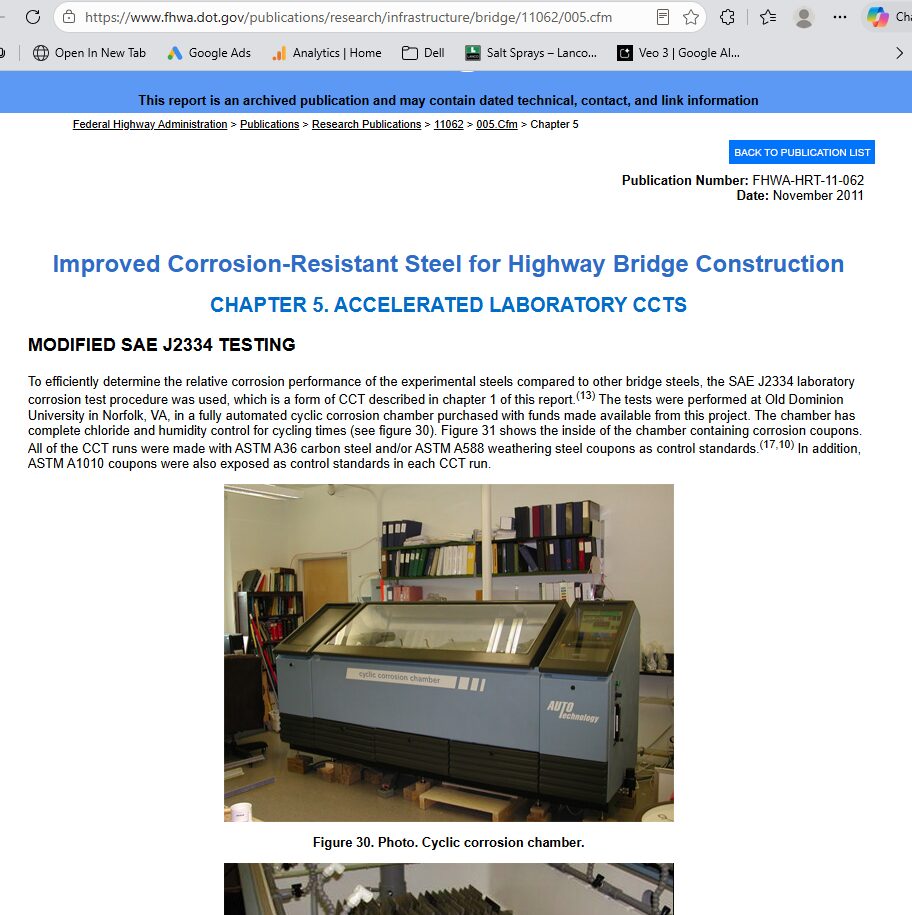
The laboratory corrosion testing was conducted at Old Dominion University in Norfolk, Virginia. The FHWA report states that the tests were performed in a fully automated cyclic corrosion chamber purchased with project funds and describes the chamber as providing complete chloride and humidity control for the test cycles.
Figure 30 of the report shows the Auto Technology cyclic corrosion chamber used for the work. Researchers used it to expose each steel to the same chloride application, drying, and high-humidity conditions.
The SAE J2334 cycle described in the report used a 15-minute salt application at 25 °C, a 17-hour-and-45-minute dry stage at 60 °C and 50% RH, and a 6-hour humid stage at 50 °C and 100% RH. The standard salt solution contained 0.5% sodium chloride, 0.1% calcium chloride, and 0.075% sodium bicarbonate.
For this project, researchers replaced the standard solution with unbuffered 5% NaCl to increase the chloride concentration. A second series used unbuffered 3% NaCl while keeping the other exposure conditions the same.
- Experimental steels were tested alongside conventional bridge steels used as controls.
- Sets of three coupons were tested for as many as 100 daily cycles in the 5% NaCl program and 70 cycles in the 3% NaCl program.
- Two coupons from each set were periodically stripped of corrosion products and measured for mass loss.
- Mass loss was converted into actual steel thickness loss using ASTM G1 procedures.
- The third coupon was reserved for X-ray diffraction analysis of the corrosion products forming on the steel surface.
The measurements showed how quickly each alloy lost metal and how chromium, silicon, aluminum, and yield strength affected corrosion under the same exposure.
What the Chamber Testing Found
As chromium decreased, thickness loss increased. Every reduced-chromium experimental steel corroded less than the conventional weathering bridge steel, but none matched the commercial 11%-chromium stainless steel or its 11%-chromium laboratory analog.
In the 5% NaCl test, the commercial 11%-chromium stainless bridge steel corroded at approximately one-tenth the rate of the conventional weathering steel. In the 3% NaCl test, its corrosion rate was approximately one-fifteenth that of the weathering steel.
Chromium Was Not the Only Variable
Chromium was not the only part of the alloy chemistry that affected the results.
- Lower chromium increased corrosion. The progressive reduction from approximately 11% Cr toward 5% Cr produced progressively greater thickness loss.
- Silicon hurt corrosion resistance. Adding 2% silicon to the 9% and 7% chromium steels significantly increased corrosion loss.
- Aluminum helped. Replacing 2% silicon with 2% aluminum in the 7% chromium steel substantially improved corrosion resistance.
- Yield strength did not control corrosion performance. The same alloys tested at different strength levels showed essentially the same corrosion behavior.
Because the exposure remained controlled, the researchers could compare those alloying changes without also changing the test environment.
Field Exposure on the Moore Drive Bridge
Three of the lower-chromium experimental steels were exposed for approximately one year on the Moore Drive Bridge in Rochester, New York. The specimens were mounted beneath a highway in a severe corrosion environment with heavy deicing-salt exposure.
FHWA noted that year-to-year variability made precise comparisons between materials exposed during different periods impossible. Even with that limitation, the field results supported the same broad finding: the commercial 11%-chromium stainless bridge steel had the lowest measured corrosion rate, and the lower-chromium experimental steels corroded less than conventional weathering steel.
The lower-chromium steels experienced approximately one-third to one-half the corrosion loss of the conventional weathering steel. The commercial 11%-chromium stainless bridge steel experienced approximately one-fourth the loss of the weathering steel.
The chamber produced a larger separation. The commercial 11%-chromium steel corroded at roughly one-tenth to one-fifteenth the rate of the weathering steel in the laboratory tests. Its measured loss on the bridge was approximately one-fourth that of the weathering steel.
Why the Accelerated Test and the Bridge Were Different
Analysis of the corrosion products showed why the laboratory and bridge results were not identical.
The modified SAE J2334 laboratory cycle had a high time-of-wetness and promoted the formation of significant amounts of maghemite. On the Moore Drive Bridge specimens, maghemite was notably absent. Instead, the field rust consisted primarily of akaganeite, goethite, and lepidocrocite.
FHWA concluded that the modified SAE J2334 protocol was fundamentally different from the actual bridge environment because its high time-of-wetness changed the corrosion products that formed. The difference also appeared in the lower-chromium steels: the chamber predicted substantially higher corrosion for the 7%-chromium steel containing silicon, while its field corrosion rate was only slightly higher than those of the other two experimental steels.
The report also compared thickness loss for the conventional weathering steel. Twenty cycles of the 5% NaCl test produced approximately the same 10 mils of thickness loss measured after four years at Moore Drive. From that comparison, FHWA estimated that 100 cycles represented approximately 20 years of exposure at that location.
That was a comparison for one steel at one site, not a universal conversion between chamber cycles and years of service. The different rust products and the smaller separation among materials in the field show why laboratory and field results must be considered together.
What FHWA Ultimately Concluded
The lower-chromium steels corroded less than conventional weathering steel, but reducing chromium caused a measurable loss of corrosion resistance.
The experimental steels could be heat treated to achieve the target strength. Their impact toughness was not sufficient for bridge construction. Of the steels developed or evaluated in the program, only the commercial 11%-chromium stainless bridge steel provided the required combination of corrosion resistance, strength, and impact toughness.
FHWA also compared a bridge girder made from the commercial 11%-chromium stainless steel with one made from painted carbon steel over a 125-year service period. Under every condition assumed in the analysis, the stainless steel girder had the lower life-cycle cost. The study estimated a greater than 90% probability that it would be the lower-cost material by year 20 and treated it as certain by year 40.
The result: reducing chromium did not produce a lower-cost bridge steel that matched the commercial stainless steel. The chamber testing isolated the effects of alloy composition and measured relative metal loss. The bridge exposure showed how those differences carried into an actual deicing-salt environment—and where the laboratory cycle produced different corrosion chemistry.
Accelerated Corrosion Testing at Auto Technology
The researchers changed the chloride concentration while keeping the rest of the cycle controlled. They measured thickness loss, analyzed the corrosion products, and used the results to select materials for field exposure.
Auto Technology builds cyclic corrosion test chambers for controlled materials research and performs customer programs through its corrosion testing laboratory.
Sources
-
Federal Highway Administration — Complete Report and Table of Contents
Improved Corrosion-Resistant Steel for Highway Bridge Construction, FHWA-HRT-11-062 -
Federal Highway Administration — Chapter 1: Introduction
Study objective and SAE J2334 cycle -
Federal Highway Administration — Improved Corrosion-Resistant Steel for Highway Bridge Construction, Chapter 5: Accelerated Laboratory CCTs
FHWA-HRT-11-062, Chapter 5 -
Federal Highway Administration — Chapter 6: One-Year Field Test at Severe Highway Corrosion Site
FHWA-HRT-11-062, Chapter 6 -
Federal Highway Administration — Chapter 7: Economic Life-Cycle Cost Analysis
FHWA-HRT-11-062, Chapter 7 -
Federal Highway Administration — Chapter 8: Conclusions
FHWA-HRT-11-062, Chapter 8